








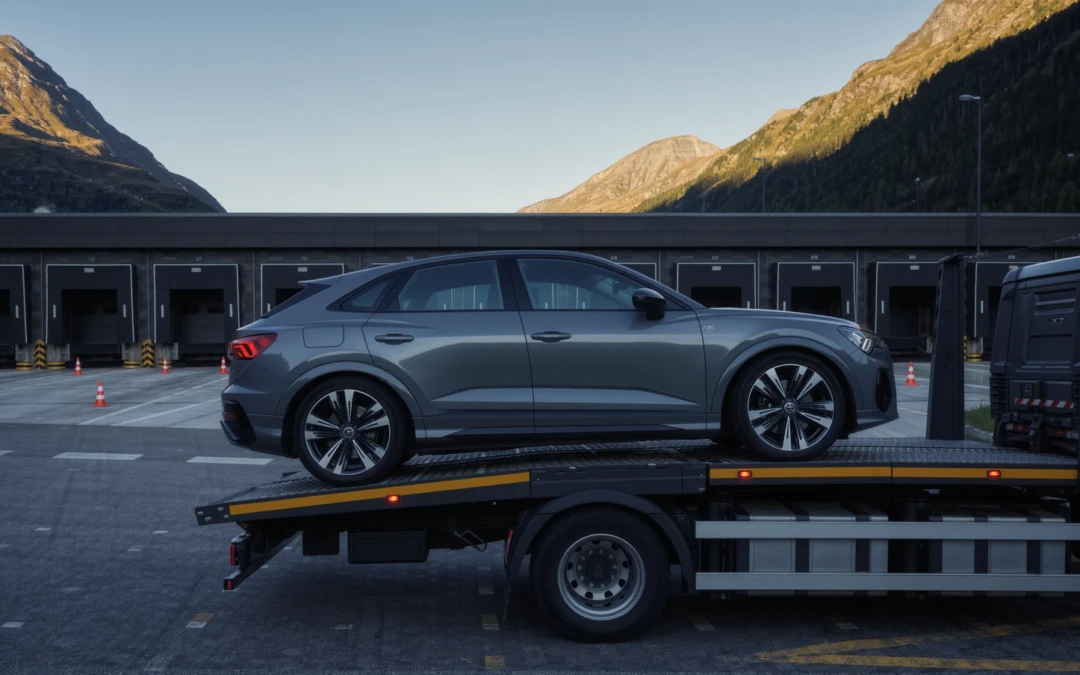
In short
- Since 1 January 2026 the importer of a new car (class M1 or N1) must report the import data to ASTRA electronically before first registration (Art. 72a VZV). ASTRA builds an electronic individual vehicle data set from the EU certificate of conformity (Art. 72b).
- Plates and registration documents are issued only if the conditions of Art. 71 para. 1 VZV are met. Since 1 January 2026 this includes any CO2 sanction under the CO2 Act being paid in full.
- A car is “new” if it is first registered, or was registered abroad a year ago or less and has at most 2000 km (Art. 29 para. 5 VTS). A used import with the right papers gets only a functional check. These provisions contain no fines.
If you import a car into Switzerland, or buy one from an importer, the paperwork changed on 1 January 2026. Two Federal Council ordinances of 15 October 2025 rewired how a car gets from the EU papers to Swiss plates.
What changed on 1 January 2026
The VZV amendment (AS 2025 650) and the VTS amendment (AS 2025 646) both took effect on 1 January 2026. I read the VZV as of 1 January 2026 and the VTS as of 1 October 2026. VTS Art. 29 now also defines what counts as “complete” and “completed” vehicles, and where a car is “new”.
Step 1: the electronic data set (Art. 72a and 72b VZV)
- For a car or light van (class M1 or N1) imported into or made in Switzerland, the importer or maker must report the import or production data to ASTRA electronically before the first registration. ASTRA determines which data (Art. 72a para. 1).
- Based on this report ASTRA fetches an electronic EU certificate of conformity from a central European database or from the foreign authority. From that and from the reported data it creates an electronic individual vehicle data set in the vehicle licensing information system (Art. 72b para. 1).
- If the certificate cannot be obtained electronically, the importer must deliver a paper EU certificate of conformity to ASTRA (para. 2). ASTRA tells the importer once the data set exists (para. 3).
Step 2: what the inspection office checks (VTS)
- A new, complete passenger car gets an administrative check: a test report signed by the type-approval or data-sheet holder, or, new since 2026, a report signed by the importer and based on the electronic data set (Art. 30 VTS).
- A vehicle that is not new gets a functional check if one of these exists: a signed test report, a paper EU certificate, the electronic data set, a UNECE Regulation No. 0 declaration with the needed approvals, or the holder has diplomatic privileges (Art. 31 para. 1). The check covers the main devices such as steering, brakes, lighting and trailer couplings (para. 2).
- If none of these exists, a comprehensive technical check follows. It examines in particular exhaust and noise rules and fitness for the intended use (Art. 31 para. 3).
Registration conditions (Art. 71 para. 1 VZV)
- The compulsory liability insurance exists, or the holder is exempt.
- The vehicle meets the construction and equipment rules and the data needed for registration exist.
- The vehicle is taxed under the car tax law or exempt, and a foreign-made vehicle is cleared by customs or exempt.
- New since 1 January 2026: any CO2 sanction owed under the CO2 Act is paid in full, or the vehicle has been assigned to the new-car fleet of a large importer or an emission community.
Foreign drivers and rental cars
These provisions concern registering a vehicle in Switzerland. I found nothing in them aimed at visitors who drive a foreign-registered car or a rental car.
Fines
The provisions above set no fine. A car that fails a condition simply does not get plates. I give no fees or tax amounts because I did not verify them here.
Mistakes I see most often
- Treating a car as “new” although it was registered abroad more than a year ago or has over 2000 km (Art. 29 para. 5 VTS).
- Finding out at the inspection that no EU certificate of conformity exists.
- Forgetting to check whether a CO2 sanction is still unpaid before asking for plates (Art. 71 para. 1 let. g VZV).
Do the math: With a paper certificate or the electronic data set your imported used car gets the short functional check. Without them you land in the comprehensive technical check with exhaust and noise (Art. 31 para. 3 VTS). Asking the maker for the certificate before you import costs a phone call and can save the larger check.
FAQ
Who reports the import data to ASTRA? The importer or maker of the class M1 or N1 vehicle, before first registration (Art. 72a para. 1 VZV).
When is a car “new” under the VTS? When it is first registered, or was registered abroad one year ago or less and its odometer shows at most 2000 km or 70 operating hours (Art. 29 para. 5 VTS).
Does Art. 71 VZV set a fine? No. It lists conditions for issuing registration documents and plates.
Where to check: fedlex.admin.ch, SR 741.51 (VZV, Art. 71, 72a, 72b, 75), SR 741.41 (VTS, Art. 29 to 31) and astra.admin.ch.
Ivan’s Take
This is dull paperwork, but it decides how fast your plates arrive. Get the EU certificate of conformity before the car crosses the border and ask who pays any CO2 sanction. Then the inspection is short.
Sources: Fedlex – SR 741.51 Verkehrszulassungsverordnung (VZV), Art. 71, 72a, 72b, Stand 1.1.2026 (AS 2025 650); Fedlex – SR 741.41 Verordnung über die technischen Anforderungen an Strassenfahrzeuge (VTS), Art. 29–31, Stand 1.10.2026 (AS 2025 646); ASTRA – Bundesamt für Strassen.
Published:
More from this section


The AvtoGear weekly
Once a week: new tests, the best deals and one useful tip for your car. Nothing extra.
