








In short
- Since 1 April 2022 a category B licence covers zero-emission heavy vehicles of 3500 to 4250 kg with at most eight seats besides the driver, but only in domestic traffic (Art. 3 para. 5 VZV).
- From 1 October 2026 Art. 41c VRV tells drivers of these vehicles to follow the traffic rules and signs for light motor vehicles. Signposted weight limits always apply.
- The change adds no fine. Several VTS duties are lifted for lorries of this kind, and a new inspection rhythm starts on 1 February 2028.
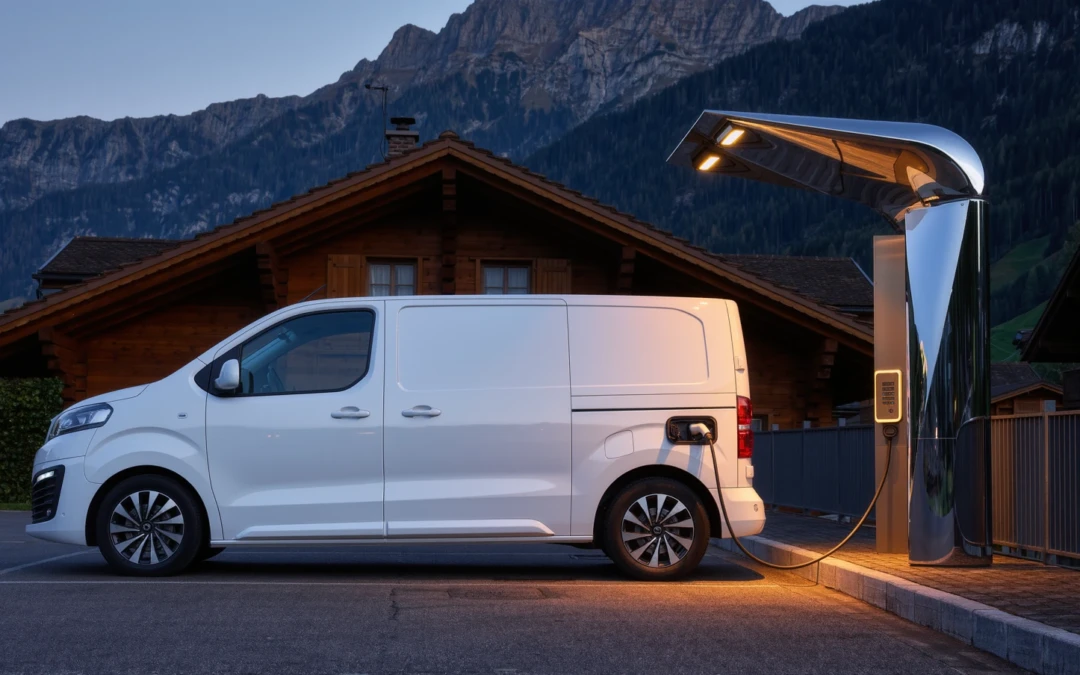
Electric vans and campers often break the 3500 kg line because of the battery. Swiss law has a special rule for that extra weight. A new rule in October 2026 now says which traffic rules those vehicles follow.
Who may drive them (VZV)
Art. 3 para. 5 VZV says a category B licence entitles you, in domestic traffic only (“im Binnenverkehr”), to drive heavy motor vehicles with a total weight above 3500 kg and up to 4250 kg, with at most eight seats besides the driver. Two conditions apply: the vehicle has a zero-emission drive, and the weight above 3500 kg is caused only by the extra weight of the zero-emission technology. You may tow a trailer of up to 750 kg. With category BE you may tow a heavier trailer behind such a vehicle (let. h). Both rules came into force on 1 April 2022 (AS 2022 15).
Art. 9a para. 2 VTS defines zero-emission vehicles as vehicles without a combustion engine, or with one whose emissions are under 1 g CO2 per kWh or per km, in particular vehicles powered only by electricity or hydrogen.
What changed on 1 October 2026
Three Federal Council acts of 19 August 2026 take effect on 1 October 2026: the VRV amendment (AS 2026 452), the VTS amendment (AS 2026 454) and a small SSV amendment (AS 2026 453). I read the amending texts.
- Art. 41c VRV, new: whoever drives a heavy motor vehicle with zero-emission drive, total weight at most 4250 kg and the surplus above 3500 kg caused solely by the drive technology, must follow the traffic rules and signs for drivers of light motor vehicles.
- If the vehicle is registered as a coach, the driver must point out the seat-belt duty to passengers in a suitable way. If it is registered as a motorhome, the driver must follow the motorhome signs, especially symbol 5.28.
- Signposted weight limits (Art. 20 SSV) always apply (Art. 41c para. 2).
The VRV amendment also rewrites Art. 3 paras. 4 to 6 on tachographs. The driver must keep the prescribed tachograph running and operate it correctly. With a digital tachograph the driver cards must stay inserted during the whole professional activity. Trips without a card are allowed where the Drivers’ Ordinance and the ordinance on light passenger transport do not apply, and then the pictogram “OUT” is used.
- Switzerland: Probation Licence Rules Since 2025 and the Traffic Course Duty Before the Theory Exam
- Switzerland: Registering an Imported Car in 2026, the Electronic Vehicle Data Set and the CO2 Condition
- Switzerland: Licence Withdrawal Instead of Points, and the Minimum Months That Grow With Every Offence
Changes in the VTS for these vehicles
- Art. 32 para. 2: the licensing authority may delegate the test report and functional check also for such zero-emission heavy transport vehicles of up to 4.25 t, besides light motor vehicles, motorcycles and trailers up to 3.5 t.
- Art. 99 para. 2 let. e: class N2 vehicles of this kind are exempt from the speed-limiter duty.
- Art. 104b para. 3 let. c: the same vehicles are exempt from the side protection duty for lorries.
- Art. 33: lorries and semi-tractors of this kind get inspected four years after first registration, then after three years, then every two years. This starts on 1 February 2028. If such a vehicle over 3.5 t is not used only in domestic traffic, its last official inspection may not be more than one year old, and the holder must arrange re-inspection (para. 2bis).
Foreign drivers and rental cars
The extension of category B applies “im Binnenverkehr”, that is in domestic traffic. I found no text in these amendments that extends it to international trips. If you rent or drive a heavy electric van registered abroad, check your licence category and the registered weight before the trip.
Fines
The amendments add no fine. Breaking the traffic rules that Art. 41c points to is judged under the rules for light vehicles. I give no amounts here.
Mistakes I see most often
- Assuming any van over 3500 kg is covered by category B. The text needs a zero-emission drive and a surplus caused only by that technology.
- Forgetting the trailer limit of 750 kg on category B.
- Ignoring signposted weight limits because the vehicle follows car rules (Art. 41c para. 2 VRV).
Do the math: A van registered at 4250 kg with a category B licence needs no extra licence in domestic traffic. A conventional van at the same weight does, because the zero-emission condition fails. Check the registered weight and drive type in the vehicle papers before you book the job.
FAQ
Can I drive a 4.2 t electric camper with a car licence? In domestic traffic, yes, if it has at most eight seats besides the driver, a zero-emission drive and the weight above 3500 kg comes only from the drive technology (Art. 3 para. 5 VZV).
Which traffic rules apply to it from 1 October 2026? Those for light motor vehicles, with the coach and motorhome duties and the signposted weight limits (Art. 41c VRV).
When does the new inspection rhythm start? On 1 February 2028 (Art. 33 para. 2 let. b no. 6 VTS).
Where to check: fedlex.admin.ch, SR 741.51 (VZV, Art. 3), SR 741.11 (VRV, Art. 3, 41c), SR 741.41 (VTS, Art. 9a, 32, 33, 99, 104b) and astra.admin.ch.
Ivan’s Take
Sensible rule. The battery should not turn a delivery van into a lorry in the law. Just remember the limits: domestic traffic, 750 kg trailer, and the weight signs still bind you.
Sources: Fedlex – SR 741.51 Verkehrszulassungsverordnung (VZV), Art. 3 Abs. 5, Stand 1.1.2026; Fedlex – SR 741.11 Verkehrsregelnverordnung (VRV), Art. 3, 41c (AS 2026 452, in Kraft 1.10.2026); Fedlex – SR 741.41 VTS, Art. 9a, 32, 33, 99, 104b (AS 2026 454, in Kraft 1.10.2026 bzw. 1.2.2028); ASTRA – Bundesamt für Strassen.
Published:
More from this section

The AvtoGear weekly
Once a week: new tests, the best deals and one useful tip for your car. Nothing extra.
