








In short
- From 1 October 2026 Art. 108 SSV says that authorities who set a different speed limit on a road section must keep the road-network hierarchy and the function of traffic-oriented roads. The expert report must check that too.
- The general limits do not change (Art. 4a VRV): 50 km/h in towns, 80 outside, 100 on expressways, 120 on motorways. A Tempo-30 zone means 30 km/h, a Begegnungszone 20 km/h.
- The change adds no fine. What counts for you is the sign you pass, and the OBV speed table decides the amount if you exceed it.
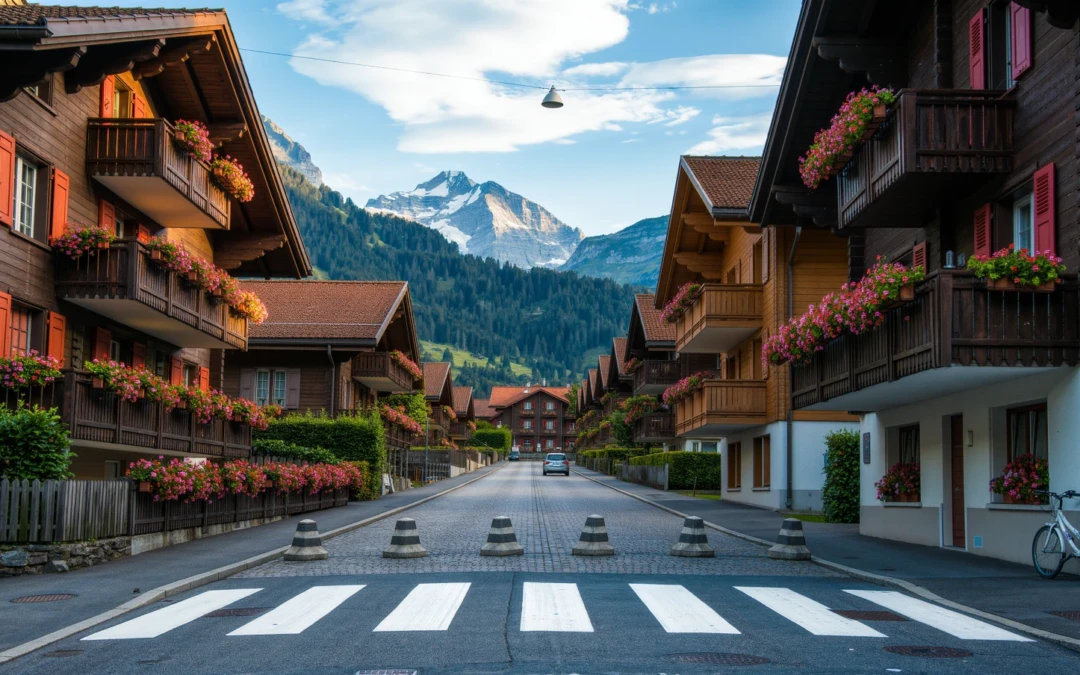
Swiss towns and cantons set their own speed limits inside a federal frame. Two amendments in 2026 changed that frame. If you drive in Swiss towns, you will meet the results as signs, zones and new limits.
What the Federal Council changed
Two amendments of the Signposting Ordinance (SSV, SR 741.21) matter here: one of 19 December 2025 (AS 2026 24, in force 1 July 2026) and one of 12 August 2026 (AS 2026 438, in force 1 October 2026). I read the SSV as of 1 October 2026 and compared it with the version of 1 March 2025.
- Art. 108 para. 1, from 1 October 2026: a new second sentence. The hierarchy of the road network set by the planning authority, and especially the functions of traffic-oriented roads, must stay guaranteed when a limit deviates from the general one.
- Art. 108 para. 4: the expert report (Art. 32 para. 3 SVG) already had to show that a measure is necessary, suitable and proportionate, or whether other measures are better, and whether it can be limited to peak hours. New: it must also check whether any traffic orientation (Art. 1 para. 9) is preserved.
- Art. 2a para. 3bis, from 1 July 2026: if a Tempo-30 zone is followed by a Begegnungszone, or the other way round, the new zone sign also ends the previous zone.
Art. 1 para. 9 SSV defines traffic-oriented roads: all roads inside towns that are mainly geared to motor traffic and meant for safe, efficient and economical transport.
The baseline you must know
Art. 4a VRV sets the general limits in favourable road, traffic and visibility conditions: 50 km/h in built-up areas, 80 km/h outside them, 100 km/h on expressways and 120 km/h on motorways. The 50 km/h limit covers the whole densely built-up area of a locality, from the sign “50 generally” (2.30.1) to its end sign (2.53.1).
Art. 108 para. 5 SSV lists the allowed deviations. On motorways, limits below 120 km/h down to 60 in steps of 10. On expressways, below 100 km/h down to 60. Outside towns on other roads, below 80 km/h in steps of 10. Inside towns: 80, 70 or 60 km/h, or below 50 km/h in steps of 10. In zones: 30 km/h (Art. 22a) or 20 km/h (Art. 22b).
In a Begegnungszone pedestrians and users of vehicle-like devices may use the whole traffic area and have priority over drivers, but they may not hinder vehicles needlessly (Art. 22b SSV). Zone signs for Tempo 30, Begegnungszone and pedestrian zone are allowed only on non-traffic-oriented side roads (Art. 2a para. 5). A 30 km/h section of a traffic-oriented road may be included in a Tempo-30 zone (para. 6). Both rules date from 1 January 2023.
Why a limit may be lowered
Art. 108 para. 2 SSV allows lower limits only if one of these applies:
- a danger is hard to see in time and cannot be fixed otherwise;
- certain road users need special protection that cannot be achieved otherwise;
- traffic flow can be improved on heavily used sections;
- excessive noise or pollutant load can be reduced, always with proportionality.
Fines
The amendment adds no OBV entry. Speeding is fined under the OBV speed table, so check the amount for your excess speed there, and note that the limit applies from the sign or zone sign until its end sign (Art. 2a para. 3 SSV). I give no speeding amounts here.
Foreign drivers and rental cars
The rules apply to everyone. Zone signs are rectangular white boards with the word ZONE, and the limit holds from the zone start sign to the end sign, after which the general traffic rules apply again (Art. 2a paras. 1 and 3).
Mistakes I see most often
- Assuming 50 km/h applies in a Begegnungszone, where the limit is 20 km/h.
- Missing the changeover between two zone types. Since 1 July 2026 the new zone sign ends the old zone at the same time.
- Slowing down only at the sign and not reading the end sign.
Do the math: One kilometre takes 72 seconds at 50 km/h and 120 seconds at 30 km/h. The difference is 48 seconds per kilometre, far less than the cost and licence risk of a speeding case.
FAQ
Did the 50 km/h limit in towns change? No. Art. 4a VRV still sets 50 km/h in built-up areas.
Can a main road get 30 km/h now? Art. 108 SSV still allows deviations for the reasons in para. 2, but the new sentence in para. 1 requires the road hierarchy to be preserved and para. 4 requires a check of the traffic orientation.
What is the limit in a Begegnungszone? 20 km/h (Art. 22b para. 2 SSV).
Where to check: fedlex.admin.ch, SR 741.21 (SSV, Art. 1, 2a, 22a, 22b, 108), SR 741.11 (VRV, Art. 4a) and astra.admin.ch.
Ivan’s Take
I read this as a brake on blanket low limits on through roads, because authorities now have to show the road hierarchy is kept. For you the rule stays simple: obey the sign, and read the end sign too.
Sources: Fedlex – SR 741.21 Signalisationsverordnung (SSV), Stand 1.10.2026 (AS 2026 24, 438); Fedlex – SR 741.11 Verkehrsregelnverordnung (VRV), Art. 4a, Stand 1.10.2026; ASTRA – Bundesamt für Strassen.
Published:
More from this section
The AvtoGear weekly
Once a week: new tests, the best deals and one useful tip for your car. Nothing extra.
