








In short
- Most European countries on the ADAC list allow 10 litres of spare fuel in a canister. Bulgaria, Greece, Romania and Luxembourg ban it. Switzerland and Turkey allow 25.
- Ferries to the UK, Ireland, Iceland and Cyprus do not take fuel canisters at all.
- ADAC advises 10 litres at most, even where the law allows more, in a canister with a UN or RKK mark.
Empty tank, no station for 40 km. A full canister in the boot sounds smart. Then a border officer asks what is in it. Is it legal? In some countries yes, in others you pay a fine. Here is the ADAC list.
The rule in one line
There is no single EU rule. Every country sets its own limit. The ADAC table shows 10 litres for most of them. Some allow more. Some allow nothing.
Limits by country (ADAC list)
- 10 litres: Belgium, Denmark, Estonia, France, Italy, Croatia, Latvia, Lithuania, Netherlands, Austria, Poland, Portugal, Slovakia, Slovenia, Spain, Czechia, Hungary
- 25 litres: Switzerland, Liechtenstein, Turkey
- 20 litres: North Macedonia
- 5 litres: Montenegro, Serbia
- Banned: Bulgaria, Greece, Romania, Luxembourg
Penalties differ by country. The ADAC does not give one fine figure, so I will not either.
Germany at home
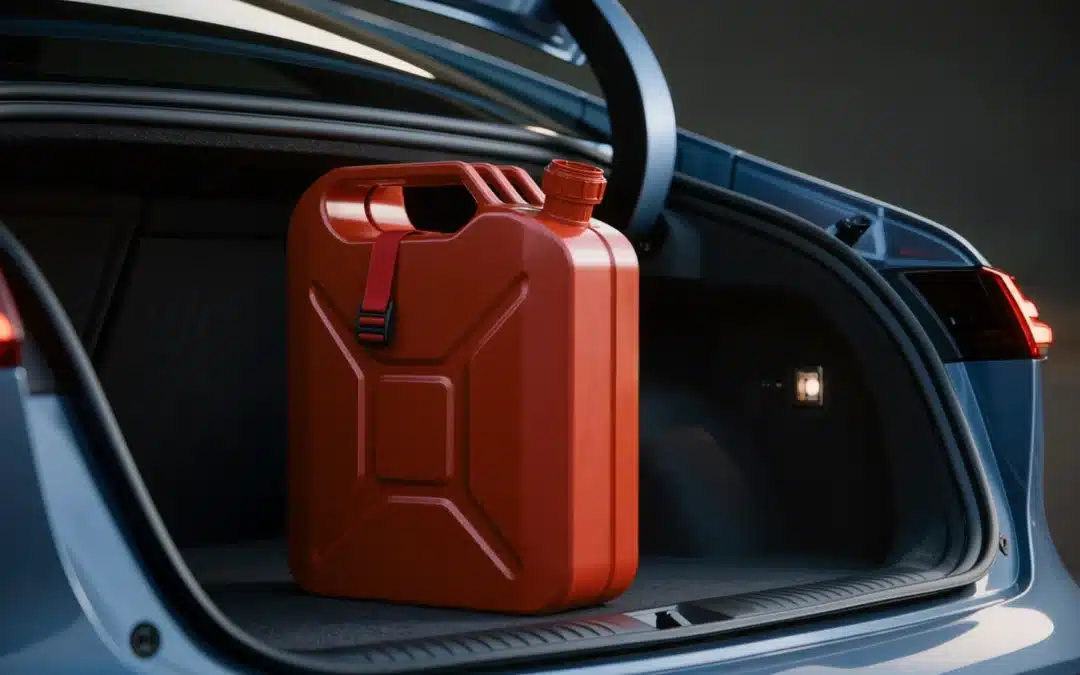
For private cars, German rules allow up to 60 litres per spare container and 240 litres per vehicle. The canister needs a UN or RKK approval, stamped into the plastic or metal. ADAC says to put it in the boot, as far from people as possible, and strap it down.
Still, ADAC advises taking 10 litres at most. Fuel vapour in a closed car is a risk. More litres only add risk.
What to buy
- Look for the UN or RKK stamp on the canister. No stamp, no use.
- Choose a size that matches the lowest limit on your route. For most trips that means 10 litres or less.
- Pick a canister with a tight cap and a proper spout, so you do not spill in the boot.
- Keep it upright and strapped, never loose behind the seats.
I am not quoting prices. I did not find a verified price list for approved canisters, and they vary by shop.
Ferries and customs
On ships to the UK, Ireland, Iceland and Cyprus, carrying spare fuel in canisters is generally banned. To Denmark, Norway, Sweden and Finland it can be banned too. Ask the ferry company before you book.
Crossing into or out of a non-EU country, spare fuel in canisters must be declared and taxed. Inside the EU there are no customs checks on fuel. If you bring more than 20 litres into Germany, mineral oil tax is due.
Mistakes to avoid
- Driving through Bulgaria, Greece or Romania with a full canister. It is banned there.
- Taking a 20 litre canister because it is legal at home. Most countries on your route stop at 10.
- Using an old plastic bottle or a canister without a mark.
- Leaving the canister in a hot car for days.
- Forgetting that the ferry may refuse you.
Do the math: Do the math: 10 litres in the canister at a consumption of 6 litres per 100 km is about 165 km of range (10 divided by 6, times 100). That is the example I use, your car will differ. It is enough to reach the next station. A 25 litre canister would give 400 km, but it is legal only in a few countries and heavier to carry. So 10 litres covers the real need.
FAQ
How much spare fuel may I carry in Europe? In most countries on the ADAC list, 10 litres. Bulgaria, Greece, Romania and Luxembourg ban it. Switzerland, Liechtenstein and Turkey allow 25 litres.
Does the canister need a special mark? In Germany yes: a UN or RKK approval stamped on the container.
Can I take it on a ferry? Not to the UK, Ireland, Iceland or Cyprus. For Denmark, Norway, Sweden and Finland ask the ferry company.
Ivan’s Take
I would carry no spare fuel at all on most trips. A full tank and a phone with a station map solve it. If I really need a canister, I take one approved 10 litre canister, strapped in the boot, and I never drive through Bulgaria, Greece or Romania with it. Always check the list before you cross a border.
Sources: ADAC – Reservekanister: Was ist erlaubt?.
Published:
More from this section


The AvtoGear weekly
Once a week: new tests, the best deals and one useful tip for your car. Nothing extra.
