








In short
- In Germany you may sleep in your car to restore your fitness to drive. ADAC confirms this applies to normal cars, not only campers.
- Elsewhere the rules differ: Italy bans camping outside campsites and stopovers, the Netherlands fines free standing up to €500, Austrian forests can cost up to €14,500.
- The key line everywhere: resting is not camping. No chairs, no awning, no cooking outside the car.
You are on the motorway at 1 a.m., your eyes are closing and the next hotel is 80 km away. Can you just pull over and sleep in the car? In many places yes, if you do it right. In some countries it costs you a fine. Here is what the rules say and what gear makes a night in the car bearable.
Resting vs camping: the line that matters
Almost every country draws the same line. Parking legally and sleeping in your seat to get fit again is treated differently from camping. Camping means you set up: an awning, table, chairs, a grill or a stove outside the car. Promobil puts it simply: when you stand free, the awning stays in and the furniture stays in the vehicle.
Local signs beat everything. Many towns and regions set their own bans. A “no camping” or “no overnight parking” sign means exactly that.
What the rules say by country
- Germany: allowed once to restore your fitness to drive, wherever parking is legal. ADAC says this also covers sleeping in a normal car. Authorities usually assume around ten hours, according to Promobil. Setting up camp is not allowed.
- Italy: camping outside campsites and official stopovers is banned, says ADAC.
- Austria: camping in the forest is banned without the owner’s consent, with fines up to €14,500 depending on the state. Outside forests the rules are not uniform, so ADAC advises asking the local authority.
- Netherlands: strict ban on free standing outside campsites and stopovers, with fines up to €500, per Promobil.
- Belgium: a single night is generally tolerated if no sign forbids it, but free standing is banned along the coast and in Flanders.
- Denmark: no driving or parking on beaches, in forests, parks or protected areas unless it is expressly allowed.
- Sweden: cars and campers may only be parked on marked places. The right of public access is mainly for people with tents.
- Switzerland: one or two nights are possible in theory, but Ticino, Graubünden and Geneva have strict bans, as do nature reserves.
Rules change and differ by town. Check the local rules for your route before you leave.
Where to stop
- Motorway service areas and truck stops with lights, toilets and people around.
- Official motorhome stopovers. Many accept cars too.
- Campsites if you plan the night instead of needing it.
- Not: hard shoulders, emergency bays, private land without permission, forests, beaches or nature reserves.
The gear that makes it work
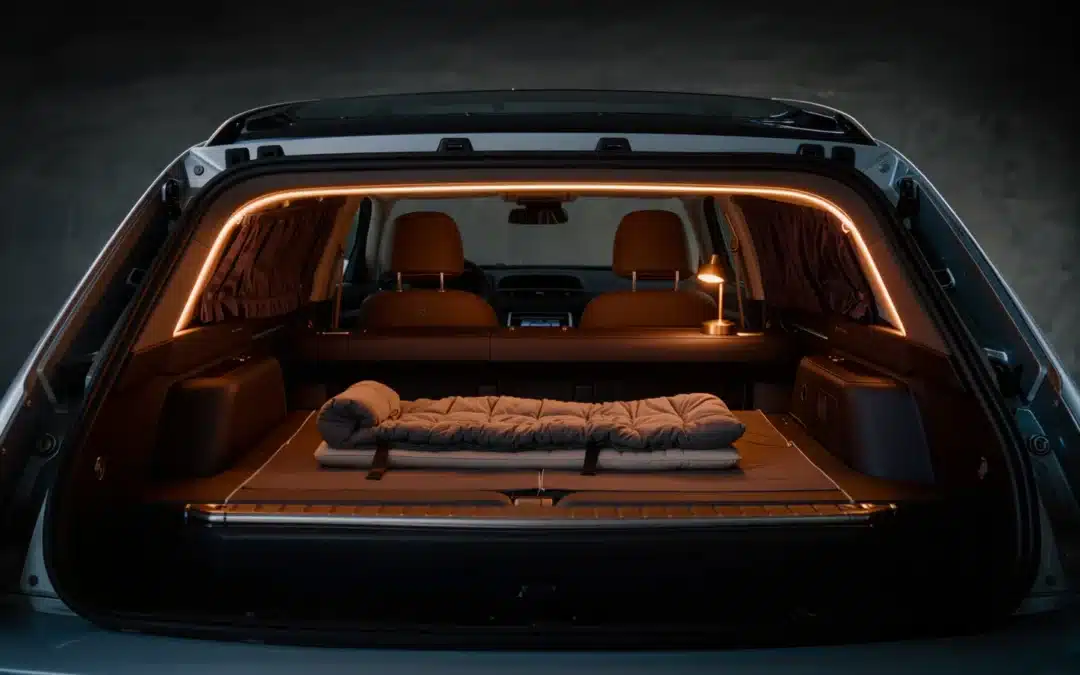
- Window sunshades or covers. Privacy, a bit of insulation and less light from the car park.
- A sleeping mat for folded rear seats, or a travel pillow if you stay in the front seat.
- A sleeping bag rated for the night temperature. A car cools down fast once the engine is off.
- A small LED lamp and a power bank, so you do not drain the car battery with interior lights.
- Water, a snack and a bag for rubbish.
- Earplugs and an eye mask. Truck stops are not quiet.
Mistakes to avoid
- Running the engine all night for heat. You burn fuel, annoy everyone and the exhaust can build up around the car, especially in snow.
- Using a gas or camping heater inside the car. Never.
- Plugging in a 12 V fan heater and sleeping. ADAC notes most of them have only about 150 W. That makes a peephole on the glass, not a warm car, and it drains your battery.
- Closing every window tight. Leave a small gap for air, or you wake up to dripping glass.
- Setting up chairs and a stove next to the car. That turns resting into camping.
- Leaving valuables on the seats. Keep them out of sight and lock the doors.
Do the math: A typical car battery holds around 60 to 70 Ah (check the label on yours). A 150 W 12 V heater draws about 12.5 A. Four hours of use is about 50 Ah, close to a flat battery in the morning. And the money side: one night in the wrong place in the Netherlands can cost up to €500. Even if a paid stopover costs you €30 (example price, check locally), you would need more than 16 nights to equal one fine.
FAQ
Is it legal to sleep in my car in Germany? Yes, to restore your fitness to drive and where parking is allowed. Do not set up camp.
Can I sleep at a motorway service area? Usually yes, as long as you park in a proper space and follow the signs there.
Should I run the engine for heat? No. Use a sleeping bag and warm clothes, keep a small air gap and switch the engine off.
Ivan’s Take
A tired driver is a dangerous driver, so I would always rather sleep two hours in a service area than push on. Window shades, a proper sleeping bag and a power bank cost little and make the night bearable. Just keep it a rest stop, not a campsite, and check the country rules before you leave.
Sources: ADAC Presse: Urlaub mit dem Reisemobil; Promobil: Stellplatz-Regeln im EU-Ausland; ADAC: Winterzubehör.
Published:
More from this section

The AvtoGear weekly
Once a week: new tests, the best deals and one useful tip for your car. Nothing extra.
