








In short
- Every registered vehicle must carry plates with its registration number as fixed in the plate regulation (Código da Estrada, art. 118 no. 8).
- Breaking that rule costs €120 to €600 (art. 118 no. 10). Plates that break the rules on technical characteristics or placement also mean the vehicle’s identification document is seized (art. 161 no. 1 h).
- Driving with no plates at all is a different league: the vehicle itself is seized (art. 162 no. 1 b).
Tinted plate covers, chunky dealer frames, a bike rack across the rear plate. They look harmless, but the Código da Estrada sets the duty, the fine and what the police can take from you. Here is exactly what it says.
The rule in detail
Article 118 no. 8 says each registered vehicle must be fitted with plates showing its registration number, under the terms fixed in a regulation. Article 117 no. 6 adds that the composition of the number and the characteristics of the plate are fixed in regulations. The Code gives no sizes, colours or positions. Those sit in the plate regulation, which I did not read, so I give no millimetre figures.
What the Code does give is the test the police apply at the roadside. Article 161 no. 1 h makes plates that do not meet the regulatory conditions on technical characteristics and placement a reason to seize the vehicle’s identification document. Article 163 no. 1 h treats a parked vehicle without a plate, or with a plate that does not allow the registration to be read correctly, as improperly or abusively parked.
Read those lines together and the practical rule is simple. If a cover, frame, sticker or load stops someone reading your plate correctly, or changes the plate from what the regulation allows, you are exposed.
Racks, boxes and loads
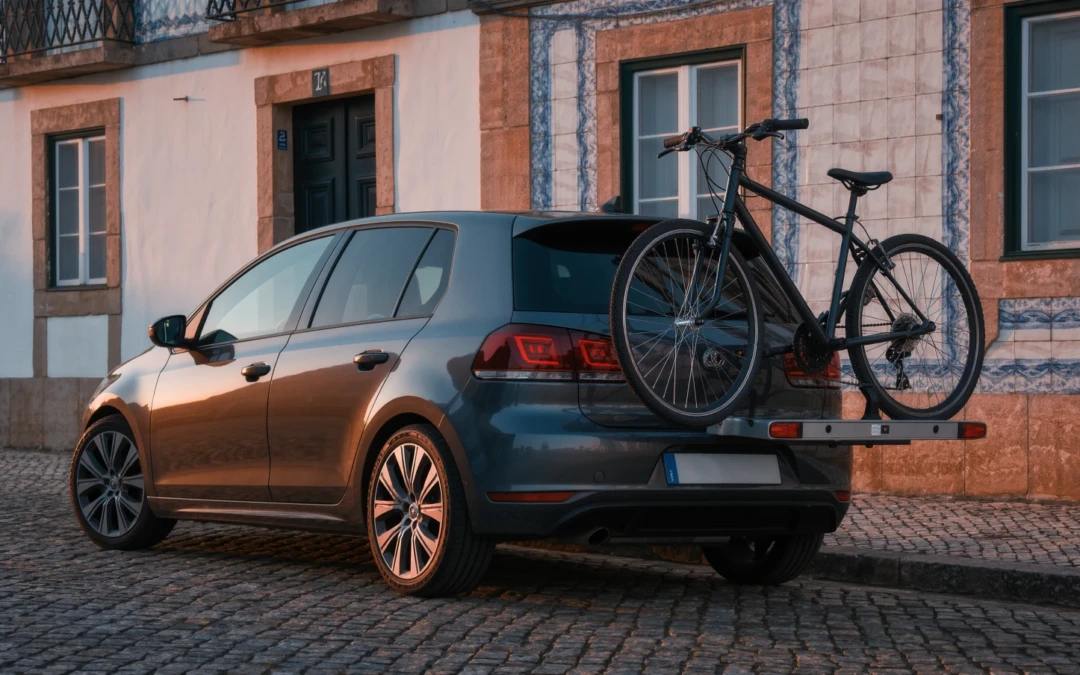
Article 56 no. 3 g says that on passenger vehicles the load must not impair the correct identification of the signalling and lighting devices and the number plate. Breaking any of the load rules in no. 3 costs €120 to €600, and the vehicle can be immobilised until the situation is fixed (art. 56 no. 6). A rear bike carrier that hides the plate falls squarely here.
Lighting is the other side. Article 59 no. 2 bans white light to the rear but expressly allows the number plate light. A dead plate lamp is a lighting fault, and the Code treats lights and plates as easy-to-fix faults (see below).
Fines and consequences
- Plates not as required by the regulation (art. 118 no. 8): €120 to €600, if no more serious sanction applies (art. 118 no. 10).
- Load or rack that impairs identification of the plate or lights (art. 56 no. 3 g): €120 to €600, plus possible immobilisation (art. 56 no. 6).
- Plates that break the rules on technical characteristics or placement: the vehicle’s identification document is seized (art. 161 no. 1 h), together with all other documents relating to the vehicle’s circulation (art. 161 no. 2).
- Driving a vehicle whose document has been seized, outside the terms of the guide you are given: €300 to €1,500 (art. 161 no. 8).
- Driving without plates: the vehicle is seized (art. 162 no. 1 b).
- Parked without a plate or with an unreadable plate: abusive parking (art. 163 no. 1 h). The vehicle can be removed (art. 164 no. 1 a), and the holder of the vehicle document pays the costs (art. 164 no. 6).
There is a cheaper exit. Under article 161 no. 6, for easy-to-repair faults in lights, tyres or the number plate, the officer can issue a guide to present the repaired vehicle at a police station within eight days. The applicable fines are then halved, both the minimum and the maximum.
I checked the lists of grave and very grave offences in articles 145 and 146. Plate offences are not on them, so the Code names no driving ban and no points for them.
Foreign drivers and rental cars
Nothing in articles 118 or 161 limits these rules to Portuguese plates, but the plate regulation is written for vehicles registered in Portugal, and I found no text in the Code on how officers judge a foreign plate. What I can say: the readability test of article 163 and the load rule of article 56 apply to any vehicle on a Portuguese public road. With a rental car, add nothing to the plates and check that your rack does not cover them.
Mistakes I see most often
- A smoked or tinted plastic cover “for style”. If it hampers reading, you hand the officer a reason under article 161.
- A rear bike rack that hides the plate. That is article 56 no. 3 g, €120 to €600.
- A burnt-out plate lamp ignored for months. It is a lighting fault you can fix in minutes.
Do the math: Do the math: The fine starts at €120. With the eight-day repair route the range drops to €60–300, but you still drive on a temporary guide and lose time at a police station. Taking a cover off costs you two minutes and €0.
FAQ
Are plate frames illegal in Portugal? The Code does not mention frames. It fines plates that do not follow the regulation and lets officers seize the document when plates break the rules on characteristics or placement. A frame that covers characters or changes the plate is the risk.
Is a tinted plate cover allowed? I found no permission for it in the Code. The test in article 163 is whether the plate allows the registration to be read correctly. I did not read the plate regulation, so I cannot give you a rule beyond that.
What if my bike rack hides the plate? Article 56 no. 3 g bans loads that impair identification of the plate on passenger vehicles. The fine is €120 to €600, and the car can be immobilised.
Where to check
Código da Estrada (Decree-Law 114/94), articles 56, 59, 117, 118, 145, 146 and 161 to 164, in the current consolidated text published by the Procuradoria-Geral Distrital de Lisboa (pgdlisboa.pt, last amended by Lei 24/2025).
Ivan’s Take
My view: the plate is the one part of the car you should not personalise. Keep it clean, lit and uncovered, and choose a rack that leaves it visible. Two minutes at home beat a seized document on holiday.
Published:
More from this section


The AvtoGear weekly
Once a week: new tests, the best deals and one useful tip for your car. Nothing extra.
