








In short
- Decreto-Lei n.º 113/2026 of 8 June 2026 sets a licensing regime for tests of automated driving systems on public roads. It entered into force 30 days after publication, on 8 July 2026.
- Key numbers: speed limits for test vehicles are cut by 20 km/h (never below 20 km/h); the test driver’s blood alcohol limits fall to 0.2 g/l and 0.5 g/l; insurance capital is four times the compulsory minimum.
- Money: testing without a licence is punished with 600 to 3,000 euros for a person or 8,000 to 40,000 euros for a company, plus loss of the vehicle to the State.
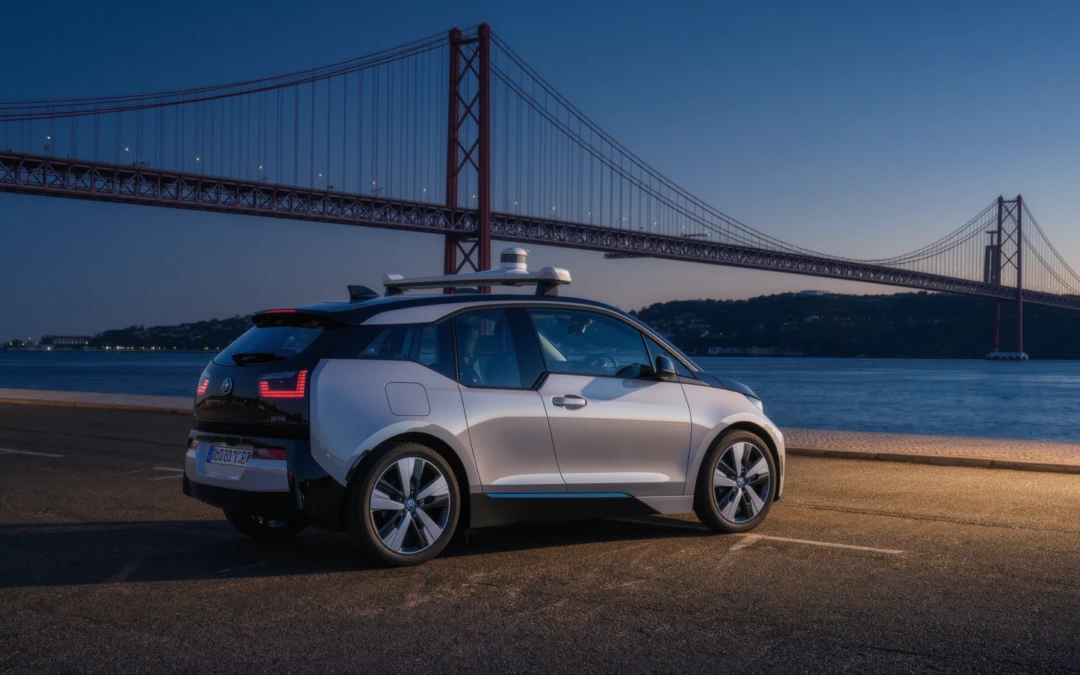
You may soon meet a car with a sensor on its roof and nobody’s hands on the wheel. Portugal has now written the rules for that. If you are only a driver sharing the road, little changes for you. If you tinker with automated systems, the penalties are heavy. I read the full decree.
What the decree covers
It sets the legal regime for licensing tests of automated driving systems installed in vehicles that are not type-approved, or whose system is installed after type approval, and the procedure for testing connectivity systems (V2V, V2I, V2X) (art. 1). It applies to public roads and to private roads open to public traffic (art. 2). Licences are issued by IMT together with ANSR, the police forces and the road administration through a joint conference (art. 17). Licences from other states can be recognised (art. 5, n.º 2).
Rules for test vehicles and their drivers
- The system must obey traffic rules and signs and police orders, operate only inside its design domain, and allow human supervision, which can be remote (art. 6).
- The driver or operator must hold, for at least six years, the licence for the class of vehicle tested, and must have no crime or road offence on the individual record in the last five years (art. 7).
- Speed: the general limits of art. 27 n.º 1 and the limits set by signs under art. 28 n.º 1 b) of the Código da Estrada are reduced by 20 km/h, with a floor of 20 km/h. The licence can waive the reduction in justified cases (art. 20, n.º 3 to 5).
- Alcohol: the 0.5 g/l and 0.8 g/l limits of art. 81 n.º 6 of the Código da Estrada fall to 0.2 g/l and 0.5 g/l for the test driver or the operator supervising the system (art. 9).
- Working time: at most three hours per period, with a rest of at least one hour between periods (art. 10).
- Data: the vehicle must record data at 10 Hz or better, and the data count as evidence in offence proceedings until proven otherwise (art. 13).
Insurance
The minimum insured capital is four times the amount of the compulsory motor liability insurance, and the licence holder must keep the contract valid for the whole licensed period (art. 11).
Fines and forfeiture
- Testing without a licence (art. 5 n.º 1): fine of 600 to 3,000 euros for a person or 8,000 to 40,000 euros for a company, classed as a serious offence, with seizure of the vehicle and loss of the vehicle and all installed equipment to the State (art. 26 to 28).
- Not carrying the authenticated copy of the licence, and some reporting failures: 300 to 1,500 euros for a person, 4,000 to 20,000 for a company (art. 26, n.º 2 b).
- Driver or operator breaking the duties of art. 8 n.º 1 to 3 or the three-hour limit of art. 10: 250 to 1,250 euros (art. 26, n.º 2 e).
- Road offences by the test vehicle remain offences under the Código da Estrada. ANSR handles the cases (art. 26 and 30).
What it means if you only drive
Nothing in this decree changes your own driving duties. A test vehicle follows the same road rules, with a lower speed limit, and the text allows a visual marking of such vehicles when the risk analysis requires it (art. 12). The decree does not give other drivers new rights or duties around them.
Mistakes I see most often
- Thinking a homemade automation kit on a public road is a private matter. The decree treats testing on public roads as licensed activity.
- Forgetting that a test driver has a 0.2 g/l limit, not the usual one.
- Assuming a foreign licence for tests does not count. Recognition exists in art. 5 n.º 2, but it needs the procedure.
Do the math: The numbers: 30 days to entry into force (8 July 2026), 20 km/h off every limit, 4 times the insurance capital, 6 years of licence, 5 clean years on the record, up to 40,000 euros for a company and 3,000 for a person, and the car itself is lost if you test without a licence.
FAQ
Can I test my own automated system on a public road? Only with a licence under this decree. Testing without it is a serious offence with forfeiture of the vehicle (art. 26 to 28).
Is the speed limit different for test cars? Yes, reduced by 20 km/h, never below 20 km/h, unless the licence waives it (art. 20).
Is there a stricter alcohol rule? For the test driver or supervising operator, yes: 0.2 g/l and 0.5 g/l (art. 9).
Ivan’s Take
I like that Portugal wrote strict rules before the cars arrived: slower, tracked, insured four times over, and a clear penalty for cowboys. For ordinary drivers the lesson is simple. If one of these cars is next to you, it is probably going slower than the sign and a human is watching it.
Sources: Decreto-Lei n.º 113/2026, de 8 de junho (Diário da República); ANSR – Autoridade Nacional de Segurança Rodoviária.
Published:
More from this section
The AvtoGear weekly
Once a week: new tests, the best deals and one useful tip for your car. Nothing extra.
