








In short
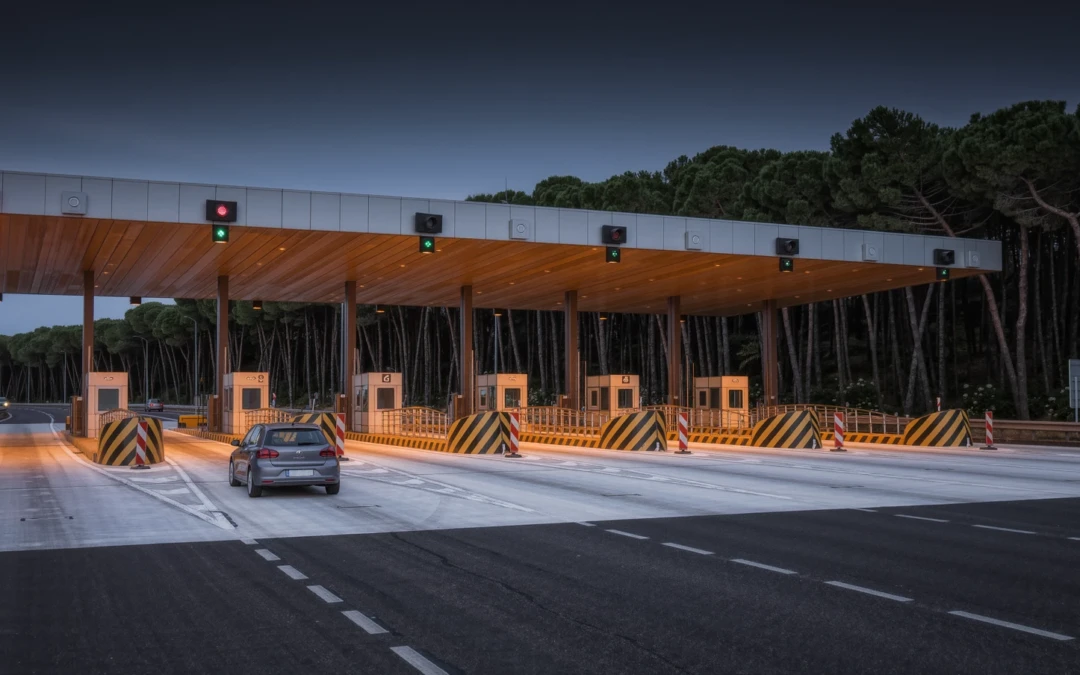
- Many Portuguese motorways have no barrier: gantries detect the car, and a foreign-registered car needs an active payment method before it drives through.
- Options for foreign plates: EasyToll (€1 plus €0.32 per trip, 30 days), Tollcard (prepaid, €0.32 per trip), Via Verde products, or a compatible foreign device.
- Not paying is a fine of at least five times the toll and never below €25; the maximum is double the minimum (Law 25/2006, art. 7).
On a Portuguese motorway you can drive under a gantry, hear nothing, see nothing and still have a debt. That is how an electronic-only toll works. The good news: the operator publishes clear options for foreign cars, and the law sets a clear penalty.
How tolls work
The national operator information site, PT Tolls, describes two systems. The traditional system uses barriers that stop the vehicle: manual lanes where you take a ticket at entry and pay at exit, and electronic lanes only for customers with an active payment system. The electronic-only system uses gantries over the road that detect the vehicle, with no barrier and no stop. A panel next to each gantry shows the toll rates, and signs mark every stretch with this system.
For a foreign-registered car on an electronic-only stretch, the operator says you must make sure you have an active payment method.
Payment options for foreign plates (PT Tolls)
- EasyToll: online or at one of four EasyToll booths near the borders; valid 30 days; €1 to join plus €0.32 per trip; valid on all national motorways except the Lusoponte crossings (25 de Abril and Vasco da Gama bridges); keep the confirmation and check the plate on it
- Tollcard: prepaid card of €5, €10, €20 or €40, activated by message; balance valid one year; €0.32 per trip; same exclusion of the Lusoponte bridges
- Go Toll: a Via Verde subscription, you pay only in months you use it, by card or direct debit; €0.32 per trip
- Via Verde (Go Toll & Beyond): same payment model without administrative costs per trip; a roaming add-on covers motorways and parking in Spain and France
- Interoperability: an electronic device from another country that works with the national systems; payment follows your contract; no administrative costs
Pay-after-the-trip (post-payment at CTT, Payshop or Multibanco within 15 working days) is listed by the operator for Portuguese plates. For foreign plates the operator lists the options above, so set one up before you go.
The fine (Law 25/2006)
Law 25/2006 turns unpaid or wrongly paid tolls into administrative offences. In the electronic system, it is an offence to pass through a toll barrier in an electronic-only lane without the vehicle being linked to the system, or not to meet the conditions of the contract (for example no device, no valid payment method or no balance). On a road with only electronic collection, passing a detection point without paying the toll is also an offence (art. 5). In the manual system, refusing to pay, not paying within the time given, or passing a barrier without stopping are offences, and a user without a valid ticket owes double the highest toll payable at that barrier (art. 6).
- Minimum fine: five times the toll, never less than €25
- Maximum fine: double the minimum, within the limits of the General Regime of Tax Offences
- Negligence is enough: you do not need to have meant to avoid the toll
- If the same person commits several offences in one month with the same vehicle on roads of the same operator, only one fine applies, with the maximum of one offence and the minimum equal to the sum of the tolls (art. 7)
The offence can be detected by any authority agent or inspection agent, and by equipment that records the image or detects the vehicle’s device. The report counts as evidence unless proven otherwise, and only one report is issued per month (arts. 8 and 9). If the driver cannot be identified, the operators notify the holder of the vehicle’s identification document (art. 10).
Mistakes I see most often
- Joining EasyToll with a wrong plate number, so the payment is linked to another car
- Assuming that the pay-after-the-trip option for Portuguese plates also works for a foreign car
- Using EasyToll or Tollcard on the Lusoponte bridges, which are excluded
Do the math: Example: a toll of €10. Unpaid, the minimum fine is €50 and the maximum €100. With EasyToll you pay the toll plus €0.32 for that trip and €1 to join. For ten gantries that is €4.20 of extra costs. The cheap way is to join before you drive.
FAQ
Do I need a toll device for a rental car? The operator says foreign-registered cars need an active payment method on electronic-only stretches. For a rental, ask at the desk what toll arrangement is included.
What is the minimum fine for a missed toll of €2? Five times €2 is €10, but the law sets a floor of €25, so the minimum is €25 and the maximum €50.
Can I pay at the gantry? No. Electronic-only stretches have no booth. Use one of the payment methods before you pass.
Ivan’s Take
Sort the toll before you cross the border. I join EasyToll online the night before, check the plate twice and keep the confirmation in the glovebox. A €1 fee and a few cents per trip is nothing next to a minimum fine of €25.
Sources: Lei n.º 25/2006 – Transgressões: taxas de portagem (versão atualizada até Lei n.º 27/2023), arts. 5–10; PT Tolls – Infraestruturas de Portugal: sistemas de portagem e como pagar; Infraestruturas de Portugal.
Published:
More from this section

The AvtoGear weekly
Once a week: new tests, the best deals and one useful tip for your car. Nothing extra.
