








In short
- Loads must be balanced, secure, not reduce your visibility, and not exceed 4 m in height from the ground (Código da Estrada, art. 56 no. 3).
- On cars carrying passengers, the load must not hide lights or plate and must not go beyond the vehicle’s outline, except in exceptional regulated cases.
- Fine: €120 to €600 for a badly arranged load, with possible immobilisation of the vehicle (art. 56 no. 6).
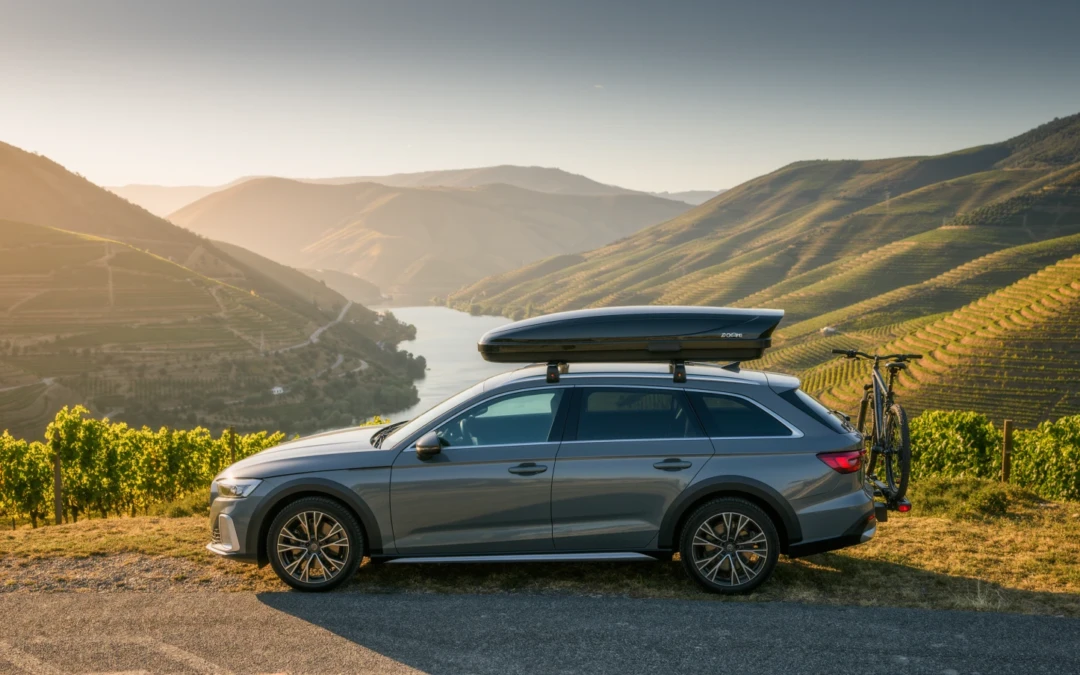
Roof box on, bikes on the rack, and off to the Algarve. The summer holiday setup is perfectly normal, until the load covers the plate or sticks out past the car. Article 56 sets the limits. Here is what it says and what it does not say.
The rule in detail
Article 56 no. 2 bans driving vehicles loaded in a way that can create danger or obstruction for other road users or damage pavements, installations and roadside buildings.
Article 56 no. 3 sets how the load must be arranged. The load must:
- keep the vehicle balanced, parked or moving;
- not be able to fall on the road, or to swing in a dangerous or troublesome way, or to throw debris onto the road;
- not reduce the driver’s visibility, and not drag on the ground;
- not exceed 4 m in height measured from the ground;
- on vehicles for passengers, not impair the correct identification of signalling and lighting devices and the number plate, and not go beyond the vehicle’s outline, except in exceptional conditions fixed in regulation;
- on goods vehicles, stay within the length and width of the load bed, except in exceptional conditions fixed in regulation;
- be fixed with retaining straps or an equivalent device when it is an indivisible load on open platforms.
The Code defines the vehicle’s outline (art. 56 no. 4): the vertical planes passing through its extreme points. A roof box that stays inside those planes, does not reduce your visibility and holds firm is within the text. A rack or load that projects beyond the outline is allowed only in the exceptional conditions of the regulation, which I did not read. So I cannot tell you how far a rear rack may stick out.
Fines and consequences
- Loading or unloading, and driving with a load that creates danger or obstruction (art. 56 nos. 1 and 2): €60 to €300 (art. 56 no. 5).
- Breaking the arrangement rules of no. 3: €120 to €600 if no more serious sanction applies, and the vehicle can be immobilised or moved to a suitable place until the situation is fixed (art. 56 no. 6).
- Vehicles over the weight or dimension limits set by regulation may not use public roads: €600 to €3,000 (art. 57).
- Special authorisation for heavier or bigger vehicles or indivisible objects (art. 58): not showing it when required costs €600 to €3,000, reduced to €60 to €300 if you present it within eight days; breaking its limits or route costs €600 to €3,000.
Plates are a separate trap. Article 161 no. 1 h lists plates that do not meet the regulation’s conditions on placement among the cases where the vehicle’s identification document is seized. I did not read that regulation, so make sure your rack leaves the plate where it belongs, fully visible.
Foreign drivers and rental cars
The article applies to any vehicle on the public road. If you arrive with a roof box and a bike rack on a foreign car, the same rules apply. A rental car does not change that: the driver arranges the load and is the one the officer stops.
Mistakes I see most often
- A rear bike rack that hides the plate or the lights. Article 56 no. 3 g puts that squarely in the €120 to €600 range.
- A load that blocks the rear view. The visibility rule is in no. 3 c.
- Loose or badly strapped items on a roof. They can fall onto the road, and that is a breach of no. 3 b.
Do the math: A badly arranged load costs €120 to €600, and the officer can keep the car where it is until you fix it. Five minutes with the straps, and a check of your plate and lights, cost €0.
FAQ
Is a roof box legal in Portugal? The Code has no ban on roof boxes. Inside the vehicle’s outline, secure, and without reducing your visibility, it meets the text I read. Fines apply to unbalanced or loose loads and anything blocking lights or plate.
How far can a load stick out behind my car? On a passenger car, the Code says the load must not go beyond the outline, except in exceptional conditions fixed in regulation. I did not read the regulation, so I cannot give a figure.
What is the maximum height? 4 m from the ground, load included (art. 56 no. 3 f).
Where to check
Código da Estrada (Decree-Law 114/94), articles 56–58 and 161, in the current consolidated text published by the Procuradoria-Geral Distrital de Lisboa (pgdlisboa.pt, last amended by Lei 24/2025). None of these articles changed after the 2020 republication. The regulation on weights, dimensions and exceptional conditions is cited by articles 57 and 58 and by article 56 no. 3 g and h.
Ivan’s Take
My view: load smart. Keep it inside the outline, keep the plate and lights visible, strap everything twice and check at the first stop. The rule is simple, and a stop for immobilisation in August is not.
Sources: Código da Estrada (DL 114/94), versão atualizada até Lei n.º 24/2025 (PGDL Lisboa) – arts. 56–58, 161; ANSR – Código da Estrada.
Published:
More from this section
The AvtoGear weekly
Once a week: new tests, the best deals and one useful tip for your car. Nothing extra.
