








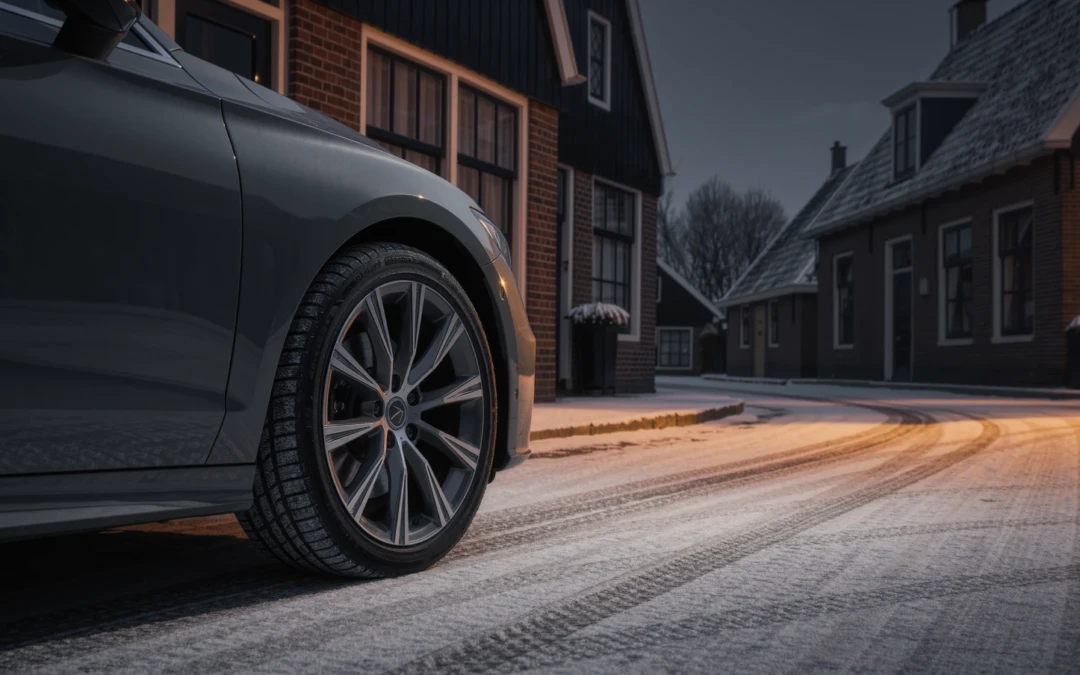
In short
- In the Regeling voertuigen (valid from 1 July 2026) and the RVV 1990 I found no duty to fit winter tyres. The tread rule applies all year: at least 1.6 mm (RV art. 5.2.27 par. 4).
- Tyres of motor vehicles may not have snow chains made of metal elements (RV art. 5.18.32a): €320 under Wet Mulder code P 321.
- Tyres below the required tread, or re-cut: €190 for one tyre, €280 for two, €420 for three (code N 270 r, s, t, cars).
If you plan a drive to the Netherlands in January, you will look for a winter-tyre law. I did not find one in the texts. What I did find is stricter than people expect in two places: the chains and the tread. Here is the list, read in the consolidated Regeling voertuigen (valid from 1 July 2026), the RVV 1990 (valid from 1 July 2026) and the Wet Mulder annex (valid from 1 September 2026).
The rule in detail
Winter tyres. I searched the Regeling voertuigen (RV) and the Reglement verkeersregels en verkeerstekens 1990 (RVV) for a duty to use winter or snow tyres and found none. I did not search every other text, so this means only that these two main texts contain no such duty.
Tread depth. In the inspection requirements for passenger cars, article 5.2.27 RV says that the tyres must have no damage that shows the carcass (par. 2), no bulges (par. 3), and that the tread of the main grooves must be at least 1.6 mm over the whole circumference of the tread, apart from wear indicators (par. 4). Paragraph 5: the tyres may not be re-cut, which means that wear indicators are cut away or the tread shape is changed. The Wet Mulder annex applies the 1.6 mm figure to passenger cars in the fine description for tyre profile.
Snow chains. Article 5.18.32a RV, paragraph 1: the tyres of motor vehicles may not be fitted with snow chains that consist of metal elements. Paragraph 2: this does not apply to vehicles of emergency services named in RVV articles 29 paragraph 1 and 30b, if chains are needed for an urgent task. I did not check what is allowed instead of metal chains, so I do not claim that textile covers are or are not accepted.
Lights in snow and fog
Article 34 RVV 1990 says in paragraph 1 that in fog, snowfall or rain that seriously limits visibility, drivers of motor vehicles may use front fog lights. Then they do not have to use dipped beam. Paragraph 2: in fog or snowfall that limits visibility to less than 50 metres, the rear fog light may be used.
The reverse is also fined. Using front fog lights when it is not fog, snow or heavy rain is code R 434: €130. Using the rear fog light when visibility is not limited to less than 50 metres is code R 436: €190. After the snow stops, switch the rear fog light off.
The RVV also has warning sign J36 for ice or snow on the road. I did not search for rules about clearing snow from the car roof, so I give none.
- Netherlands: a roof box, a bike rack and the 75 kg tow-bar limit (art. 5.18.7) and what it costs
- Netherlands: the lorry road charge started on 1 July 2026 – every truck over 3,500 kg needs an on-board unit
- Netherlands: strict duties after an accident and a two-offence rule for novice drivers – what the law demands and what it costs
Foreign drivers
The texts I read do not distinguish by the nationality of the car. A car with foreign plates is therefore best treated as bound by the same tyre, chain and light rules on a Dutch road. If your own country requires winter tyres, check that rule in your own law, because I did not verify it here. For rental cars, check the tyres before you leave the counter: a bald tyre is a Dutch fine even if the car is not yours.
Fines
- P 321, tyres with snow chains made of metal elements (art. 5.18.32a RV): €320
- N 270 r, 1 tyre with insufficient tread or re-cut tyre (art. 5.2.27 RV, passenger car): €190
- N 270 s, 2 tyres: €280
- N 270 t, 3 tyres: €420
- R 434, front fog lights outside fog, snow or heavy rain (art. 34 par. 1 RVV): €130
- R 436, rear fog light when visibility is not under 50 metres (art. 34 par. 2 RVV): €190
These figures are from the Wet Mulder annex, version valid from 1 September 2026, column for passenger cars. The OM states that its amounts are exclusive of €9 administration costs.
Mistakes I see most often
- Fitting metal chains on a Dutch road because they are required in the Alps
- Leaving the rear fog light on after the snow has stopped, because it is switched on once and forgotten
- Assuming that a tyre that passed a check in October is still above 1.6 mm in January
The maths
Do the math: Three bald tyres on a car: €420 + €9 = €429. One metal chain set on the drive wheels: €320 + €9 = €329. A tyre depth gauge costs a few euros. A glance at the grooves takes ten seconds.
FAQ
Are winter tyres mandatory in the Netherlands? I found no duty in the Regeling voertuigen or the RVV 1990 valid in November 2026. The tread rule of 1.6 mm still applies in all seasons.
Can I use snow chains? Not chains that consist of metal elements. Article 5.18.32a RV bans them on tyres of motor vehicles, with an exception for named emergency services.
When can I use fog lights? Front fog lights in fog, snowfall or rain that seriously limits visibility. The rear fog light only when visibility is under 50 metres in fog or snowfall.
Ivan’s Take
Ice is ice. The law gives me no tyre rule, so I decide myself and put winter tyres on from November. The fine is not the point. The point is that a bald tyre breaks the one tyre rule the Dutch texts state clearly.
Sources: Regeling voertuigen, art. 5.2.27 and 5.18.32a, version valid from 01-07-2026; Reglement verkeersregels en verkeerstekens 1990 (RVV 1990), art. 34, sign J36; Wet Mulder, bijlage (P 321, N 270, R 434, R 436), version valid from 01-09-2026; Openbaar Ministerie – Boetebedragen.
Published:
More from this section
The AvtoGear weekly
Once a week: new tests, the best deals and one useful tip for your car. Nothing extra.
