








In short
- There is no general penalty-point system, but novice drivers have a two-offence rule: two convictions for listed serious offences lead to a CBR driving test (Regeling maatregelen rijvaardigheid en geschiktheid 2011).
- After an accident with damage or injury you may not leave the scene, unless you let the others establish your identity and your vehicle’s identity (art. 7).
- Leaving the scene after damage only can mean up to 3 months in prison or a fine of €11,000. Not placing the warning triangle costs €190.
People ask me about the Dutch points system. The Wegenverkeerswet 1994 (version from 1 September 2026) has no general points counter, but novice drivers have a two-offence rule, explained below. The law also has a clear list of duties after an accident. I read it with the Reglement verkeersregels en verkeerstekens 1990, the Wahv annex and the Regeling maatregelen rijvaardigheid en geschiktheid 2011 on wetten.overheid.nl on 13 November 2026.
What the law demands after an accident
- Do not leave the scene if someone was killed or injured, if someone suffered damage, or if an injured person would be left helpless (art. 7, paragraph 1).
- Paragraphs a and b of that rule do not apply if you properly gave the opportunity to establish your identity and, if you drove a motor vehicle, the identity of the vehicle (art. 7, paragraph 2).
- Nobody may behave in a way that causes danger on the road or hinders traffic (art. 5).
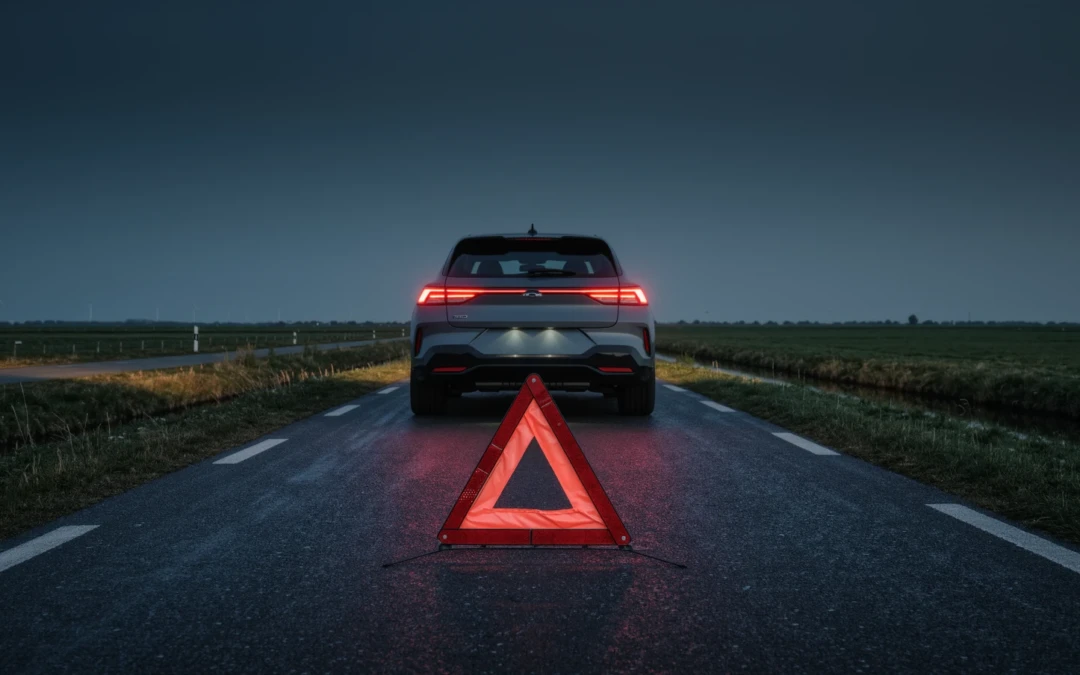
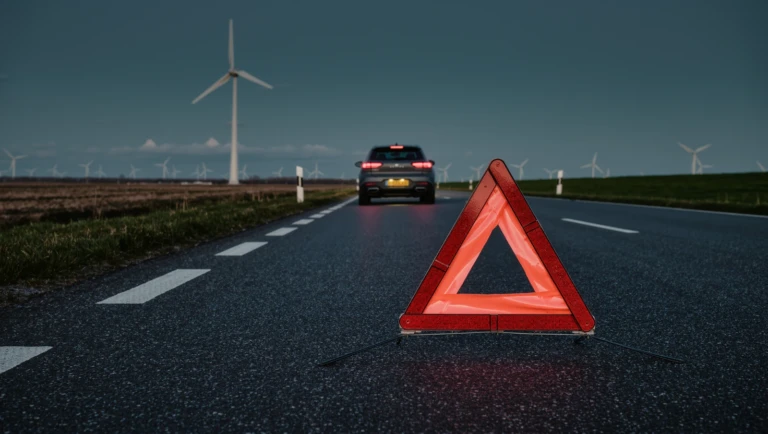
- If your stopped vehicle is an obstacle that approaching drivers cannot see in time, place the warning triangle well visible on the road about 30 metres from the vehicle, towards the traffic for which it is a danger. You do not need it when flashing warning lights are on (RVV 1990, art. 58).
- On the request of an authorised officer you must show the registration certificate, and your driving licence, Dutch or issued abroad, and an international licence if you have one (art. 160, paragraph 1).
Penalties
- Leaving the scene after death or injury, or leaving an injured person helpless: up to one year in prison or a fine of the fourth category (art. 176, paragraph 2), which is €27,500 from 1 January 2026 (Wetboek van Strafrecht, art. 23).
- Leaving the scene after damage only: up to three months in prison or a fine of the third category (art. 176, paragraph 5), which is €11,000.
- Causing an accident through your own fault, with injury: up to one year and six months or a fourth-category fine (art. 175, paragraph 1). If the fault is recklessness: up to three years or a fourth-category fine for injury, up to six years or a fifth-category fine (€110,000) for a death (art. 175, paragraph 2).
- The court can ban you from driving for up to five years for several of these offences (art. 179).
- Not placing the warning triangle where required, with no flashing warning light: €190 in the Mulder tariff, plus €9 administration costs.
- Leaving a vehicle so that it causes danger or hinders traffic (art. 5): €190.
The novice-driver rule instead of points
The Wegenverkeerswet has no general points counter, but the Regeling maatregelen rijvaardigheid en geschiktheid 2011 has a two-offence rule for novice drivers. A novice is a driver as defined in art. 8(3) WVW: in general the first five years after the first licence. If a novice is convicted twice, or gets two final penalty orders from the public prosecutor (OM), for offences on the list in annex 1, part A.IV, the licence must be handed in (art. 5 n), the CBR suspends it (art. 6) and orders a driving test (art. 23(2)(b)). The list covers art. 5, 5a and 6 WVW (dangerous or reckless driving, causing an accident by fault), art. 19 RVV (not being able to stop in time), speeding (art. 20, 21, 22 and 45 RVV and signs A1 and A3) and any other RVV offence that caused injury or damage. Fail the test and the licence is declared invalid (art. 27); pass it and the CBR orders the course ‘gedrag en verkeer’ (art. 14(1)(d)), at your cost (art. 25). An ordinary Wet Mulder fine is not on that list. For alcohol, art. 123b WVW makes a licence invalid after a repeat conviction within five years.
Foreign drivers and rental cars
The duties after an accident apply to everyone who is involved in an accident in the Netherlands. Article 160 mentions a licence “issued by the competent authority outside the Netherlands”, so a foreign licence is covered. Keep the licence and the rental contract in the car.
Mistakes I see most often
- Driving away because the damage is small. Damage to someone else is enough to trigger the duty to stay (art. 7, paragraph 1, b).
- Putting the triangle too close to the car. The text says about 30 metres.
- Leaving the car in a lane without hazard lights and without a triangle.
Do the math: two minutes to give your details are free. Leaving after a scratch on a parked car risks up to €11,000 or three months in prison. A warning triangle costs €190 + €9 = €199 if it is missing when it is needed.
FAQ
Does the Netherlands have penalty points? Not a general points system. Novice drivers have a two-offence rule: two convictions for listed serious offences in the novice period lead to a CBR driving test, and failing it makes the licence invalid.
Must I wait for the police after a small accident? The text I read requires you to stay and give the other party the chance to establish your identity and the identity of your vehicle (art. 7, paragraph 2). It does not say you must wait for the police in every case.
How far away do I place the warning triangle? About 30 metres, well visible, in the direction of the traffic for which the vehicle is a danger (RVV, art. 58, paragraph 2).
Ivan’s Take
My view: the Dutch approach is strict and simple. There is no points counter for experienced drivers, but a novice gets only two chances, and the worst offences can end any licence at once. After an accident I stay, I put the triangle out, and I give my details. Two minutes, and nothing more to explain later.
Sources: Wegenverkeerswet 1994 (art. 5, 5a, 6, 7, 8, 123b, 160, 175, 176, 179; version from 01-09-2026), wetten.overheid.nl; Reglement verkeersregels en verkeerstekens 1990 (art. 19, 58), wetten.overheid.nl; Wet administratiefrechtelijke handhaving verkeersvoorschriften (annex, feiten R 395, R 526), wetten.overheid.nl; Regeling maatregelen rijvaardigheid en geschiktheid 2011 (art. 1, 5, 6, 14, 23, 25, 27, annex 1 A.IV; version from 01-04-2023), wetten.overheid.nl; Wetboek van Strafrecht (art. 23), wetten.overheid.nl.
Published:
More from this section
The AvtoGear weekly
Once a week: new tests, the best deals and one useful tip for your car. Nothing extra.
