








In short
- Regeling voertuigen art. 5.18.7: goods on the roof must sit on a sound carrier that is sound fixed, and you may never exceed the vehicle maker’s maximum roof load. A rear or front carrier may not stick out more than 0.20 m beyond the sides.
- Tow-bar carrier: no more than the maker’s maximum vertical load, or 75 kg if the tow bar states none. If the carrier hides your lights or plate it needs its own.
- Named fines for a car (Wet Mulder annex): €190 for roof and rear carrier faults, €130 for a tow-bar load over the limit or a carrier that can touch the road, €500 for loose cargo not properly covered, plus €9 administration costs.
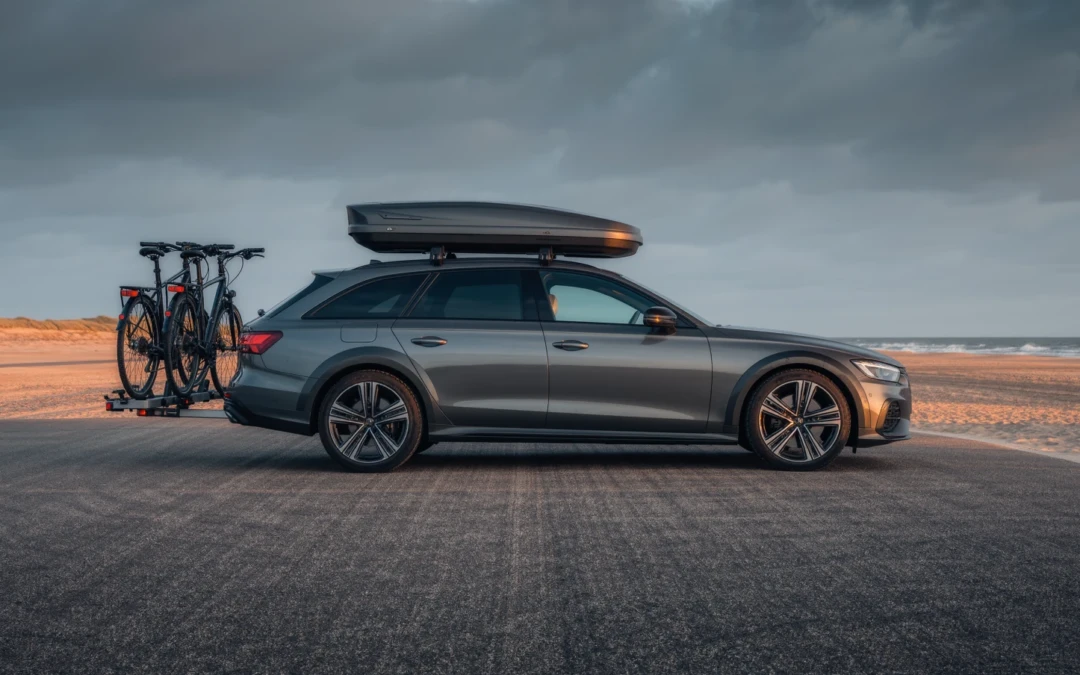
A roof box or a bike rack turns a holiday car into a load carrier, and Dutch rules treat it as one. I read the current Regeling voertuigen (in force from 1 July 2026) and the Wet Mulder annex (in force from 1 September 2026). The rules below are the ones for loads and carriers on passenger cars and similar vehicles. I did not read the separate rules for caravans and trailers.
Roof boxes and roof loads
Article 5.18.7, paragraph 2: for goods on the roof, the goods must be fixed on, in or to a sound carrier, the carrier must be fixed soundly to the vehicle, the maximum roof load set by the vehicle manufacturer may not be exceeded, and if the carrier is built for specific goods, you may not carry other goods or more of them than it was built for. A roof box is such a carrier. Your car’s maximum roof load is in the manufacturer’s data, so check the manual. The Dutch text gives no fixed number of its own.
Rear and front carriers, and bike racks
Paragraph 1 covers goods at the front or rear. The goods and the carrier must be soundly fixed. The carrier, with the goods, may not stick out more than 0.20 m beyond the sides of the vehicle. If the carrier or the goods hide the rear lights and reflectors, the carrier must have two red tail lights, two red brake lights, two red reflectors and two amber indicators, placed no further than 0.50 m from the widest point. If it hides the number plate, the carrier needs a plate with your registration number, readable, with the approval mark and not covered, plus plate lighting if the car requires it.
For a carrier on the tow bar, the maximum vertical load set by the tow bar maker may not be exceeded. If the tow bar states none, the limit is 75 kg. The carrier, with its fixing parts, may not be able to touch the road under normal use. Fixing parts left on the tow bar may not limit the movement of a coupled trailer.
Other loads
Article 5.18.6 says load must be secured so it cannot fall off or endanger stability, and names minimum forces it must withstand: 0.8 times its weight forward, 0.5 sideways and 0.5 backward. Loose cargo that cannot be fixed must be properly covered if it creates danger or nuisance. Article 5.18.12 says load may not stick out more than 1.00 m behind the vehicle or in front of it, and may not block the view of lights, reflectors, indicators or number plate.
Fines
The Wet Mulder annex gives these amounts for a car in euros. The Openbaar Ministerie states its published amounts exclude €9 administration costs.
- Rear or front carrier: goods or carrier not soundly fixed, carrier sticks out more than 0.20 m, or the wrong goods carried (feitcode P 070 a to d): €190 each.
- Carrier hides lights or plate and lacks its own lights or plate (P 070 e, f): €190.
- Tow-bar carrier over the permitted vertical load or 75 kg (P 070 g): €130. Carrier can touch the road (P 070 h): €130.
- Roof load not soundly fixed, carrier not soundly fixed, maximum roof load exceeded or more goods than the carrier is built for (P 070 j to m): €190 each.
- Loose cargo not properly covered while danger or nuisance arises (P 061): €500.
- Load sticks out in front of the vehicle (P 120 aa): €190. View of lights or plate blocked by protruding load (P 121 g): €190.
I found no separate row in the annex for the general securing duty in article 5.18.6, paragraph 1. I do not name an amount for it.
Foreign drivers and rental cars
The articles speak of the driver of a vehicle and have no nationality condition. I did not read an official text on how they apply to foreign-registered cars, so I do not claim more. In a rental car, find the maker’s maximum roof load first.
Mistakes I see most
- Loading the roof box without checking the roof load in the car manual.
- Fitting a bike rack that hides the number plate and having no plate or lights on the rack.
Do the math: a roof box over the maximum roof load costs €190 + €9 = €199. A tow-bar rack over the limit costs €130 + €9 = €139. Loose cargo that flies off costs €500 + €9 = €509. Reading the load limit in the manual costs €0.
FAQ
How heavy can a tow-bar bike rack be? Not above the maximum vertical load set by the tow bar maker, or 75 kg if the tow bar states none (art. 5.18.7, paragraph 1).
Do I need a second number plate on my bike rack? Only if the rack or the bikes hide the car’s plate. Then the rack needs its own readable plate.
What is the maximum roof load? The Dutch text refers to the maximum set by the vehicle manufacturer. It sets no number of its own.
Where to check
Regeling voertuigen articles 5.18.4 to 5.18.7 and 5.18.12, and the Wet Mulder annex (feitcodes P 041, P 061, P 070, P 120, P 121), are on wetten.overheid.nl. Current amounts are in the Boetebase on om.nl.
Ivan’s Take
Most people never read the roof load in the manual, and that is where the fine starts. Check it, fit a plate board if the rack hides your plate and keep the tow-bar load under the maker’s number. A loaded rack is a tiny trailer, so treat it as one.
Sources: Regeling voertuigen, art. 5.18.4, 5.18.6, 5.18.7, 5.18.12 (wetten.overheid.nl; in force from 01-07-2026, consulted 13-11-2026); Wet Mulder, Bijlage, feitcodes P 041, P 061, P 070, P 120, P 121 (wetten.overheid.nl; in force from 01-09-2026); Openbaar Ministerie – Boetebedragen (administratiekosten).
Published:
More from this section
The AvtoGear weekly
Once a week: new tests, the best deals and one useful tip for your car. Nothing extra.
