








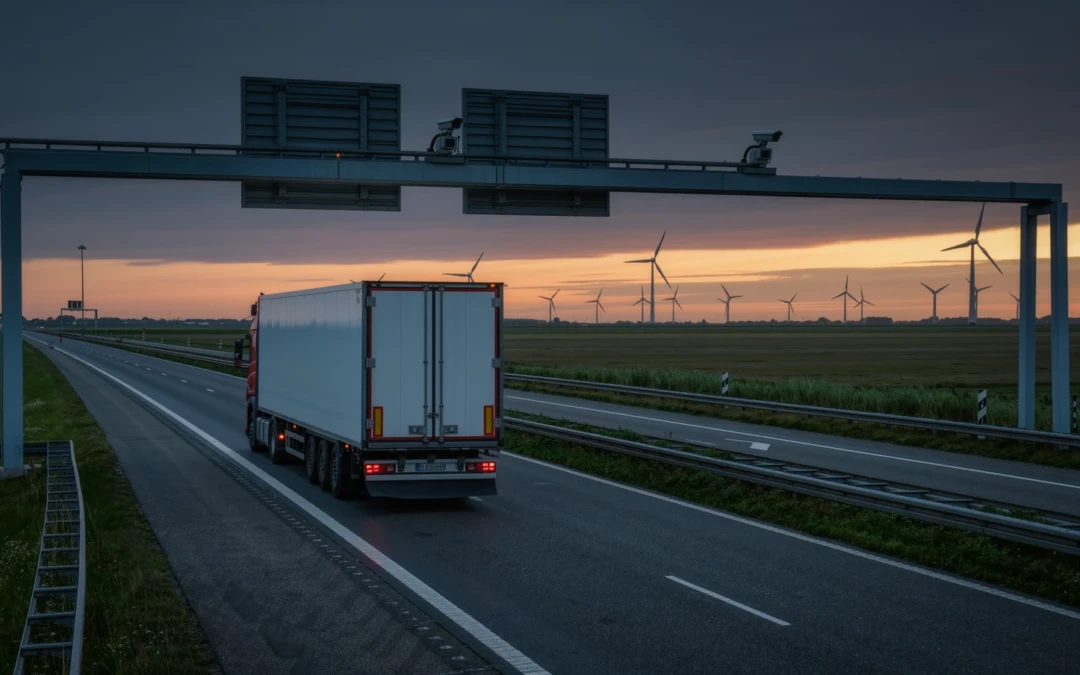
In short
- Since 1 July 2026 the Netherlands charges Dutch and foreign trucks over 3,500 kg (categories N2 and N3) per kilometre on motorways and some other roads. The Dutch Eurovignet has stopped.
- Every truck needs its own working on-board unit (tolkastje) from a service provider. Checks started on 1 July.
- Fines: no contract €400, a switched-off or faulty unit €250, until 1 January 2027. From then €800 and €500. From 1 September to 31 December 2026 the rates are cut by 22.3%.
If you drive a truck through the Netherlands, the Eurovignet no longer covers you. A distance charge replaced it on 1 July 2026. Here is what the Dutch government and the RDW publish: who pays, how much and what a missing unit costs.
Who pays
The charge applies to Dutch and foreign vehicles in categories N2 and N3, with a technical maximum mass of more than 3,500 kg. You find the category on the registration certificate. It applies on almost all motorways and on some provincial and municipal roads. The RDW publishes a road map and a list of roads. Owners pay per kilometre driven on those roads, and the cleaner and lighter the vehicle, the lower the rate. On 1 July 2026 the Dutch Eurovignet stopped, and Dutch road tax for trucks up to 12,000 kg was abolished.
The on-board unit
Every truck must carry its own on-board unit (tolkastje) that works in the Netherlands, supplied by a service provider. According to the Rijksoverheid, checks for a working unit began on 1 July 2026. The Dutch system is designed to work like those in Germany, Belgium and Denmark, so one provider can cover several countries. I did not verify which providers cover which countries, so ask yours before you cross.
Rates
The RDW publishes rates by weight class, Euro class and CO2 class. From 1 September to 31 December 2026 a temporary reduction of 22.3% applies to all trucks. Examples per kilometre, CO2 class 1, Euro 6:
- Over 3,500 up to 12,000 kg: €0.088 (1 Sep to 31 Dec 2026), €0.116 in 2027.
- 12,000 to 18,000 kg: €0.125, and €0.165 in 2027.
- 18,000 to 32,000 kg: €0.141, and €0.187 in 2027.
- Over 32,000 kg: €0.156, and €0.206 in 2027.
The RDW says rates rise by 2.6% on 1 January 2027 for inflation. An electric truck in the heaviest class pays about 4 cents per kilometre in 2027. The RDW page says the 2027 amounts are to be formally published in the Staatscourant, so check the current table.
Fines
The RDW lists these fines. In the first half year the fine is half of the normal amount, so the first amount applies until 1 January 2027:
- No contract with a service provider for the Netherlands: €400 until 1 January 2027, then €800.
- Driving with an on-board unit that is switched off: €250, then €500.
- A unit that does not work properly: €250, then €500.
- A unit that belongs to another truck: €250, then €500.
Per plate you can get at most one fine in 24 hours. If you commit several offences in that time, only the highest amount counts. Checks use cameras over the road and mobile devices.
Foreign drivers
The charge applies to foreign vehicles too, and the Rijksoverheid says it creates a level playing field for international transport. The RDW site offers a way to find your rate when the truck has no Dutch plate: use the weight, the Euro class and the CO2 class. I did not find an official statement on how unpaid Dutch fines are collected from foreign operators.
Mistakes I see most often
- Assuming a German or Belgian unit works in the Netherlands without checking.
- Reading the CO2 class wrong and budgeting the wrong rate.
- Starting a trip with the unit switched off.
Do the math: 1,000 km in a Euro 6 truck over 32 tonnes costs €156 in the discount period and €206 in 2027. A €800 no-contract fine equals about 3,900 km of 2027 toll, and costs nothing if you sign up first.
FAQ
Does this apply to a van? Only to vehicles over 3,500 kg in N2 and N3. Vans up to 3,500 kg are outside it.
Is the Eurovignet still valid in the Netherlands? No. The Dutch Eurovignet stopped on 1 July 2026.
Is there a grace period for fines? The fines are half the normal amount until 1 January 2027, then the full amount.
Where to check
The Rijksoverheid page on the lorry charge, the RDW site vrachtwagenheffing.nl (rates, fines, control, road list) and the Wet vrachtwagenheffing.
Ivan’s Take
This is a toll that punishes the unprepared. Sign up with a provider before the trip, check the unit and the CO2 class, and book the 2027 rate into your quote now. The half-price fines end on 1 January, and that is a date I would not test.
Sources: Rijksoverheid: Vrachtwagenheffing (from 1 July 2026); RDW: Vrachtwagenheffing – Dit gaat u betalen (rates); RDW: Controle van vrachtwagenheffing (fines); RDW: Tarieven vrachtwagenheffing 2027 (20-08-2026).
Published:
More from this section
The AvtoGear weekly
Once a week: new tests, the best deals and one useful tip for your car. Nothing extra.
