








In short
- Dutch administrative traffic fines (Wet Mulder, Wahv) were indexed by 2.6% on 1 January 2026, and apply to offences committed from that date.
- For a car driver: holding a phone €440, running a red light €320, no seat belt €190, expired inspection €190, entering a closed low-emission zone with a diesel €130.
- Unpaid, the fine rises by 50% by law and then by a further 100%: a €440 fine can become €1,320 before administration costs.
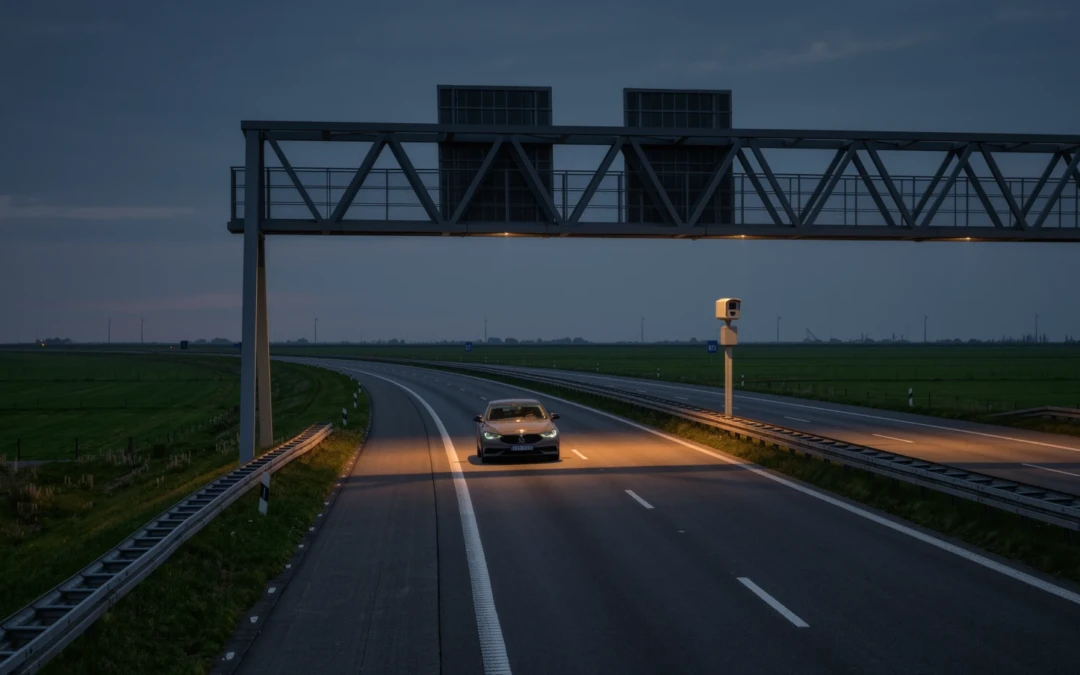
Every January the Netherlands raises its automatic traffic fines. For 2026 the raise is 2.6%, set in a decree of 26 November 2025. The amounts below are the ones that count for a car driver today.
What the decree changed
The decree of 26 November 2025 (Stb. 2025, 413) rewrote the annex to the Wahv, the law behind automatic fines sent to the registered keeper, and the annexes to the OM-afdoening decree. Its main point is the yearly indexation of 2.6%. The percentage now follows consumer prices from June 2024 to March 2025; earlier decrees used June to June, which left too little time before 1 January. The decree entered into force on 1 January 2026 and, under its article III, the new amounts apply only to offences committed after that date. Other changes in the annex are technical, following changed laws.
Fines for a car driver (category 1)
- Holding a phone or other mobile device while driving, art. 61a RVV 1990 (R 545): €440.
- Not stopping for a red light, art. 68 RVV 1990 (R 602): €320.
- Driver or passenger not using an available seat belt, art. 59 RVV 1990 (R 533): €190.
- Child under 12 and at least 1.35 m carried without using an available seat belt (R 535 k): €280.
- Car up to 3,500 kg with a lapsed inspection certificate (APK), art. 72 WVW 1994 (K 045 b): €190.
- Number plate not properly visible, art. 40 WVW 1994 (K 030 a): €190.
- Diesel car in a closed low-emission zone (R 572 e): €130.
Administration costs are added to every fine; the OM states €9 on top of the amounts it publishes. Speeding fines have their own table by km/h; the speed columns are split by vehicle category, so read the row for your category on the official annex.
- Netherlands: extra lights, light bars and xenon or LED swaps under Regeling voertuigen, with named fines
- Netherlands: traffic from the right goes first – Dutch priority rules, zebra crossings and the €320 fines
- Netherlands: new low-emission zone sign since 1 January 2026 – diesel cars and the €130 fine
How the fine reaches you
- The decision must be sent within four months of the offence (art. 4 Wahv). If the keeper is not known yet, the term starts when the keeper’s details are known, with a maximum of five years.
- If the driver is not stopped, the fine goes to the person registered as keeper (art. 5). A registration in a foreign register counts as a plate (art. 1(2)).
- You can appeal to the public prosecutor (art. 6) and then to the subdistrict judge (art. 9). For a fine of €225 or more you must first put up security of €225 plus the costs (art. 11).
- For a fine of €225 or more you can ask for instalments (art. 23(2)).
If you do not pay
Payment is due within two weeks after the decision becomes final. If you miss the term, the fine rises by 50% by law (art. 23(3)). You then get a reminder with a four-week term (art. 24). If that is missed too, the amount rises by 100% of the fine plus the first increase (art. 25). The state can then recover it for three years, and a vehicle can be taken or immobilised (art. 29).
Foreign drivers and rental cars
The fine goes to the registered keeper. With a rental car, the keeper can have the decision cancelled by showing a written business rental contract of at most three months that names you (art. 8). I did not find an official statement on how fines are collected from other countries, so treat any Dutch letter as real and check the offence date.
Mistakes I see most often
- Throwing the letter away because it came from abroad and the deadline passes.
- Paying late and meeting the 50% surcharge.
- Thinking a phone in a holder is illegal. The offence is holding it.
Do the math: a phone fine of €440 becomes €660 after the first increase and €1,320 after the second, before administration costs. Paying on time saves €880.
FAQ
Does the new amount apply to an offence from December 2025? No. The new amounts apply only to offences after 1 January 2026 (art. III).
Can I pay in instalments? Yes, if the fine is €225 or more, on request (art. 23(2)).
What if I was not the driver? The fine goes to the registered keeper, but the decision is cancelled if the keeper shows the car was used against their will, or a written business rental contract of at most three months that names the renter (art. 8).
Where to check
Stb. 2025, 413 on officielebekendmakingen.nl for the annex, and the Wahv on wetten.overheid.nl (version of 1 September 2026) for articles 4 to 25.
Ivan’s Take
Two point six per cent sounds small, but the real number to remember is the multiplier. Late payment triples a fine. I would treat every Dutch fine letter like a bill with a short fuse: read it the day it arrives, check the date and plate, and pay or appeal inside the term.
Sources: Staatsblad 2025, 413 (Wahv annex and OM-afdoening, indexation 2.6%); Wet administratiefrechtelijke handhaving verkeersvoorschriften (Wahv), art. 1, 4-9, 11, 23-25, 29; Reglement verkeersregels en verkeerstekens 1990 (RVV 1990), art. 59, 61a, 68.
Published:
More from this section
The AvtoGear weekly
Once a week: new tests, the best deals and one useful tip for your car. Nothing extra.
