








In short
- At a junction without signs you give way to traffic coming from the right (RVV 1990, art. 15). Signs and road markings override that rule (art. 62).
- You must let pedestrians and mobility-scooter users go first on a zebra crossing, also when they are clearly about to cross (art. 49).
- Not giving way to traffic from the right, at a give-way sign or when turning costs €320, plus €9 administration costs.
Priority is the rule that surprises visitors most on Dutch roads. The text is short. I read the Reglement verkeersregels en verkeerstekens 1990 (version from 1 July 2026), the Wegenverkeerswet 1994 (version from 1 September 2026) and the Wahv fine annex on wetten.overheid.nl on 13 November 2026.
The rules in detail
- Art. 15: at junctions, drivers give way to drivers coming from their right. The exceptions: a driver on an unpaved road gives way to a driver on a paved road, and everyone gives way to a tram.
- Art. 62: traffic signs override the traffic rules when the two conflict. Sign B1 is a priority road, B3 to B5 priority junctions, B6 means give way and B7 means stop and give way to traffic on the crossing road (annex 1).
- Art. 14: drivers may not block a junction.
- Art. 15a: you may enter a level crossing only if you can drive straight on and clear it completely. A rail vehicle always goes first.
- Art. 49, paragraph 2: drivers must let pedestrians and mobility-vehicle users go first who are crossing at a zebra crossing, or who are clearly about to cross. Paragraph 4 removes this duty when a red pedestrian light or a flashing yellow light applies to them.
- Art. 49, paragraph 1: drivers must let blind people with a white cane and other people who have difficulty moving go first.
Turning and manoeuvring
- Art. 17: you may position yourself early at the right edge to turn right, or near the centre line to turn left, and you must signal with the indicator or arm before turning.
- Art. 18: a driver who turns must let go the traffic that comes the other way on the same road, and traffic beside or close behind. A driver turning left lets oncoming vehicles that turn right at the same junction go first.
- Art. 54: when pulling away, reversing, leaving a driveway, entering a driveway, making a U-turn, joining a motorway or leaving it, or changing lane, you let the other traffic go first.
- Art. 56: inside a built-up area, you let a bus that signals pull away from a bus stop.
Roundabouts
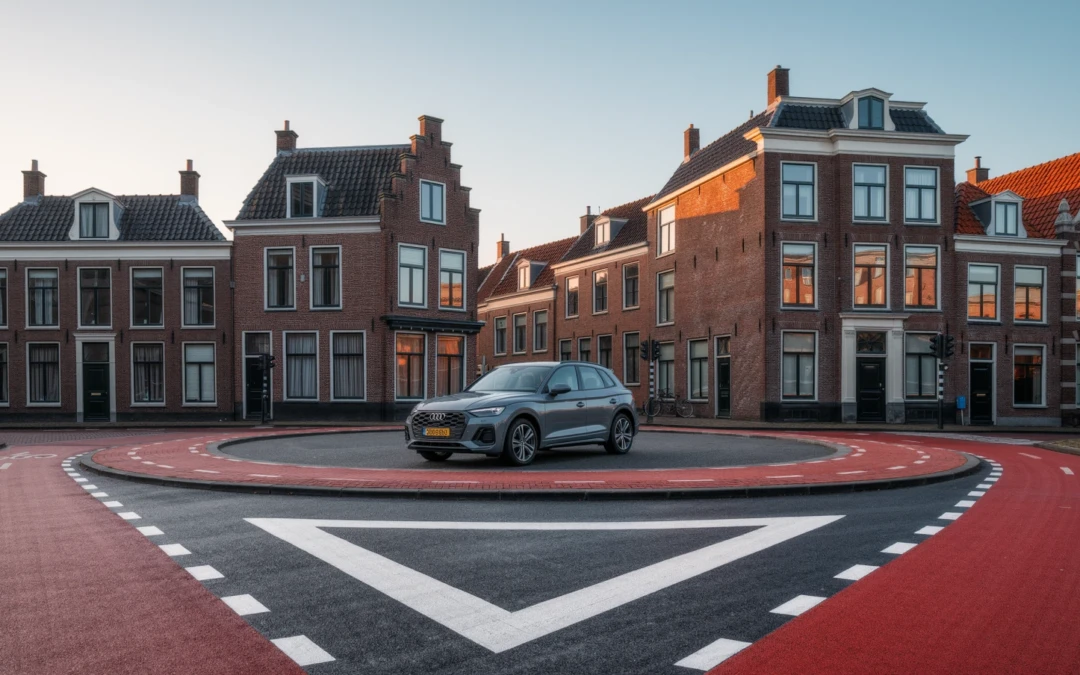
Articles 47 and 48 say that drivers near or on a roundabout may use a position other than the right-hand side, and may overtake on the right. The priority on the roundabout itself comes from the signs and the white triangles on the road, called haaientanden. Under art. 62 those signs win over the general rule. I found no general roundabout priority sentence in the RVV, so follow the signs on each roundabout.
The fines (car, category 1)
The amounts come from the Wahv annex as indexed on 1 January 2026. The OM states they exclude €9 administration costs.
- Not giving way at a junction to traffic from the right (art. 15(1), feitcode R 336): €320.
- Not giving way from an unpaved to a paved road, or to a tram (art. 15(2), R 337 and R 338): €320.
- Not giving way at a B6 give-way sign (R 548) or at shark’s teeth on the road (R 621): €320.
- At a B7 stop sign: not stopping €190 (R 549 a); not giving way, with or without stopping, €320 (R 549 b and c).
- Turning without letting the oncoming or adjacent traffic go (art. 18): €320.
- Pulling away, reversing, entering or leaving a driveway, U-turn, joining or leaving a motorway without letting other traffic go (art. 54): €320.
- Turning without signalling (art. 17, paragraph 2): €130. No signal when pulling away or overtaking (art. 55): €130.
- Not letting a bus pull away from a stop in a built-up area (art. 56): €190.
For the zebra-crossing duty (art. 49) I found no line in the Wahv annex, so I quote no fixed amount for it.
Foreign drivers and rental cars
The same priority rules apply to every driver. I found no special rule for foreign cars. The rule of the right is the one that surprises visitors most, and it applies on ordinary junctions without signs.
Mistakes I see most often
- Assuming the bigger road always has priority. Without a B1 or B3 sign, the car from the right goes first.
- Stopping for pedestrians too late on a zebra crossing. The duty starts when they are clearly about to cross.
- Turning left and forgetting the car that turns right from the opposite side. Art. 18, paragraph 2 gives it priority.
Do the math: turning without yielding costs €320 + €9 = €329. Two seconds of waiting at the junction costs nothing.
FAQ
Who has priority at a junction without signs? The driver coming from your right (art. 15). Trams are the exception: they always go first.
Must I stop for a pedestrian at a zebra crossing? Yes, for pedestrians who are crossing or clearly about to cross (art. 49, paragraph 2), unless a red pedestrian light or flashing yellow light applies to them.
Who goes first on a roundabout? It depends on the signs and markings at that roundabout. I found no general rule in the RVV, so read the signs.
Ivan’s Take
My view: priority in the Netherlands is simple once you accept two things. The signs win over the rule of the right, and pedestrians on a zebra win over you. When in doubt, wait. I have never regretted waiting two seconds on a Dutch junction.
Sources: Reglement verkeersregels en verkeerstekens 1990 (art. 14-18, 47-49, 54-56, 62, annex 1), wetten.overheid.nl; Wet administratiefrechtelijke handhaving verkeersvoorschriften (annex, feiten R 336-R 348, R 505-R 519, R 548, R 549, R 621; version from 01-09-2026), wetten.overheid.nl; Openbaar Ministerie: Boetebase.
Published:
More from this section
The AvtoGear weekly
Once a week: new tests, the best deals and one useful tip for your car. Nothing extra.
