








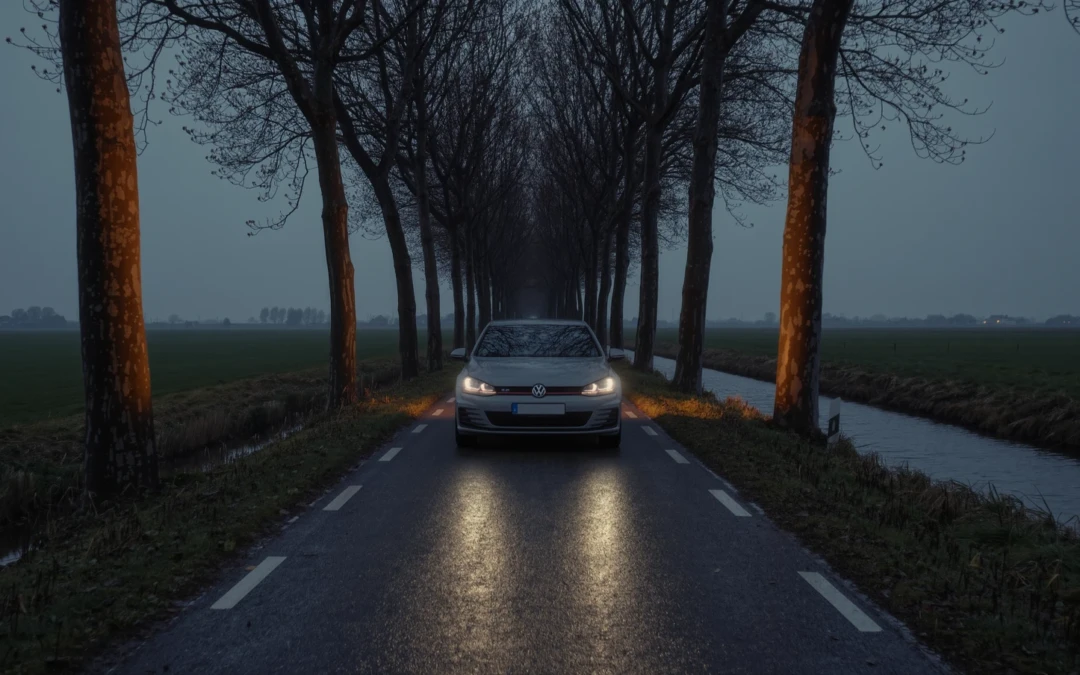
In short
- Dipped lights are required at night and by day when visibility is seriously reduced (RVV 1990, art. 32).
- Main beam is allowed, except by day, when you meet someone, and when you follow closely. Fog lights only in fog, snow or rain that seriously reduces visibility (art. 34).
- No dipped light at night costs €130 in a built-up area and €190 outside it, plus €9 administration costs.
The Dutch lighting rules for cars are short and strict. They say when a light must burn, when it may, and when it is forbidden. I read them in the Reglement verkeersregels en verkeerstekens 1990 (version from 1 July 2026) and the fine annex of the Wahv (version from 1 September 2026) on wetten.overheid.nl on 13 November 2026.
The rule in detail
- Art. 32, paragraph 1: drivers of motor vehicles must use dipped lights at night, and by day if visibility is seriously reduced.
- Art. 32, paragraph 2: you may use main beam instead of dipped lights, except by day, when you meet another road user, and when you follow another vehicle at a short distance.
- Art. 32, paragraph 3: the rear light and the number-plate light must burn at the same time as the main beam, dipped beam, parking light or fog light.
- Art. 34, paragraph 1: in fog, snow or rain that seriously reduces visibility you may use front fog lights, and then you do not need dipped lights.
- Art. 34, paragraph 2: the rear fog light may be used only when fog or snow limits visibility to less than 50 metres.
The text I read asks for dipped lights at night and in seriously reduced visibility. I found no sentence in the RVV that requires lights in normal daylight. Daytime running lights on the car itself are a vehicle-technical matter, and I did not read that regulation, so I make no claim about it.
The fines (car, category 1)
The amounts are from the annex to the Wahv, as indexed on 1 January 2026. The OM states that they exclude €9 administration costs.
- No dipped or main beam at night in a built-up area: €130. At night outside a built-up area: €190. By day when visibility is seriously reduced: €190 (art. 32, paragraph 1).
- Main beam when it is not allowed, so by day, when meeting someone or following closely: €190 (art. 32, paragraph 2).
- Rear light not burning: €130 at night in a built-up area, €190 outside it or by day in poor visibility (art. 32, paragraph 3).
- Number-plate light not burning: €65 (art. 32, paragraph 3).
- Front fog lights when there is no fog, snow or serious rain: €130 (art. 34, paragraph 1).
- Rear fog light when visibility is 50 metres or more: €190 (art. 34, paragraph 2).
Foreign drivers and rental cars
The RVV 1990 applies to every road user in the Netherlands, so the same rules and the same tariff apply to foreign and rental cars. I found no separate lighting rule for them. Check that the rear lights and the number-plate light work on a hire car before you leave the depot.
Mistakes I see most often
- Driving on parking lights at dusk because the road still looks bright. At night the law wants dipped beam.
- Leaving the rear fog light on after the fog has gone. It is a €190 line and it blinds the driver behind.
- Using main beam behind another car on a dark polder road. Following at a short distance is one of the banned cases.
Do the math: a dead number-plate bulb costs €65 + €9 = €74. Driving at night outside a town without dipped beam costs €190 + €9 = €199. Walk around the car once and look at every light, it takes a minute.
FAQ
Do I have to drive with lights on in daytime in the Netherlands? The RVV requires dipped lights at night and by day only when visibility is seriously reduced. I found no general daytime rule in that text.
Can I use fog lights in rain? Only in fog, snow or rain that seriously reduces visibility (art. 34, paragraph 1). Otherwise the fine is €130.
Is main beam allowed? Yes, but not by day, not when you meet another road user and not when you follow another vehicle closely.
Ivan’s Take
My view: lights are the cheapest safety item on a car and the cheapest fine to avoid. On flat Dutch roads with cyclists everywhere, I would rather be seen two seconds early. Dipped beam on as soon as the light fades, and a quick bulb check before every trip.
Sources: Reglement verkeersregels en verkeerstekens 1990 (art. 32-34), wetten.overheid.nl; Wet administratiefrechtelijke handhaving verkeersvoorschriften (annex, feiten R 421-R 436), wetten.overheid.nl; Openbaar Ministerie: Boetebase.
Published:
More from this section
The AvtoGear weekly
Once a week: new tests, the best deals and one useful tip for your car. Nothing extra.
