








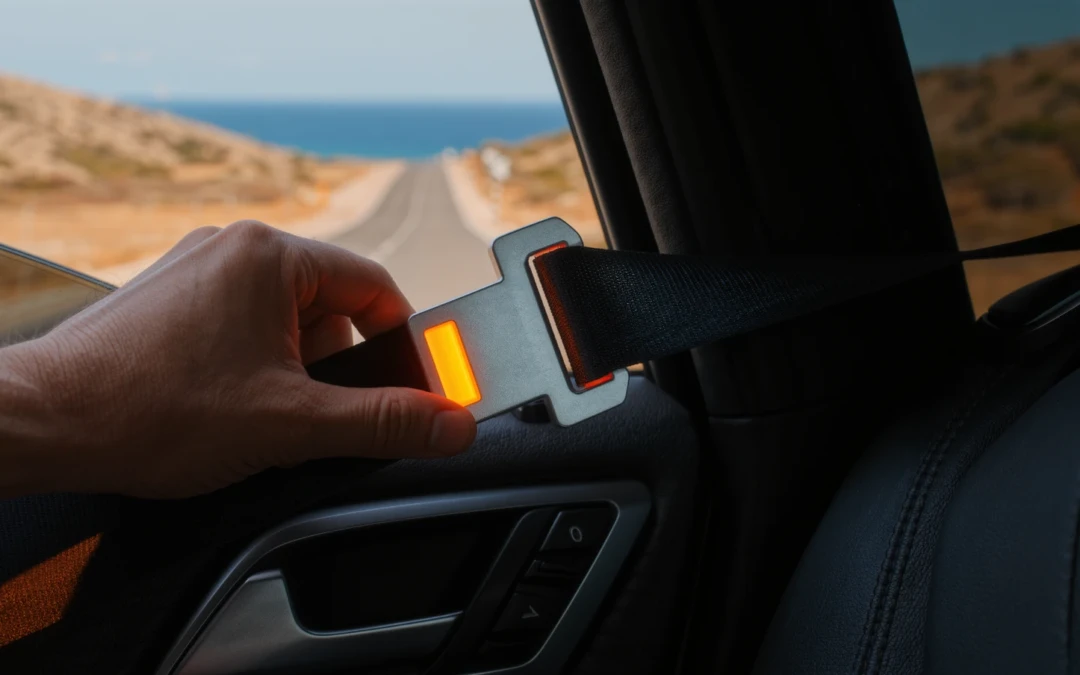
In short
- Occupants of cars and vans (categories M1, N1, N2, N3) must use the seat belts fitted in the vehicle (Road Safety Law 174/1986, art. 15).
- Only a medical exemption certificate issued by the Registrar, or a medical certificate from an EU member state, excuses you, and you must show it on request (art. 16).
- Court maximum for not wearing a belt: up to 6 months and/or €2,000 (art. 17(2)). An owner who does not keep the belts fitted: up to 3 months and/or €1,000 (art. 17(1)).
Cyprus drives on the left, but belts work the same way: click it every trip. I read the consolidated Road Safety Law of 1986 (174/1986) on cylaw.org, with amendments up to 103(I)/2026. Part III covers seat belts, and it applies to visitors as well.
The rule in detail
Article 14(2) says every registered motor vehicle in the categories covered by the law must carry belts or restraint systems firmly attached to fixed points on the vehicle frame, for the driver and the people in all seats. The same subsection says this applies to vehicles driving in Cyprus on plates of a country that is not an EU member state, so a car brought from outside the EU is not exempt. The Registrar can grant a permit for exemptions in specific cases, for example where fitting belts is technically impossible (art. 14(3)).
Article 15(1) says occupants of vehicles in categories M1, N1, N2 and N3 that are in use must use the safety systems fitted in them. For buses and coaches (M2 and M3), art. 15A requires every seated person aged three or over to use the belts fitted, forbids carrying a child in the front seat, and art. 15B requires the driver or co-driver, or the group leader, to tell passengers that belts are compulsory while the vehicle moves.
Belts and restraints approved by the competent authority of an EU member state count as meeting the law (art. 12(2)). Children under 150 cm in these vehicles must be restrained with a child restraint suited to their weight (art. 15(2)); art. 15(7) sets which children may use an adult belt. For the full rules on children I point you to the separate guide on child seats.
Medical exemption
A person given a certificate by a doctor that, for serious health reasons, they should not use a belt or restraint, permanently or for a period, is excused for that period from the duties in arts. 15 and 15A. The Registrar issues the exemption certificate (art. 16(1)). A medical certificate of exemption issued by the competent authority of an EU member state is treated as meeting this rule (art. 16(2)). You must show the certificate whenever a police officer or other competent official asks; refusing or failing to show it at once, or within the time set, counts as breaking arts. 15 and 15A (art. 16(4)).
Penalties
- Occupant not using the belt (art. 15(1), 15A, 15B), art. 17(2): up to 6 months and/or €2,000.
- Driver who allows or tolerates a child not being restrained as required (art. 17(3)): up to 6 months and/or €2,000.
- Owner or keeper who refuses or neglects to keep belts fitted as art. 14(2) requires (art. 17(1)): up to 3 months and/or €1,000.
- Repeat offence within 3 years of a conviction (art. 17(6)): the court may impose double the penalties.
- Disqualification (art. 18): for convictions under art. 17(2) and (3), the court may bar you from holding or obtaining a driving licence for up to 3 months.
These are court maximums. The Out-of-Court Settlement Law 47(I)/1997 also lists not using a seat belt among its fixed-notice offences, with notice amounts capped between €8 and €500 (art. 3(3)). Its Table II, item 12 sets the fixed fine at €150, or €300 if the same person repeats the offence within 3 years of the first notice, and the officer may also offer the minimum 3 penalty points (Law 86/1972, art. 20A).
Mistakes I see most often
- Skipping the belt on a short drive. Art. 15(1) names no distance exception; the exemption I found is the medical certificate (art. 16).
- Forgetting the back seat. The law applies to occupants in all seats that have belts, not only the front ones.
- Letting a child ride unrestrained because the trip is short. The driver who tolerates it faces art. 17(3).
Do the math: Clicking the belt takes about a second. The court ceiling for not wearing it is €2,000 or 6 months, and the court can add a licence ban of up to 3 months (art. 17(2), art. 18). Double that if you repeat within 3 years (art. 17(6)).
FAQ
Does the law apply to a rental or foreign-plated car? Art. 14(2) applies to vehicles with plates of non-EU countries, and art. 15(1) applies to occupants of vehicles in use. Nothing in the text I read exempts visitors.
Can I use a medical certificate from my home country? Art. 16(2) accepts a medical exemption certificate issued by the competent authority of an EU member state. For other countries, ask the Road Transport Department before you travel.
Who is responsible if a child is not buckled? The driver who allows or tolerates it, under art. 17(3), and an accompanying adult in the cases listed in art. 17(4).
Where to check
Road Safety Law 174/1986 (art. 12–18) and Law 47(I)/1997 on cylaw.org; Road Transport Department of Cyprus, mcw.gov.cy/rtd.
Ivan’s Take
There is no clever angle here: the belt is the cheapest safety equipment in the car, and the law backs it with a €2,000 ceiling and a possible licence ban. I treat the click as part of starting the engine, and I check that every passenger has done it before I pull out.
Sources: Cyprus Law 174/1986 – Road Safety Law (cylaw.org); Cyprus Law 47(I)/1997 – Out-of-Court Settlement of Offences Law (cylaw.org); Road Transport Department of Cyprus.
Published:
More from this section
The AvtoGear weekly
Once a week: new tests, the best deals and one useful tip for your car. Nothing extra.
