








In short
- If nobody is visibly hurt, police are not needed and the cars can be driven, section 14B of Law 86/1972 says the cars are moved to the nearest point so they do not block traffic.
- Before moving: call your insurer, exchange names, policy numbers, licence numbers, vehicle details and phone numbers, and photograph the final positions, plates and damage.
- Skipping this is an offence with a fine of up to €1,000. Moving the car is not an admission of fault and is not leaving the scene. Cyprus drives on the left.
Cyprus has a specific rule for the common case: a small bump in traffic. It tells you to clear the road, but only after you have done the paperwork on the spot, with your phone. Here is what section 14B says.
When the rule applies
Section 14B of the Motor Vehicles and Road Traffic Law 86/1972 covers a collision between motor vehicles on any road, including open spaces, squares and public places, when all of these are true:
- nobody involved has visible bodily injuries
- the police do not need to attend or be present
- the vehicles can be moved without towing and without causing more damage to them or the road
- moving them is reasonable in the circumstances at that moment
Then the vehicles that can move are moved to the nearest point so that other traffic is not obstructed. The move is made by the drivers, or by another person with a valid licence and insurance cover, on the driver’s instruction. ‘Reasonable’ takes into account the traffic, the time and day, and, on motorways and expressways, the safety of those involved and other users (s.14B(5)).
What to do before you move the cars
- Inform your insurance company immediately.
- Exchange names, insurance policy certificate numbers, driving licence numbers, vehicle details and phone numbers.
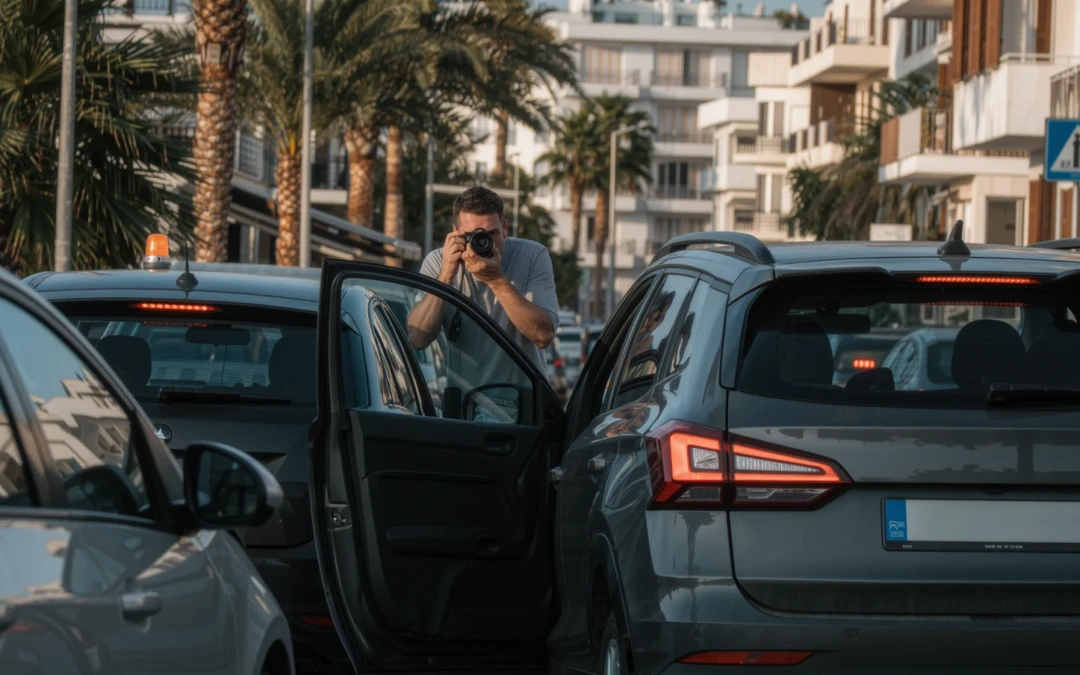
- Take photographs quickly: the cars in their final positions, the registration numbers, the damage and the surroundings. Keep to data minimisation under the GDPR.
- Exchange the photos and send them to the person your insurer indicates.
If a driver cannot take photos, they can ask the other driver, a person they trust, or the insurer’s representative to take them.
What the law protects
- Moving a vehicle is not an acceptance of liability (s.14B(2)).
- Moving it is not a breach of a condition in your insurance policy (s.14B(3)).
- If you had no visible injury, moving the car does not take away your right to claim compensation later from the party at fault.
- Moving vehicles is not treated as leaving the scene.
When the rule does not apply
Sections 14B(1) and (2) do not apply if an uninsured vehicle or a government vehicle is involved, or if any driver leaves the scene. Then the ordinary rules apply, and police should be called. I did not find in the text a general rule about when police must be called for every accident, so I do not state one.
Penalties
- Breaking s.14B(1) or (2): a fine of up to €1,000 (s.14B(4A)).
- Pushing or forcing a driver to break them: also up to €1,000 (s.14B(4B)).
- Using the data and photos for any other purpose breaches the GDPR and Cyprus data protection law, with administrative fines possible (s.14B(4)).
- Leaving the scene of an accident without helping: 5 to 10 penalty points (Penal Code section 235A, in the points table of s.20A), and a court can disqualify up to 3 months (s.19).
- Causing death by a reckless, rash or dangerous act: 5 to 10 points, and disqualification up to 2 years (s.19, s.20A).
- Leaving a vehicle on a road in a dangerous position: up to 3 months and/or €1,000 (s.14), and 1 to 2 points.
Alcohol and drug tests after a crash
After a traffic accident police can ask anyone they reasonably believe was driving for a breath sample (Road Safety Law 174/1986, s.6(3)) or a saliva sample for drugs (s.11C(3)). Refusing is an offence. Do not drive on after a crash if you have had a drink.
Foreign drivers and rental cars
Section 14B has no exception for foreign plates or visitors; the exchange of details and photos is the same. If a police officer asks the owner of a vehicle who was driving, the owner must give the information (Law 86/1972, s.21), so a rental company will name you. Tell the rental company about the crash too; I could not verify from an official text what your rental contract requires.
Mistakes I see most often
- Driving off the carriageway first and talking later: the law wants the exchange and photos before the move.
- Photographing people instead of the scene, then sharing the images widely.
- Leaving because ‘it is only a scratch’: if you leave, the protections in s.14B do not apply.
Do the math: The whole procedure takes a few minutes on your phone. Skipping it can cost up to €1,000 per driver, and leaving the scene adds 5 to 10 points, a third to two thirds of the 16-point limit that lets a court take your licence.
FAQ
Do I admit fault by moving my car? No. Section 14B says moving the vehicle is not an assumption of liability and does not breach your insurance policy.
What if the other car has no insurance? The simplified procedure does not apply; call the police and do not move on your own.
Can I post the photos online? The data may be used only for the purposes in section 14B, and misuse can lead to GDPR penalties.
Where to check
cylaw.org: Law 86/1972, sections 14, 14B, 19, 20A and 21 (consolidated to 77(I)/2026), and Road Safety Law 174/1986, sections 6 and 11C (to 103(I)/2026).
Ivan’s Take
This is one of the sensible rules in Cypriot law: it tells you to clear the road, but forces you to document first. My advice is simple: photograph before you move, always, and let your insurer have the pictures the same day.
Sources: Law 86/1972 Motor Vehicles and Road Traffic, s.14, 14B, 19, 20A, 21 (CyLaw, consolidated to 77(I)/2026); Road Safety Law 174/1986, s.6 and 11C (CyLaw, consolidated to 103(I)/2026).
Published:
More from this section
The AvtoGear weekly
Once a week: new tests, the best deals and one useful tip for your car. Nothing extra.
