








In short
- At roundabouts you give priority to traffic coming from your right, unless signs, markings or lights say otherwise.
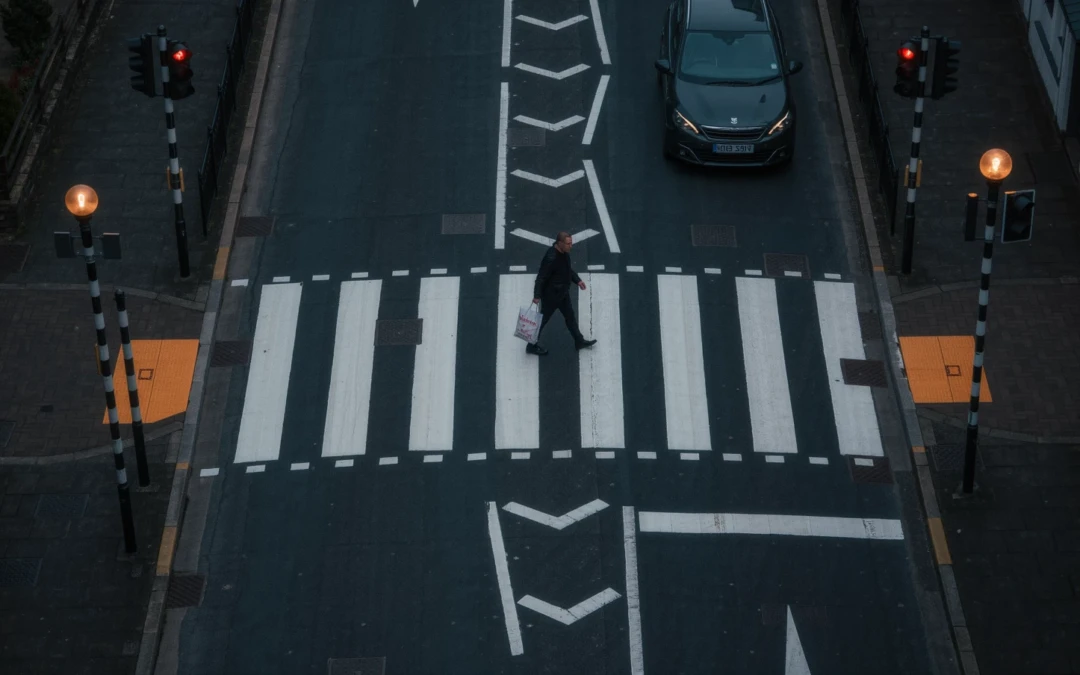
- You must give way to pedestrians on a zebra crossing, and since the 2022 update of the Highway Code you should give way to pedestrians waiting to cross a road you are turning into or out of.
- Pedestrian crossing and traffic sign offences carry 3 penalty points; failing to obey a traffic sign can cost up to £1,000 (€1,197) in court.
Driving on the left is the easy part. The hard part is who goes first. British roundabouts turn clockwise, so the danger comes from the right. And since January 2022 the Highway Code has a hierarchy of road users that puts pedestrians and cyclists first at junctions. Many foreign drivers have never heard of it.
The hierarchy of road users (rules H1 to H3)
Rule H1 says those in charge of vehicles that can cause the greatest harm bear the greatest responsibility to reduce the danger they pose. That means lorries and buses first, then vans, cars and motorcycles. Two practical rules follow:
- Rule H2: at a junction you should give way to pedestrians crossing or waiting to cross a road into which or from which you are turning. On a zebra crossing you must give way. On a parallel crossing you must give way to pedestrians and cyclists.
- Rule H3: do not turn across cyclists, horse riders or horse-drawn vehicles going straight ahead, including in a cycle lane or on a roundabout. Wait for a safe gap.
Junctions and give way lines
Rule 172: you must give way to traffic on the main road when you emerge from a junction with broken white lines across the road. This is a legal requirement under section 36 of the Road Traffic Act 1988.
Roundabouts (rules 184 to 190)
- When you reach the roundabout, give priority to traffic approaching from your right, unless signs, markings or traffic lights tell you otherwise (rule 185).
- First exit left: signal left, approach in the left lane, keep left and keep signalling to leave.
- Exit to the right or full circle: signal right, approach in the right lane, keep right, then signal left after the exit before the one you want.
- Intermediate exits: choose the right lane on approach, normally without a signal, and signal left after the exit before yours.
- Give priority to cyclists on the roundabout and do not overtake them within their lane (rule 186). Treat each mini-roundabout separately.
Pedestrian crossings (rules 191 to 199)
- Zebra crossings: give way to pedestrians waiting to cross. You must give way once a pedestrian has moved onto the crossing (rule 195). Do not wave or flash pedestrians across.
- Zig-zag lines: you must not park on a crossing or on the zig-zags, and you must not overtake the moving vehicle nearest the crossing or the vehicle that has stopped for pedestrians (rule 191).
- Pelican crossings: you must stop on red. On flashing amber you must give way to pedestrians on the crossing (rule 196). A pelican crossing that goes straight across is one crossing, even with a central island (rule 197).
- Puffin, toucan and equestrian crossings have no flashing amber. They work like traffic lights (rule 199).
Points and fines
- Pedestrian crossing offences: 3 penalty points (codes PC10, PC20, PC30).
- Traffic lights, stop signs, double white lines and other traffic signs: 3 points (TS10 to TS70). Failing to obey a traffic sign under RTA section 36 carries a maximum level 3 fine, £1,000 (€1,197).
- Careless driving, for example cutting up a cyclist: a £100 (€120) fixed penalty under the Fixed Penalty Order 2000, or 3 to 9 points (CD10) on conviction.
The Highway Code says that rules with should are not offences on their own. But the Code can be used as evidence in court to establish liability, so ignoring rule H2 can cost you after a collision.
Foreign drivers and rental cars
- Clockwise roundabouts: look right before you enter, then keep looking right.
- From a left-hand-drive car the view to the right at a junction is harder. Creep forward slowly.
- Pedestrians in the UK expect drivers to stop at zebras. They will step out.
Mistakes I see most often
- Looking left at a roundabout out of habit.
- Overtaking a car that has stopped before a zebra crossing. That car is stopped for a reason.
- Turning left across a cyclist in a cycle lane. Rule H3 says wait.
Do the math: Do the math: 3 points for one missed zebra crossing, 3 for a red light. Four such moments in 3 years and you reach 12 points and a ban of at least 6 months. Waiting five seconds for a pedestrian costs nothing.
FAQ
Who has priority at a UK roundabout? Traffic coming from your right, already on or approaching the roundabout, unless signs or markings say otherwise.
Do I have to stop for pedestrians waiting at a zebra crossing? The Highway Code says you should give way to them. Once they step onto the crossing you must.
Do pedestrians have priority at junctions in the UK? Since 2022 the Code says you should give way to pedestrians crossing or waiting to cross the road you are turning into or out of.
Where to check
The Highway Code on GOV.UK: introduction (rules H1 to H3) and Using the road (rules 159 to 203); Road Traffic Act 1988 section 36; endorsement codes on GOV.UK Penalty points; Fixed Penalty Order 2000 and Road Traffic Offenders Act 1988 on legislation.gov.uk. Pounds at the Bank of England rate of 11 November 2026: £1 = €1.1969.
Ivan’s Take
At a British roundabout I say it out loud: look right. It sounds silly, but habits from home are stronger than any sign. And at a zebra I stop when someone is waiting, not when they are already on the stripes.
Sources: The Highway Code: introduction, rules H1 to H3 (hierarchy of road users); The Highway Code: Using the road, rules 159 to 203 (junctions, roundabouts, crossings); Road Traffic Act 1988, section 36 (traffic signs); GOV.UK: Penalty points (codes PC, TS, CD); Fixed Penalty Order 2000, Schedule 1; Road Traffic Offenders Act 1988, Schedule 2; Bank of England: GBP/EUR spot rate 11.11.2026.
Published:
More from this section
The AvtoGear weekly
Once a week: new tests, the best deals and one useful tip for your car. Nothing extra.
