








In short
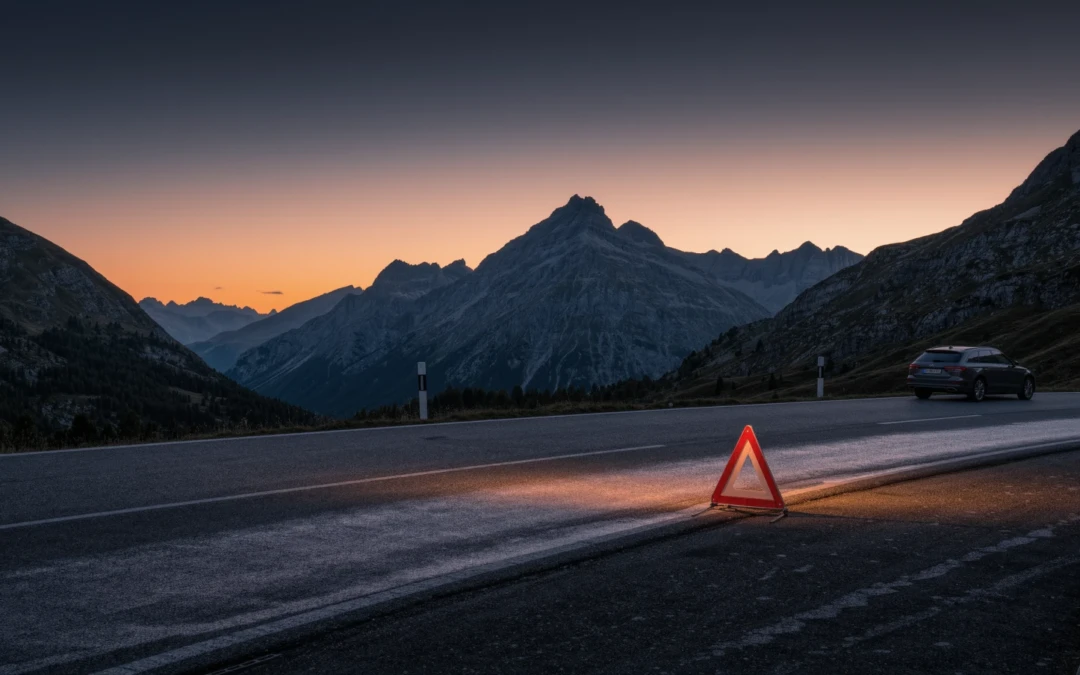
- A passenger car must carry a warning triangle tested to UNECE Regulation No. 27 or No. 150 (Art. 90 para. 2 VTS).
- Not carrying it is a fixed fine of CHF 40, about €43.37 (OBV Annex 1, no. 400.1).
- A first-aid kit is compulsory only in coaches and a fire extinguisher only on heavy goods vehicles. I found no rule for a reflective vest in a car.
Drivers arrive in Switzerland with a boot full of “mandatory equipment” from other countries. The Swiss list for a passenger car is shorter than you think. This is what the two federal ordinances say, in the versions in force on 17 November 2026, and what they leave out.
The warning triangle
Art. 90 para. 2 of the Ordinance on the Technical Requirements for Road Vehicles (VTS, SR 741.41, version of 1 October 2026): motor vehicles wider than 1.00 m must carry a warning triangle that is tested and marked under UNECE Regulation No. 150 or No. 27. Motorcycles, with or without a sidecar, and a few special vehicle types are excluded. Art. 36a para. 2 VTS confirms that the rule also applies to vehicles with EU type-approval.
Art. 23 of the Traffic Rules Ordinance (VRV, SR 741.11, version of 1 October 2026) says how to use it:
- It must be easy to reach inside the vehicle (para. 1).
- Put it at the roadside as soon as a vehicle has to stand on the roadway against the rules for compelling reasons, and to mark a vehicle stopped on a hard shoulder (para. 2).
- Distance: at least 50 m behind the vehicle, at least 100 m on roads with fast traffic. On a hard shoulder it goes at the right edge.
- No triangle is needed when you stop in a signposted emergency bay (sign 4.16).
- Hazard lights are for warning of danger only. On a standing vehicle they come in addition to the triangle. On a moving vehicle they are allowed, for example, before an unexpected accident site or a tailback, and when towing on motorways (para. 3).
- A towed vehicle carries the triangle on its rear (para. 6).
What is not compulsory in a car
I searched the VTS and VRV for each item below. The VTS requires only:
- A first-aid kit in coaches, with a valid expiry date and to DIN 13164 (Art. 123 para. 4 VTS). Not for cars.
- One or more fire extinguishers, 6 kg in total, on heavy goods motor vehicles (Art. 114 para. 2 VTS). Not for cars.
- A wheel chock on heavy motor vehicles (Art. 114 para. 1) and on trailers over 0.75 t (Art. 195 para. 3 VTS).
I found no provision requiring a reflective vest, spare bulbs or a tow rope in a passenger car, and the fixed-fine list has no entry for them. That is not advice to leave them at home. It only means the Swiss texts do not make them compulsory.
Fines
Fixed fines (Ordinance on Fixed Fines, OBV, SR 314.11, version of 1 August 2026, Annex 1). Euro amounts use the Swiss National Bank’s daily rate of 17 November 2026: 1 EUR = 0.9222 CHF.
- Not carrying the warning triangle (no. 400.1): CHF 40 (about €43.37).
- Not carrying a required fire extinguisher, first-aid kit in a coach or wheel chock (no. 400): CHF 40 each (about €43.37).
- Number plates not mounted as prescribed (no. 401): CHF 60 (about €65.06).
You may pay at once or within 30 days. Without a Swiss domicile you must deposit the amount or give security if you do not pay at once (Art. 6 and 10 of the Fixed Fines Act, OBG, SR 314.1).
Foreign cars and rental cars
Art. 36a para. 4 VTS says foreign vehicles must meet the technical requirements of this part, unless it sets stricter requirements than the international agreements or the law of the state of registration. Whether your foreign car must carry a triangle therefore depends partly on your home rules. The safe choice is simple: carry one. In a rental car, look in the boot before you drive off.
Mistakes I see most often
- A triangle without the UN approval mark. The VTS asks for a tested and marked one.
- Setting it up too close. The VRV says 50 m, and 100 m on fast roads.
- Using only the hazard lights on a standing vehicle. The VRV says they come in addition to the triangle.
Do the math: One missing triangle is CHF 40 (about €43.37). A compliant triangle is a small one-off purchase, and I quote no shop price because it is not an official figure. Paying the fine does not put a triangle in the boot, so you pay again at the next check.
FAQ
Is a reflective vest compulsory in Switzerland? I found no such rule in the VTS or the VRV, and the fixed-fine list has no entry for it.
Do I need a first-aid kit in my car? Not under the VTS. It requires one only in coaches (Art. 123 para. 4).
How far behind the car do I put the triangle? At least 50 m, and at least 100 m on roads with fast traffic (Art. 23 para. 2 VRV).
Where to check
Federal law on fedlex.admin.ch: VTS (SR 741.41), VRV (SR 741.11), OBV (SR 314.11), OBG (SR 314.1), read in the versions in force on 17 November 2026.
Ivan’s Take
Switzerland asks for less than your neighbours do, and I like that. But I would still keep a vest and a kit in the car. They cost little and the law not requiring them is not the same as the road not needing them. The triangle is the one thing the fine list will not forgive.
Sources: Verordnung über die technischen Anforderungen an Strassenfahrzeuge VTS (SR 741.41), Stand 1.10.2026; Verkehrsregelnverordnung VRV (SR 741.11), Stand 1.10.2026; Ordnungsbussenverordnung OBV (SR 314.11), Stand 1.8.2026; Ordnungsbussengesetz OBG (SR 314.1), Stand 1.1.2025; SNB: Devisenkurse (Tageskurs 17.11.2026, 1 EUR = 0.9222 CHF).
Published:
More from this section
The AvtoGear weekly
Once a week: new tests, the best deals and one useful tip for your car. Nothing extra.
