








In short
- Art. 164 of the Italian Highway Code: the load must not fall, block your view, upset stability or hide lights and number plates. It may stick out at the rear up to 3/10 of the vehicle’s length, never at the front.
- Any rear overhang must be marked with a square red-and-white retroreflective panel of at least 2,500 cm² (50 × 50 cm), and sideways the load may stick out at most 30 cm beyond the position lights.
- Breaking the rule costs €87–344 and 3 points, and the police can stop you until the load is fixed, holding licence and registration.
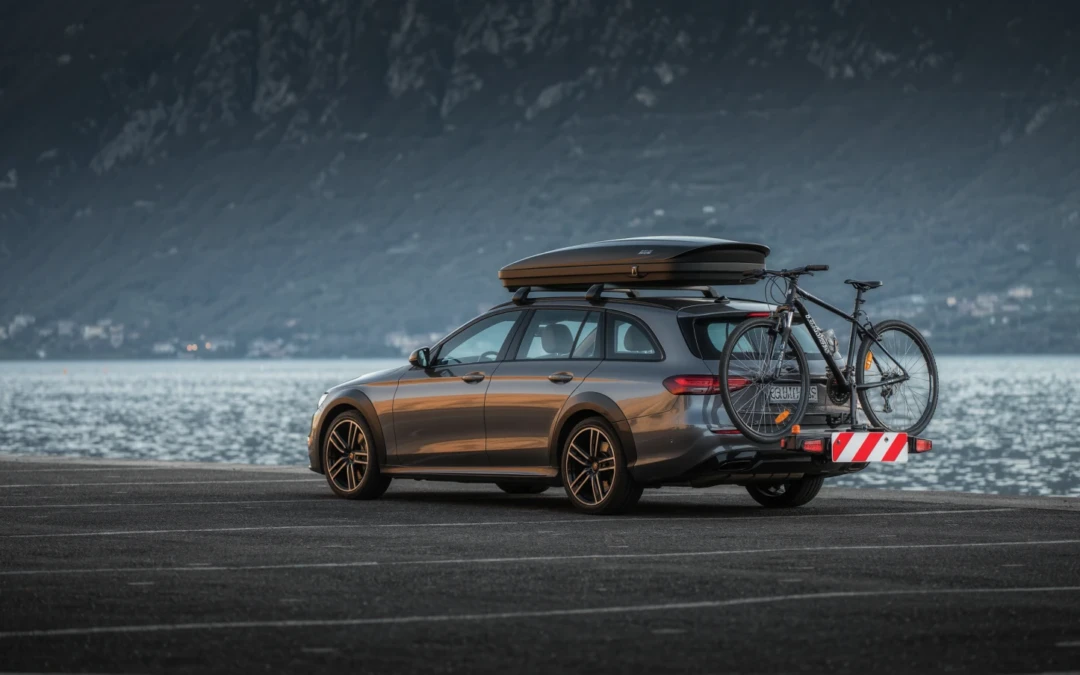
Bikes on the back, a roof box on top, Italy in August. Every summer that picture ends at a police check because of one missing thing: the red-and-white panel. In Italy it is not decoration, it is the law, and without it the trip stops on the spot.
The rule in detail
Article 164 of the Codice della Strada (Legislative Decree 285/1992, consolidated text on normattiva.it) governs every load, including bikes on a carrier and luggage in a roof box. Under paragraph 1 the load must be arranged so that it does not fall or scatter, does not reduce the driver’s visibility or freedom of movement, does not compromise the stability of the vehicle and does not mask lights, signalling devices, number plates or arm signals.
- Front: the load may not stick out at the front at all (art. 164(2)).
- Rear: indivisible items may stick out at the rear up to 3/10 of the vehicle’s length, within the size limits of art. 61 (2.55 m width, 4 m height).
- Sides: up to 30 cm on each side, measured from the front and rear position lights (art. 164(3)). Poles, bars or sheets carried horizontally may not stick out sideways at all.
- Moving parts: accessories may not swing outside the vehicle’s outline or drag on the ground (art. 164(4) and (5)).
The red-and-white panel
If the load sticks out beyond the vehicle’s outline, the overhang must be marked with one or two special square panels of retroreflective material, placed at the end of the overhang and always perpendicular to the vehicle axis (art. 164(6)). The implementing regulation (Presidential Decree 495/1992, art. 361) sets the panel: at least 2,500 cm², white and red stripes at 45°, class 2 reflective film, visible by day and night. If the load overhangs the full width of the rear, two panels are needed, one at each end. Since 1 January 2021 new panels on the market must carry a declaration of performance under EU Regulation 305/2011, while older approved panels in use stay valid.
Do roof boxes and racks need approval?
No. The Polizia di Stato explains in its magazine Polizia Moderna that roof racks and roof boxes, even if fixed permanently, are not subject to approval for the vehicle type, and a removable rear bike carrier needs no technical approval and no entry in the registration document. But the same article is clear: under art. 164 the driver is responsible for a correct and solid installation, for not covering the rear lights or the plate, for marking the rear overhang with the striped panel and for keeping the sideways overhang within 30 cm.
Fines and consequences
- Any breach of art. 164: €87 to €344 (art. 164(8)); €60.90 if paid within five days (art. 202).
- Points: 3 (points table of art. 126-bis).
- Trip stopped: you may not continue until the load is fixed. The police withdraw the registration document and the licence on the spot and return them once the load complies (art. 164(9)).
Foreign drivers and rental cars
The rule applies to every vehicle in Italy, so a panel is needed even if your home country does not require one. With a car registered abroad, art. 207 lets you pay the reduced amount on the spot; otherwise you leave a deposit, equal to the reduced amount for EU and EEA cars, or the car is held for up to 60 days. Buy the panel before the trip, not at the border.
Mistakes I see most often
- No panel on the bike carrier because “the bikes don’t stick out much”. Any rear overhang needs it.
- Bikes covering the plate or a rear light. Art. 164(1) forbids masking them.
- Handlebars sticking out more than 30 cm beyond the position lights on the side.
- Straps that work loose. The driver answers for the fixing, not the shop that sold the rack.
Do the math: Do the math: A compliant striped panel is a one-off purchase you keep for years. Without it you risk €87 to €344 and 3 points, and the trip ends at the roadside until the load complies, while the police hold your licence and registration. Add the lost hours and the panel is the cheapest thing on your car.
FAQ
Do I need the panel for a roof box? Only if the load sticks out beyond the vehicle outline. A box that stays within the roof does not overhang. A rear bike carrier usually does.
How big must the panel be? At least 2,500 cm², so 50 × 50 cm, with red and white stripes at 45° in retroreflective material.
Does the bike carrier need to be in the registration document? According to the Polizia di Stato, a removable rear carrier needs no approval and no entry. The driver is responsible for fitting it correctly.
Where to check the official rules
Read articles 61, 164, 126-bis (points table), 202 and 207 of the Codice della Strada and article 361 of the regulation (DPR 495/1992) on normattiva.it, and the Polizia di Stato article “Veicoli fai da te” in Polizia Moderna.
Ivan’s Take
I treat the panel like the seat belt: it goes on before the engine starts. Two straps, the panel, a look at plate and lights, a check after the first 50 km. Five minutes against a day lost at the roadside.
Sources: Normattiva – Codice della Strada art. 164 (sistemazione del carico); Normattiva – Codice della Strada art. 61 (sagoma limite); Normattiva – DPR 495/1992 art. 361 (pannelli sporgenza carico); Normattiva – Codice della Strada art. 126-bis (tabella punteggi); Normattiva – Codice della Strada artt. 202 e 207; Polizia di Stato – Polizia Moderna, “Veicoli fai da te”.
Published:
More from this section
The AvtoGear weekly
Once a week: new tests, the best deals and one useful tip for your car. Nothing extra.
