








In short
- Stay with the car. ADAC: do not walk off, closures can clear fast, and the hard shoulder is not yours to use.
- The real danger is a blocked exhaust. Clear snow from the tailpipe before you run the engine for heat, and crack a window.
- Idling for heat uses about 0.8–1.2 litres an hour (ADAC). ADAC’s test: small EVs could heat for about 15–17 hours on a full battery.
Every winter it happens somewhere in Europe. Heavy snow, a lorry sideways, the motorway closed for hours. You are not in danger because of the cold alone. You are in danger if you do the wrong thing out of boredom or panic. Here is the plan.
The first 10 minutes
- Form the rescue lane as soon as traffic slows. In Germany and Austria this is the law, and ADAC says it applies the moment traffic stalls.
- Hazard lights on if you are at the end of the queue. At night keep your sidelights on so others see you.
- Turn on the radio or a traffic app. Closures are announced there first.
- Check your fuel or battery level and plan with it.
Stay with the car
ADAC is blunt about it. Do not leave the car to walk out, and stay close to it. A full closure can be lifted quite quickly and then your car blocks everyone. The hard shoulder is for emergency services, not for you.
If you really need help, call 112. It works across the EU, also without a local SIM.
The silent danger: a blocked exhaust
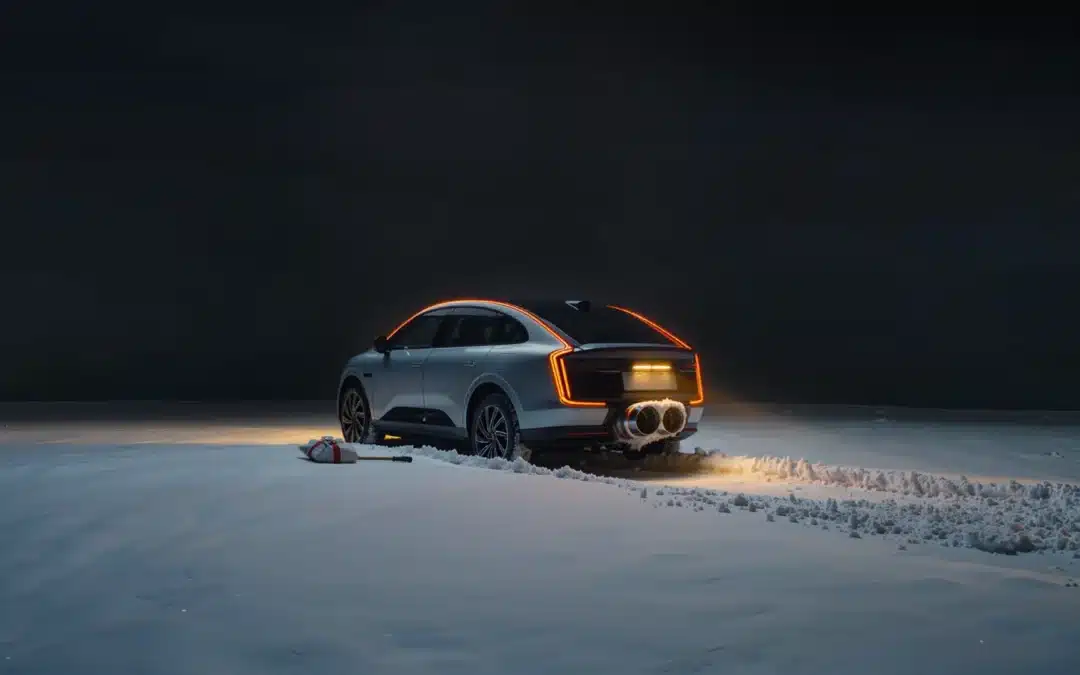
Snow piling up behind the car can block the tailpipe. Then exhaust gas, including carbon monoxide, can get into the cabin. You cannot smell it. US road safety authorities such as NHTSA advise clearing the exhaust of snow and running the engine only from time to time. The Michigan State Police give a concrete figure: 5 to 10 minutes per hour, with a window slightly open. Car makers add one more point in their manuals: clear snow from around the base of the car too, not only the pipe.
How long your fuel or battery lasts
ADAC puts the fuel use of a petrol or diesel car standing with the heater on at about 0.8 to 1.2 litres per hour, depending on the model. A full tank is not a problem. A tank on reserve is.
Electric cars do better than most people think. In an ADAC test a Renault Zoe and a VW e-up stood overnight at minus 9 to minus 14 °C with the cabin at 22 °C, seat heating on and sidelights on. After 12 hours the Zoe had used about 70 percent of its battery, the e-up about 80 percent. That is roughly 17 and 15 hours of heating. Start with a full battery and it is enough.
Do the math: Ten hours stuck with a petrol or diesel car: 8 to 12 litres at ADAC’s 0.8–1.2 L/h. If fuel costs you €1.70 a litre, that is about €14–20. Cheap insurance. Running the heater in short bursts with a blanket on your legs cuts it further. The expensive part is running out of fuel and needing a tow.
Stay warm without wasting fuel
- Blankets and warm clothes do most of the work. ADAC Saxony names blankets and warm drinks first.
- Use seat heating instead of high cabin heat. In an EV, ADAC also recommends recirculation, a lower temperature and switching off rear window heating, wipers and dipped beam.
- Keep doors and windows shut except for the small gap while the engine runs.
- Small children cool down fastest. Keep them in the middle of the car, dressed in layers.
What to keep within reach
ADAC’s winter list: tow rope, snow chains, jump leads, a spare fuel can, screen antifreeze and de-icer spray, ice scraper and hand brush, a shovel and sand, gloves and a wool blanket. Its point is simple. A blanket at the bottom of a full boot does not help you. Put it where you can reach it from the seat.
Mistakes to avoid
- Running the engine non-stop with snow building up behind the car.
- Walking along the motorway in the dark to look for the cause.
- Starting a long winter trip with a quarter tank. ADAC Saxony advises at least a third full even for short trips in heavy snow.
- Using the hard shoulder to escape the queue.
FAQ
Should I turn the engine off completely? Not necessarily. Run it in short bursts for heat, with a clear exhaust and a window cracked, then switch off and rely on blankets.
Is an EV more dangerous in a winter jam? ADAC’s test says no, as long as the battery is reasonably full at the start.
When should I call 112? If someone is cold and cannot warm up, feels dizzy or sick, or if your fuel or battery is nearly gone.
Ivan’s Take
I keep a blanket and a small shovel in the cabin, not under the luggage. For about €20 of fuel you can sit out a whole night in a jam, so never start a winter trip on reserve. And the one rule I would never break: check the tailpipe before you run the engine.
Sources: ADAC Sachsen; ADAC (EV winter jam test); Auto Bild / ADAC fuel use; Michigan State Police.
Published:
More from this section


The AvtoGear weekly
Once a week: new tests, the best deals and one useful tip for your car. Nothing extra.
