








In short
- German insurers counted about 276,000 wildlife collisions in 2025, more than 750 a day. The average claim rose to about €4,400 (GDV).
- After the crash: hazard lights, vest, warning triangle, call the police. You need their wildlife accident certificate for the insurer.
- Partial casco usually pays for a hit with game animals. Swerve into a tree without touching the animal and often only full casco pays.
October to December is peak season. Clocks go back, rush hour moves into the dusk, and deer, boar and foxes cross exactly when you drive home. German insurers paid out €1.215 billion for wildlife collisions in 2025. The number of crashes barely changed. The cost per crash did. Here is how to stay out of that statistic, and what to do if you can’t.
When and where it happens
According to ADAC, the risk peaks in April and May and again from October to December. Dusk, night and fog are the worst times. Roads along forests and fields are the worst places.
The roe deer is involved in about every second wildlife accident in Germany, according to the German hunting association data ADAC quotes. And they rarely come alone. One deer crosses, two more follow.
How to avoid a collision
- Slow down where the forest meets the road, even without a warning sign. Every km/h less shortens your stopping distance.
- Watch the verges, not just the lane. Eyes reflect your headlights long before you see the animal.
- Animal on the road edge? Brake hard, dip your high beam and use the horn. High beam blinds the animal and it freezes or jumps.
- Expect a second and third animal after the first.
- Keep both hands on the wheel and brake in a straight line.
Why you should not swerve
ADAC’s rule is clear: better a controlled impact than an uncontrolled swerve. A deer hits your bumper and bonnet. A tree, oncoming truck or ditch can kill you.
There is also money on the line. Partial casco usually pays only when you actually hit a game animal. Swerve, miss the deer and hit a guardrail, and many policies treat it as your own crash. Then only full casco pays, and your no-claims bonus goes with it.
What to do after you hit an animal
- Stay calm. Hazard lights on, high-vis vest on before you step out.
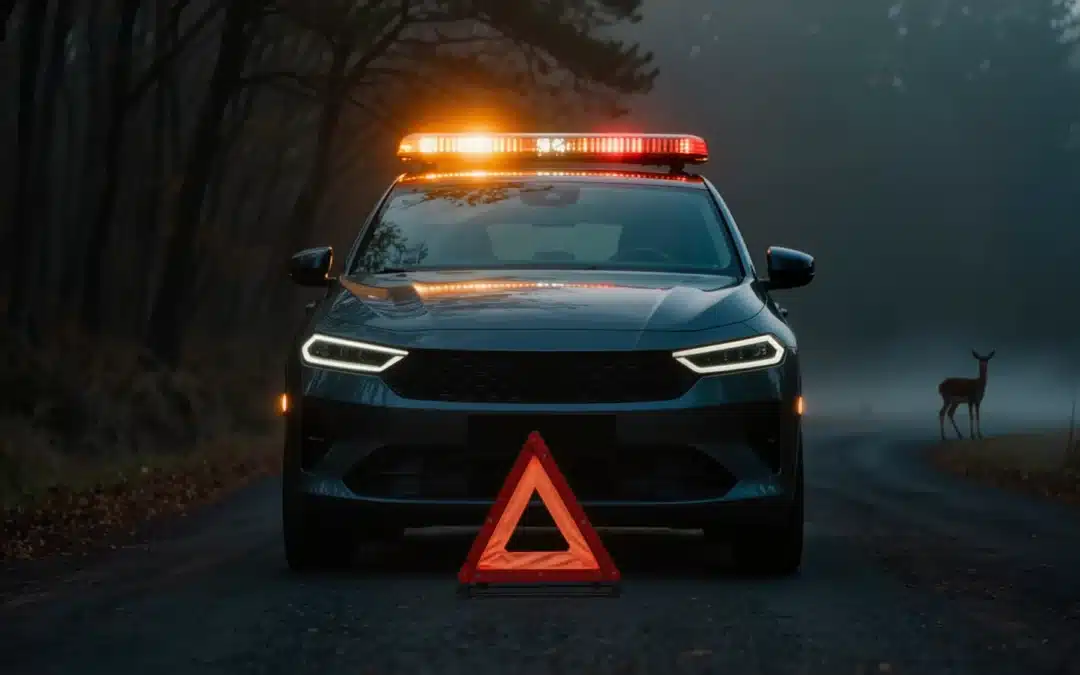
- Secure the scene with the warning triangle at a safe distance behind the car.
- Call the police. In Germany 110, anywhere in the EU 112. The police contact the local hunter and issue the wildlife accident certificate.
- Do not touch an injured animal. A wounded deer or boar can kick and bite.
- Take photos of the car, the animal and the scene. Hair and blood on the car are proof.
- Report it even if the animal ran away. Mark the spot.
- Never put a dead animal in your boot. That counts as poaching.
A dash cam helps here. Footage of the animal jumping out removes any doubt about whether you swerved or hit it.
Who pays
In Germany, partial casco usually covers collisions with game animals under the federal hunting law: roe deer, red deer, wild boar, fox and similar species. Cows, horses, dogs, cats and birds are usually not included, unless your policy says animals of all kinds. Check your contract today, not after the crash.
In other countries, cover depends on your casco policy and local rules. The police report is the document every insurer will want. Get it on the spot.
What to keep in the car
- Warning triangle and high-vis vest, within reach, not under the boot floor.
- A torch. At night on a forest road you need to see and be seen.
- Gloves, if you have to move debris.
- A dash cam, for proof.
Mistakes to avoid
- Swerving at speed. It turns a bumper repair into a rollover.
- Driving on without reporting. In some cases that can lead to trouble, and you lose the insurance claim.
- Loading the animal into the car.
- Forgetting the certificate. Without it, your insurer may refuse to pay.
Do the math: The average wildlife claim in Germany was about €4,400 in 2025 (GDV), up from €3,850 in 2023. With partial casco you pay only your deductible. Without it you pay the full repair. Swerve into a guardrail without touching the animal and partial casco often pays nothing at all. Braking straight is also the cheaper choice.
FAQ
Do I have to call the police for a small deer? Yes. You need the certificate for the insurer, and the hunter has to look for an injured animal.
Does partial casco pay if I swerve? Usually not, if you didn’t touch the animal. Then it is often a case for full casco. Some policies differ, so read yours.
Do the blue reflectors on roadside posts help? Studies disagree. A 2018 study by the universities of Göttingen and Zurich for German insurers found no significant effect on animal behaviour. Lower speed works. Don’t rely on reflectors.
Ivan’s Take
I slow down on every forest road from October on, and I keep the vest and triangle where I can grab them in two seconds. If something jumps out, I brake straight and hold the wheel. Spend five minutes checking your casco policy today: that’s the cheapest protection here.
Sources: ADAC: Wildunfall-Risiko und Versicherung; Versicherungsbote: GDV-Zahlen Wildunfälle 2025.
Published:
More from this section

The AvtoGear weekly
Once a week: new tests, the best deals and one useful tip for your car. Nothing extra.
