








In short
- Many new cars have no spare wheel. They carry a sealant and compressor kit or a temporary space-saver instead.
- Check yours before winter: the sealant has an expiry date, the space-saver needs its own pressure, and the jack and wheel brace must be there.
- The check costs €0 and ten minutes. Finding out at night on the hard shoulder costs far more.
The short answer: Check the sealant expiry date, the space-saver pressure and speed limit, the jack and the locking wheel nut key before winter.
What is in your boot
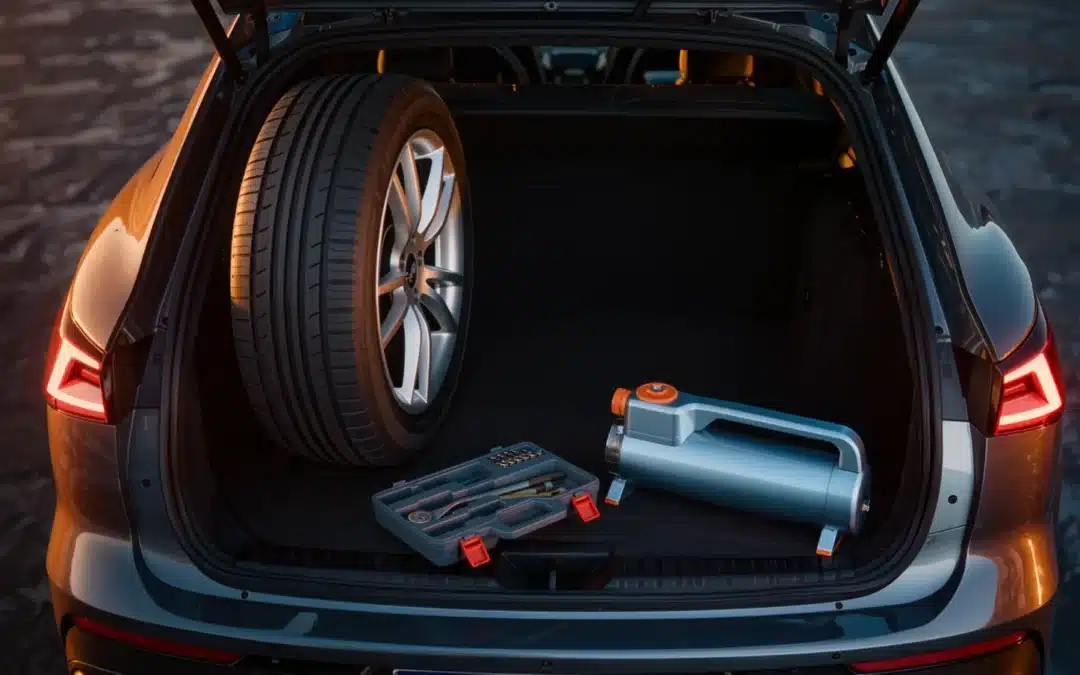
Open the boot floor and look. You will find one of three things: a full-size spare, a temporary space-saver, or a repair kit with sealant and a small compressor.
Is it still there and in working order? Many drivers have never looked.
Check these five things
- The sealant bottle. It has an expiry date printed on it. An expired bottle may not seal, so replace it.
- The space-saver pressure. It usually needs a higher pressure than your normal tyres. The figure is on the wheel, on the sticker or in the manual.
- The space-saver speed limit. It is usually printed on the wheel, often 80 km/h. Check yours and keep to it.
- The jack and the wheel brace. If you have locking wheel nuts, find the key. It is often in the glovebox. Without it you cannot take the wheel off.
- The age of the tyre. Tyres age even when they sit unused. Look at the DOT date on the sidewall, as in our DOT date article.
Do the math: The check costs €0 and takes ten minutes. If your kit has no compressor, a 12 V tyre inflator is a cheap fix: in our earlier inflator test, a €17 model scored 1.8. A breakdown on a winter night is the alternative. I have no verified price for a tow or roadside call-out, so I leave it out of the maths.
What a sealant kit can and cannot do
It can close a small puncture in the tread, enough to get you to a tyre shop.
It cannot fix sidewall damage or a large cut. In that case you need a spare or a tow.
After you use sealant, drive carefully, go to a tyre shop soon, and tell them sealant is inside. It can complicate the repair.
Pros and cons
- Pro: free, quick, and you find problems in your driveway, not on the road.
- Pro: you learn where the jack and the key are while it is calm.
- Con: if the kit is expired or missing, you have to buy a replacement.
- Con: a space-saver is a short-term fix with a speed limit, not a new tyre.
Who it is for
Every driver. Especially if you bought the car used and never opened the boot floor, or if you have locking wheel nuts.
Ivan’s Take
Do it this weekend. It is the cheapest breakdown insurance there is. I would also keep a small 12 V inflator in the boot, because sealant alone will not help every puncture.
Published:
More from this section



The AvtoGear weekly
Once a week: new tests, the best deals and one useful tip for your car. Nothing extra.
