








In short
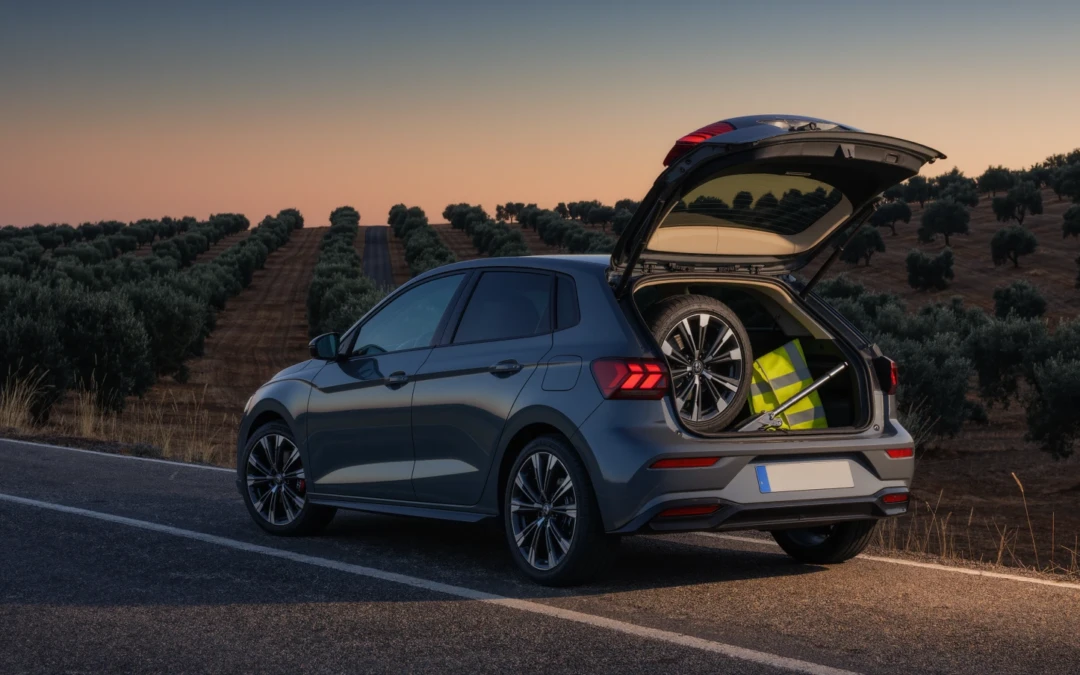
- Cars, mixed vehicles and vans up to 3,500 kg must carry a V-16 beacon, a certified high-visibility vest and a spare or temporary wheel with tools, or a repair system that keeps the car moving (General Vehicle Regulation, Annex XII).
- Spare bulbs and spare glasses are not on the list. A fire extinguisher is required only on buses and vehicles over 3,500 kg. From 1 October 2026 motorcycles must carry a vest.
- Stepping onto the carriageway or hard shoulder of an interurban road without wearing the vest: €200 according to the DGT.
Ask ten drivers what Spain makes you carry and you get ten lists. Spare bulbs, two vests, a first aid kit. The real list is in one annex of the BOE and it is shorter than most people think.
The rule in detail
Annex XII of the General Vehicle Regulation (RD 2822/1998, consolidated text of 26 June 2026, in force since 1 October 2026) lists the kit for cars, mixed vehicles and goods vehicles up to 3,500 kg. Three-wheelers and quadricycles are excluded.
- The V-16 beacon. It replaced the triangles. I covered it in a separate article: Spain V16 connected beacon.
- One high-visibility reflective vest, CE-marked under RD 1407/1992 and meeting standard UNE EN 471, at least class 2. Escort vehicles need one vest per crew member.
- A complete spare wheel or a temporary-use wheel with the tools to change it, or an alternative system that offers enough guarantees for the car to keep moving. A repair kit counts. With any alternative you must respect its own limits.
Buses, goods vehicles over 3,500 kg and vehicle combinations must carry the V-16 and the vest plus an approved fire extinguisher, suitable and in working order. The annex does not ask them for the spare wheel.
New this autumn: Royal Decree 518/2026 added a third point to Annex XII. From 1 October 2026 motorcycles must carry a high-visibility vest too.
When you must wear the vest
Carrying it is half the rule. Article 118.4 of the General Traffic Regulation says drivers of motorcycles, cars, buses, goods vehicles and mixed vehicles must wear the vest when they get out and stand on the carriageway or hard shoulder of an interurban road. Since 1 October 2026 the same article also makes riders who work on motorcycles, mopeds, bicycles or personal mobility vehicles wear it on every road.
- Spain winter tyres and snow chains: the new 3PMSF rule from May 2026, when chains are compulsory and what M+S no longer covers
- Spain: Bike Racks, Roof Boxes and Overhanging Loads – 10% Rule, V-20 Panel and When It Is a Reform
- Spain ITV inspection: how often your car must go, the windscreen sticker, defect levels and the €200 fine
What is not required
- Spare bulbs. The current Annex XII does not list them. Carry them if your car makes it easy, but there is no duty.
- Spare glasses. The General Drivers Regulation (RD 818/2009) has no such rule. What it has is licence code 01: if your licence carries it, you must wear your glasses or lenses while driving.
- A first aid kit or extinguisher in a private car. Annex XII does not ask for them.
Fines
- Not wearing the vest on the carriageway or hard shoulder of an interurban road: serious offence, €200 (DGT magazine, rule now in RGC art. 118.4).
- No V-16 beacon: €80 (DGT).
- Driving without the glasses your licence requires (code 01): €200 (DGT).
- No vest or no spare wheel or kit in the car: I found no specific amount in the law or on DGT pages, so I will not invent one.
- Pay within 20 days and any of these drops by 50% (Traffic Act, art. 94).
Foreign drivers and rental cars
The wearing rule in art. 118.4 applies to anyone who steps onto an interurban road in Spain, whatever the plates. The DGT’s exception for foreign-registered cars was stated for the V-16, not for the vest. Renting? Lift the boot floor before you sign: many cars come with a kit instead of a wheel, which is legal, but you want to know before a puncture at night.
Mistakes I see most often
- Vest in the boot. You need it before you step out, so keep it in the cabin.
- Driving on a space-saver wheel like on a normal tyre. The annex says you must respect the limits of the alternative.
- Buying a cheap vest with no CE marking or class. The annex asks for EN 471, class 2 at least.
Do the math: Not wearing the vest: €200, or €100 if you pay within 20 days. Moving the vest from the boot to the door pocket costs nothing and takes five seconds.
FAQ
Do I need a vest for every passenger? Annex XII asks for one vest per car. Only escort vehicles need one per crew member.
Is a puncture repair kit legal instead of a spare wheel? Yes. The annex accepts an alternative system that keeps the car mobile, as long as you respect its limits.
Do I still need triangles? Not in a Spanish-registered car since 1 January 2026. The V-16 is the only valid device.
Where to check
BOE: General Vehicle Regulation (RD 2822/1998), Annex XII; Royal Decree 518/2026, second final provision; General Traffic Regulation (RD 1428/2003), art. 118.4; General Drivers Regulation (RD 818/2009), Annex I code 01; Traffic Act (RDL 6/2015), art. 94. DGT: magazine report on the most expensive oversights and the V-16 press release of 25 November 2025.
Ivan’s Take
The Spanish list is short and sensible: be seen, be able to move. I would still carry what the law does not ask for, a torch and a charged phone. But the vest goes in the door pocket, not under the luggage. Two hundred euros is a lot to pay for a five-second habit.
Sources: BOE: Reglamento General de Vehículos (RD 2822/1998), anexo XII; BOE: Real Decreto 518/2026, disposición final segunda; BOE: Reglamento General de Circulación (RD 1428/2003), art. 118; BOE: Reglamento General de Conductores (RD 818/2009), anexo I; BOE: Ley de Tráfico (RDL 6/2015), art. 94; Revista DGT: Los 8 descuidos más caros; DGT: nota de prensa V-16, 25.11.2025.
Published:
More from this section
The AvtoGear weekly
Once a week: new tests, the best deals and one useful tip for your car. Nothing extra.
