








In short
- In a car, a load may stick out only at the rear, by up to 10% of the vehicle’s length (15% if indivisible), and never to the sides or front (RGC art. 15).
- Anything that sticks out at the rear, bikes on a carrier included, needs the red-and-white V-20 panel; two panels in an inverted V when the load spans the full width. At night or in poor visibility, add a red light.
- Load or a carrier that hides the lights or the plate breaks RGC art. 14. Badly secured load: 200 €; load that falls and creates serious danger: 500 €.
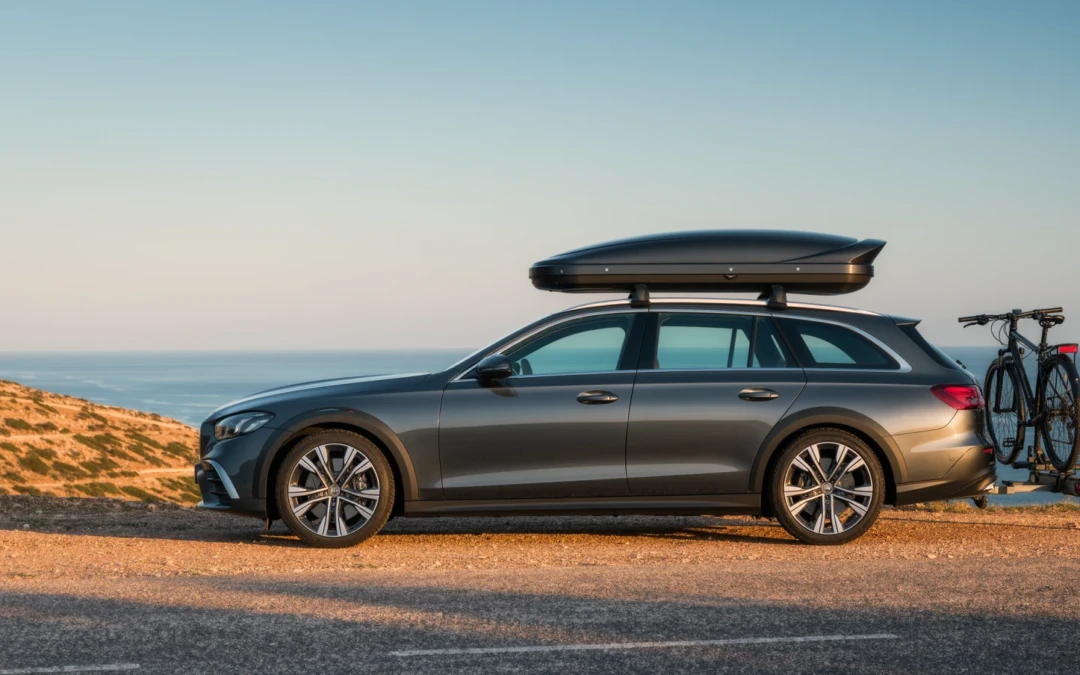
Every summer Spanish motorways fill up with bikes on tow bars and boxes on roofs. The rules are short and very specific, and most drivers only know half of them. Here is what the regulation actually says.
How far a load may stick out
Article 15 of the General Traffic Regulation (RGC, Real Decreto 1428/2003; paragraph 6 last reworded by Real Decreto 465/2025, in force since 1 July 2025) sets the limits:
- 15.1: the load must not stick out of the vehicle’s plan projection, except in the cases below.
- 15.3: in vehicles not used exclusively for goods, such as cars, the load may stick out at the rear by up to 10% of the vehicle’s length, or 15% if it is indivisible.
- 15.5: an overhanging load needs all precautions to avoid damage or danger, and its end must be protected to soften a possible scrape or impact.
For a 4.5 m car that means 45 cm at the rear, or 67.5 cm for an indivisible load. Nothing may stick out to the sides or the front.
The V-20 panel and lights
- 15.6: any load overhanging at the rear must be marked with the V-20 signal, placed at the rear end of the load and always perpendicular to the vehicle’s axis.
- When the load overhangs across the full rear width: two panels, one at each end of the load, forming an inverted V.
- Between sunset and sunrise, or when weather reduces visibility, the overhanging load also needs a red light. A load overhanging at the front needs a white light.
- The V-20 itself is defined in Annex XI of the General Vehicle Regulation: a red-and-white reflective panel (level 2) on an aluminium plate.
- Spain winter tyres and snow chains: the new 3PMSF rule from May 2026, when chains are compulsory and what M+S no longer covers
- Spain: the three documents you must carry when driving, foreign licences and the fines
- Spain ITV inspection: how often your car must go, the windscreen sticker, defect levels and the €200 fine
Securing the load, lights and plate
RGC article 14.1 says the load and the accessories used to carry it must be arranged and, if needed, secured so that they cannot drag, fall or shift dangerously, compromise the vehicle’s stability, make avoidable noise, or hide the lights, signalling devices, compulsory plates or the driver’s hand signals. A bike carrier that covers the tail lights or the plate breaks this rule.
When a carrier is a vehicle reform
The Manual de Reformas (rev. 7, corr. 2) lists under reform code 8.52 two items that matter here: luggage carriers anchored at points other than those foreseen by the manufacturer, and load-carrying supports not suitable for towing (towing mass zero) used only for bikes, motorbikes, personal mobility vehicles or animals. Those supports must carry an identification and the ITV card is annotated. Roof bars on the manufacturer’s anchor points are not listed as a reform.
Fines
- Driving with a badly arranged load or one at risk of falling: serious offence (Traffic Act art. 76.r), 200 € (art. 80.1).
- Driving with a load that has fallen onto the road because it was badly secured, creating serious danger: very serious offence (art. 77.b), 500 €.
- Neither offence costs points: they are not in Annex II of the Traffic Act.
Foreign drivers and rental cars
Articles 14 and 15 of the RGC apply to every vehicle on Spanish roads. A carrier that is fine at home still needs the V-20 panel in Spain when bikes stick out at the rear. The reform rules apply only to cars registered in Spain.
Mistakes I see most often
- No V-20 panel because “the bikes are on a proper carrier”. The panel is about the overhang, not the carrier.
- A single panel in the middle of a full-width load. The rule asks for two panels, one at each end, in an inverted V.
- A carrier covering one tail light. The regulation says the load and its accessories must not hide the lights.
Do the math: a V-20 panel costs a few euros. Driving without securing or marking the load can cost 200 €, or 500 € if something falls onto the road.
FAQ
Do I need a V-20 panel for bikes on a tow-bar carrier? Yes, if the bikes stick out beyond the rear of the car. RGC article 15.6 requires it for any rear overhang.
How far may bikes stick out? Up to 10% of the car’s length at the rear, never to the sides.
Is a roof box a reform? Not on the manufacturer’s anchor points. A luggage carrier anchored elsewhere is listed under reform code 8.52.
Where to check
BOE: Reglamento General de Circulación articles 14 and 15 (art. 15.6 as amended by Real Decreto 465/2025); Reglamento General de Vehículos Annex XI (V-20); Traffic Act (RDL 6/2015) articles 76.r, 77.b and 80. Ministry of Industry: Manual de Reformas rev. 7 corr. 2, code 8.52.
Ivan’s Take
A bike holiday should not start with a 200 € fine at the first roundabout. Measure the overhang, hang the V-20 panel, check the lights and the plate before you leave, and pull every strap once more after the first 20 kilometres.
Sources: BOE – Reglamento General de Circulación (RD 1428/2003, consolidated), arts. 14 and 15; BOE – Real Decreto 465/2025 (amends RGC art. 15.6, in force 1 July 2025); BOE – Reglamento General de Vehículos (RD 2822/1998), Annex XI, signal V-20; BOE – Ley sobre Tráfico (RDL 6/2015, consolidated), arts. 76.r, 77.b, 80, Annex II; Ministerio de Industria – Manual de Reformas de Vehículos, rev. 7 corr. 2, code 8.52.
Published:
More from this section
The AvtoGear weekly
Once a week: new tests, the best deals and one useful tip for your car. Nothing extra.
