








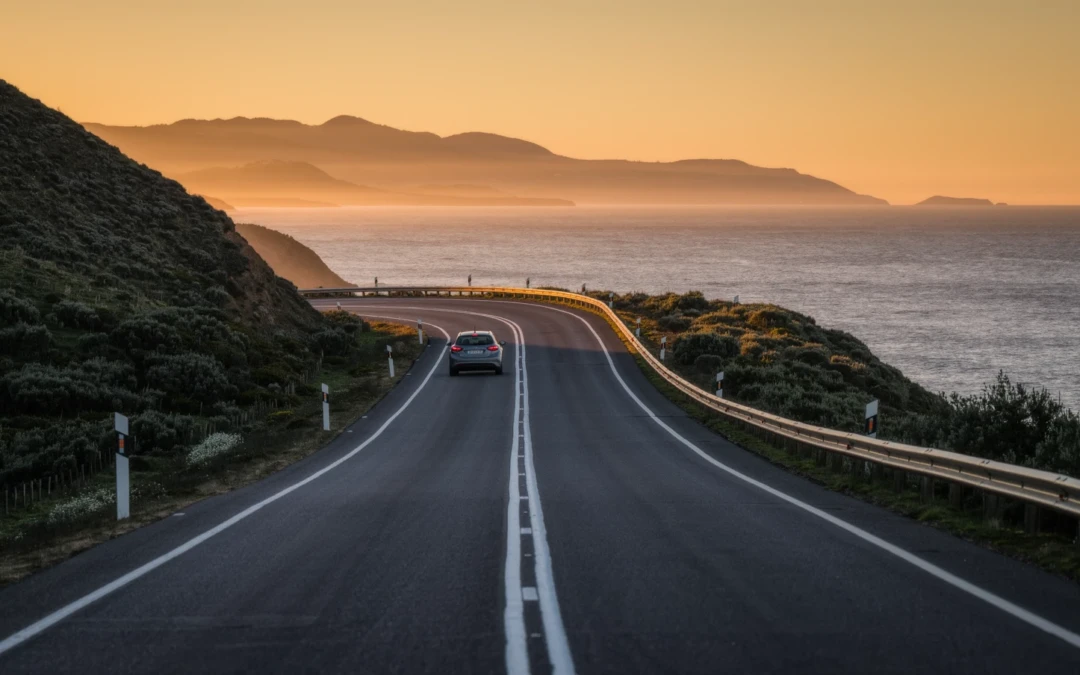
In short
- Car limits (Código da Estrada, art. 27): 50 km/h in towns, 90 outside, 100 on expressways reserved for cars, 120 on motorways.
- Fine bands run from €60–300 for a small excess to €500–2,500 for the worst. Big excesses also bring a driving ban and points.
- Fined on the spot, you must lodge a deposit equal to the minimum fine within 48 hours, or your documents are seized.
Portugal checks speed with fixed cameras, average-speed sections and patrols. The Código da Estrada ties the fine to how far over the limit you were, not to the sign alone. Here is the scale as the law reads, for an ordinary car.
The limits for a car
Article 27(1) sets the maximum speeds. For a passenger car without a trailer: 50 km/h inside a localidade (the built-up area marked by town signs), 90 km/h on other public roads, 100 km/h on roads reserved for cars and motorcycles, and 120 km/h on motorways. Coexistence zones (shared space with pedestrians) are 20 km/h. With a trailer the figures drop to 50, 70, 80 and 100 km/h. A light goods vehicle without a trailer gets 50, 80, 90 and 110. I read these values in the table of art. 27(1) in the current consolidated text (last amended by Lei 24/2025).
Signs can change this. Article 28 lets the authorities fix lower or higher limits on a given road or period, and signed limits win over the general table. On motorways you may not drive slower than 50 km/h, with a fine of €60–300 (art. 27(6)–(7)). You must also adapt speed to traffic, weather and visibility (art. 24, fine €120–600) and slow down near crossings, schools, bends, bridges and wet roads (art. 25, fine €120–600).
Average-speed controls count. Under art. 27(4), driving a measured distance at an average speed that is only possible by breaking the limit is an offence, committed where the controlled stretch ends.
Fines for a car or motorcycle
Article 27(2)(a) gives four bands:
- Up to 20 km/h over in town, or up to 30 km/h over outside: €60–300
- 20–40 km/h over in town, or 30–60 over outside: €120–600
- 40–60 km/h over in town, or 60–80 over outside: €300–1,500
- More than 60 over in town, or more than 80 over outside: €500–2,500
Other vehicles, such as lorries and buses, have tighter thresholds (art. 27(2)(b)). The law gives a range, and the authority sets the exact amount.
Licence ban and points
Speeding goes from a plain fine to a serious offence at more than 20 km/h over in town or more than 30 km/h over outside (art. 145(1)(b)–(c)). It becomes very serious above 40 km/h in town or 60 outside (art. 146(i)). Serious offences carry a driving ban (inibição de conduzir) of 1 month to 1 year, very serious ones 2 months to 2 years (art. 147(2)). Points are taken under art. 148(1): 2 for a serious speeding offence and 4 for a very serious one. Only speeding inside a coexistence zone costs 3 or 5 points. Every driver starts with 12 points (art. 121-A).
You may pay the minimum fine voluntarily within 15 working days of notification (art. 172). If a ban applies, the case continues for the ban only.
Foreign drivers and rental cars
I found no separate speeding scale for foreign plates in the Code, so the same bands apply. If you are fined on the spot, art. 173 requires a deposit equal to the minimum fine immediately or within 48 hours. Without it, officers can provisionally seize your driving licence and give you a substitute document. Under art. 174, if earlier fines are unpaid, you must pay at once or documents are seized, and the vehicle after 15 days.
Mistakes I see most often
- Using 120 km/h with a trailer. The limit is 100.
- Forgetting that a wide road through a village is still 50.
- Treating the lowest band as harmless. It still costs at least €60, and the next band starts quickly.
Do the math: 100 km at 120 km/h takes 50 minutes. At 140 it takes about 43. You save 7 minutes and risk €60–300. At 30 over outside the limit you are already in the €120–600 band with a ban in play.
FAQ
Is the fine fixed? No. The Code gives a range per band and the authority decides the amount.
Can I pay less? You can pay the minimum within 15 working days (art. 172), but any ban still goes ahead.
Do the limits change for a rental car? No. They depend on the vehicle class and trailer, not on who owns the car.
Ivan’s Take
I treat 120 as a ceiling, not a target. Seven minutes on a long motorway leg are not worth a ban. Ride the speed the sign allows, and remember a trailer lowers it.
Sources: Código da Estrada (DL 114/94), versão atualizada até Lei n.º 24/2025 (PGDL Lisboa) – arts. 24, 25, 27, 28, 121-A, 145–148, 172–174; ANSR – Legislação: Código da Estrada.
Published:
More from this section

The AvtoGear weekly
Once a week: new tests, the best deals and one useful tip for your car. Nothing extra.
