








In short
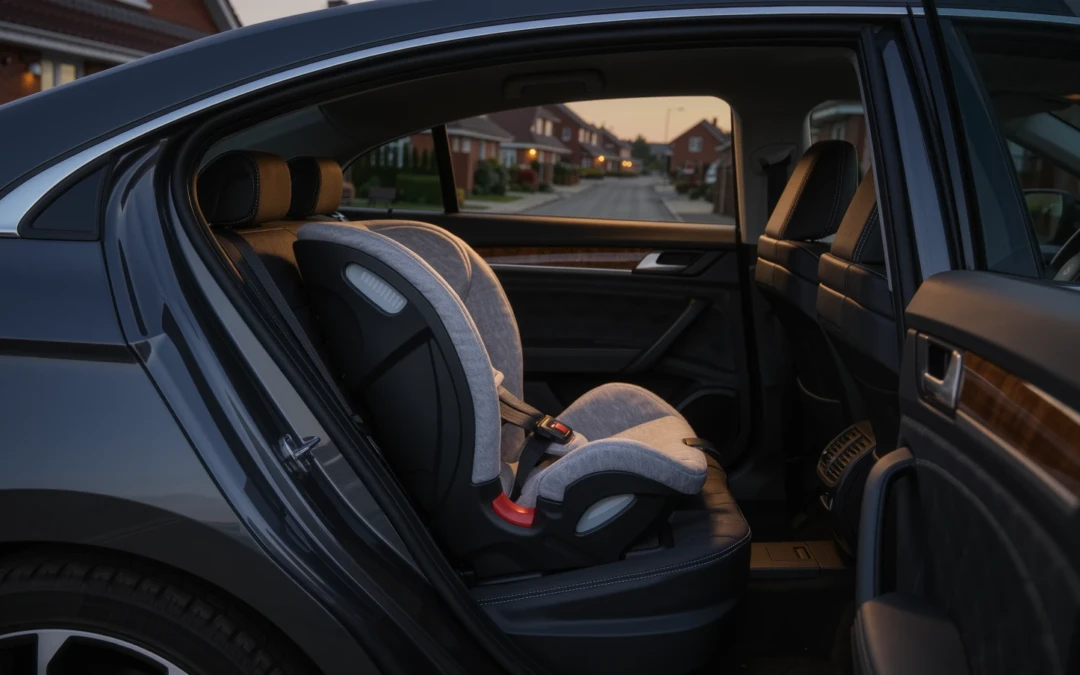
- In cars, vans and lorries fitted with seat belts, a child under 150 cm must travel in a child seat that matches its weight and height and meets EU or UN ECE standards.
- Breaking the rule costs 300 zł (about €68). The points depend on how many children travel the wrong way: 5 for one, 10 for two, 15 for three or more.
- A rear-facing seat may never sit on a front seat with an active passenger airbag. That is also 300 zł.
Polish rules on children in cars are not measured in years but in centimetres. The magic number is 150 cm, with two narrow exceptions. Here is what Article 39 and Article 45 of the Road Traffic Act say, and what the police charge.
The rule: under 150 cm in a child seat
Article 39(3) of the Road Traffic Act (Prawo o ruchu drogowym, consolidated text of the Sejm Chancellery up to Dz.U. 2026 item 1073) applies to vehicles of categories M1, N1, N2 and N3, that is cars, vans and lorries, fitted with seat belts or child restraints. In them, a child under 150 cm must travel in a child seat or other child restraint that matches the child’s weight and height and meets the technical requirements of EU law or UN ECE regulations. Article 39(3a) adds that the seat must be installed according to the manufacturer’s instructions.
The two exceptions
- 135 cm on the rear seat (Article 39(3b)): a child at least 135 cm tall may ride on the rear seat with only the seat belt, if its weight and height make it impossible to fit a suitable child seat.
- Third child (Article 39(3c)): in a car or van (M1, N1), a third child aged at least 3 may ride on the rear seat with a seat belt when two children already sit in child seats on the rear seats and there is no room to fit a third one.
- Poland: pedestrian priority at zebra crossings – 1,500 zł and 15 points, plus the rules for junctions and roundabouts
- Poland: dipped beams or DRL at all times – 100 zł by day, 300 zł and 6 points at night, 200 zł in tunnels
- Poland’s new points-reduction course: 6 points off every 6 months from June 2026
What is banned outright
Article 45(2) forbids the driver to:
- carry a child in a rear-facing child seat on a front seat with an active passenger airbag (point 4);
- carry a child under 3 in a car, van or lorry that has no seat belts and child seat (point 5);
- carry a child under 150 cm on a front seat outside a child seat or other restraint (point 6);
- carry any passenger in breach of the seat belt rules of Article 39 (point 3).
Who is exempt
Under Article 39(4) the child seat rule does not apply in a taxi, in a specialist ambulance, in a vehicle of the Police, Border Guard or municipal guard, or to a child with a medical certificate against travelling in a child seat. That certificate must carry the child’s name, ID number, validity period and the EU symbol (Article 39(5)).
Fines and points
These are petty offences under Article 97 of the Code of Petty Offences. The fixed fines come from Table B of the fine tariff (Dz.U. 2021 item 2484, rows 58-64), the points from Annex 1 of the regulation of 29 May 2026 (Dz.U. 2026 item 724):
- Child under 150 cm without a suitable child seat: 300 zł (€68) (row 58).
- Rear-facing child seat on a front seat with an active airbag: 300 zł (€68) (row 59).
- Child under 3 in a vehicle without seat belts and a child seat: 300 zł (€68) (row 60).
- Child under 150 cm on a front seat outside a child seat: 300 zł (€68) (row 61).
- Child seat not installed according to the manufacturer’s instructions: 300 zł (€68) (row 62).
- Driver without a seat belt: 100 zł (€23) (row 63), 5 points (H07). Driving with passengers not wearing belts: 100 zł (€23) (row 64), 5 points for one passenger, 8 for more (J04, J05).
For carrying children against the rules the points rise with the number of children: 5 points for one child (J01), 10 for two (J02) and 15 for more than two (J03). Euro amounts use the National Bank of Poland rate of 12 November 2026: €1 = 4.4018 zł.
Foreign drivers and hire cars
The rules apply to every car on Polish roads, including foreign-registered and hire cars. Polish law asks for a seat that meets EU or UN ECE technical requirements, so it looks at the approval of the seat, not at the country where you bought it. If you rent a seat with the car, check that it fits your child’s weight and height and install it exactly as the manufacturer’s label shows.
Mistakes I see most often
- Moving a 10-year-old to a plain belt because “they are big now”. The test is 150 cm, or 135 cm on the rear seat only when no seat fits.
- Putting a baby seat facing backwards on the front seat without switching off the airbag.
- Skipping the seat for a short trip. The tariff has no distance discount: it is 300 zł per offence.
Do the math: Do the math: Two children without seats on the school run: 300 zł (€68) and 10 points. Get caught three times within a year and you hold 30 points, above the 24 that send you to a re-test. A seat is bought once and protects the child on every trip.
FAQ
Until what height does a child need a car seat in Poland? Under 150 cm, with two exceptions: from 135 cm on the rear seat when no suitable seat fits, and a third child aged 3+ on the rear seat when two seats leave no room.
Can a child sit in the front in Poland? Yes, but under 150 cm only in a child seat. A rear-facing seat is not allowed in front of an active passenger airbag.
Do I need a child seat in a Polish taxi? No. Article 39(4) exempts taxis from the child seat rule.
Ivan’s Take
I measure children with a tape, not by age. Up to 150 cm the seat stays in the car, and I check the airbag switch every time a rear-facing seat goes in front. The 300 zł is the smallest cost of getting it wrong.
Sources: ISAP (Sejm) – Prawo o ruchu drogowym, consolidated text, arts. 39, 45; ISAP – Kodeks wykroczeń, Dz.U. 2026 poz. 1372, art. 97; ISAP – Fine tariff, Table B, Dz.U. 2021 poz. 2484, rows 58-64; ISAP – Penalty points regulation, Dz.U. 2026 poz. 724, annex 1 (H07, J01-J05); NBP – EUR mid rate, table 220/A/NBP/2026 of 12.11.2026.
Published:
More from this section
The AvtoGear weekly
Once a week: new tests, the best deals and one useful tip for your car. Nothing extra.
