








In short
- The rule: Polish traffic law (Prawo o ruchu drogowym) contains no ban on dash cams, front or rear.
- The key point: the camera must not cut your field of view. The windscreen must give you full, clear visibility.
- The money: 0 zł fine and 0 points for having one. Posting faces and plates online is a GDPR question, not a traffic one.
You drive into Poland with a camera on the glass. Will the officer at a roadside check care? Not about the camera itself. What matters is where you mount it and what you do with the video later.
The rule in detail
I read the consolidated Prawo o ruchu drogowym (Dz.U. 2024 poz. 1251) together with the amending acts up to the law of 8 October 2026 (Dz.U. 2026 poz. 1466). There is no article that bans, licenses or registers a dash cam. The vehicle technical regulation (Dz.U. 2024 poz. 502, last amended by Dz.U. 2024 poz. 1417) does not mention them either.
Two rules decide where the camera can go. Art. 66(1)(5) of the traffic law says a vehicle must give the driver a sufficient field of view and easy, safe use of the controls while watching the road. § 8(5)(1) of the technical regulation says the windscreen must give the driver full and clear visibility without distortion.
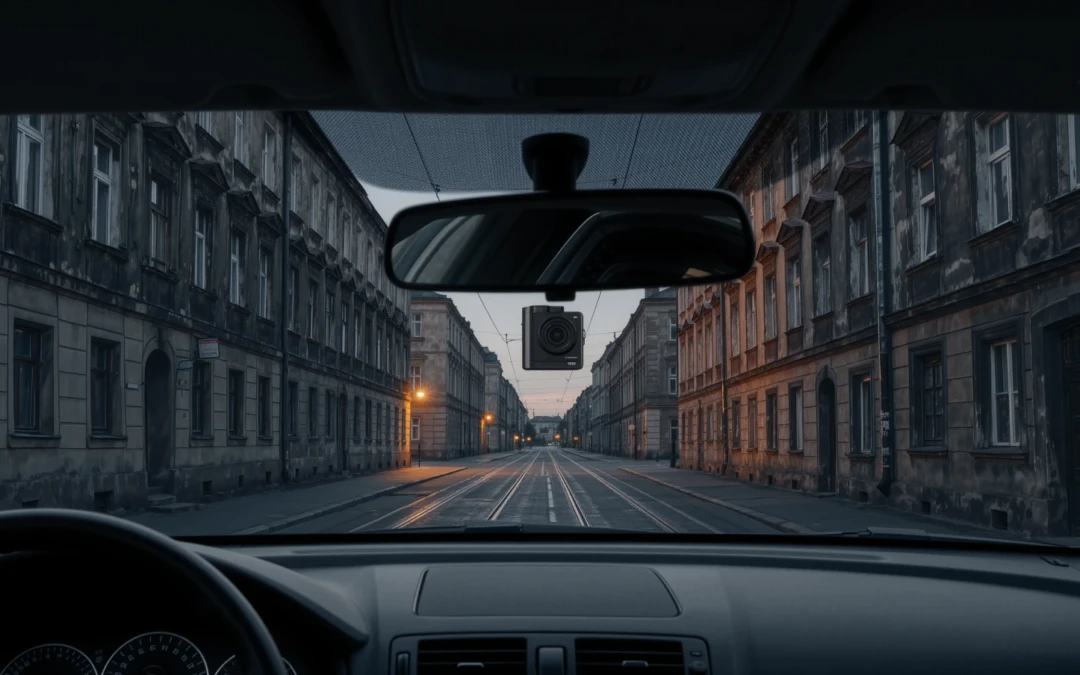
So the law cares about your eyes, not about the gadget. My practical reading: high up, behind the rear-view mirror, with the cable tucked into the headliner. That spot keeps the camera out of your line of sight and out of every argument.
What GDPR says about your footage
The traffic law stops at the windscreen. The video itself falls under GDPR. Poland’s data protection authority, UODO, publishes the Polish text of the EDPB Guidelines 3/2019 on processing personal data through video devices. Three points matter for drivers.
- Household exemption is narrow. Filming for purely personal or family use can fall outside GDPR. Publishing a video online so that an unlimited number of people can see it does not (point 12 of the guidelines, citing the EU Court of Justice in Lindqvist).
- Continuous recording. The guidelines use a car camera as an example: if you install it to collect evidence in case of an accident, make sure it does not continuously record traffic and people at the roadside. Otherwise the interest in having evidence cannot justify that intrusion.
- Parking cameras that are built or set up so they collect nothing that identifies a person, such as plates or passers-by, are outside GDPR altogether.
What does that mean for you? A camera that loops, overwrites old files and locks a clip when something happens is the setup closest to the guidelines. Keep the clip that matters. Let the rest disappear.
- Poland: pedestrian priority at zebra crossings – 1,500 zł and 15 points, plus the rules for junctions and roundabouts
- Poland: child seats up to 150 cm – 300 zł per offence and up to 15 points for three children
- Poland: dipped beams or DRL at all times – 100 zł by day, 300 zł and 6 points at night, 200 zł in tunnels
Fines and points
- Having a dash cam: no fine. The national fine table (Dz.U. 2021 poz. 2484) has no line for it, and the points regulation in force since 3 June 2026 (Dz.U. 2026 poz. 724) gives it no points.
- Camera mounted where it blocks your view: there is no specific fine line for this either. The legal requirement you would break is the field-of-view rule in Art. 66(1)(5).
- Using your phone as a dash cam and holding it while driving: that is phone use under Art. 45(2)(1). Fine table item 67: 500 zł (€114). Points code H 09: 12 points.
- Problems with footage you published are a GDPR matter for UODO, not a roadside ticket.
Euro amounts use the NBP rate of 12 November 2026 (table 220/A/NBP/2026): €1 = 4.4018 zł.
Foreign drivers and rental cars
The traffic law has no separate dash cam rule for foreign-registered cars, so the same view rule applies to you. GDPR and the EDPB guidelines apply in every EU country, so the footage rules do not change at the border either. Driving a rental? Ask the company before you stick a mount on their windscreen.
Mistakes I see most often
- The camera sits in the middle of the windscreen at eye height, with a cable hanging across the glass.
- A full clip with clear faces and plates goes on social media to shame another driver. That is exactly the publication the household exemption does not cover.
- The phone in the holder doubles as the camera, and the driver keeps grabbing it on the move to save a clip.
Do the math: Do the math: a dash cam costs you 0 zł in fines and 0 points. Picking up your phone to start recording while driving costs 500 zł (€114) and 12 points. Do it twice and you are at 1,000 zł (€227) and 24 points. A camera that records on its own is the cheaper option every time.
FAQ
Is a dash cam legal in Poland? Yes. Neither the traffic law nor the vehicle technical regulation bans it. It only has to sit where it does not limit your view through the windscreen.
Can I post my dash cam video online? Then GDPR applies, because publishing to an unlimited audience is outside the household exemption. Blur faces and number plates before you share anything.
Does the rule change for a car registered abroad? No. The view rule in the traffic law and the GDPR guidelines apply to every car on Polish roads.
Where to check
The traffic law, the technical regulation, the fine table and the points regulation are on isap.sejm.gov.pl (the Sejm legal database). The Polish text of EDPB Guidelines 3/2019 is on uodo.gov.pl.
Ivan’s Take
I would drive in Poland with a camera every time. The law is clear: no ban, no fee, no fine. Mount it behind the mirror, let it loop, and keep your clips for the insurer, not for Facebook.
Sources: Prawo o ruchu drogowym, consolidated text Dz.U. 2024 poz. 1251 (ISAP); Act of 8 October 2026 amending the traffic law, Dz.U. 2026 poz. 1466 (ISAP); Regulation on vehicle technical conditions, Dz.U. 2024 poz. 502 (ISAP); Fine table (taryfikator), Dz.U. 2021 poz. 2484 (ISAP); Points regulation, Dz.U. 2026 poz. 724 (ISAP); EDPB Guidelines 3/2019 on video devices, Polish text (UODO); NBP exchange rate EUR, table 220/A/NBP/2026.
Published:
More from this section

The AvtoGear weekly
Once a week: new tests, the best deals and one useful tip for your car. Nothing extra.
