








In short
- Germany has no general chain rule. You need chains only where the blue sign 268 stands.
- With chains the limit is 50 km/h (§ 3 para. 4 StVO). No sign, no obligation.
- No chains at the sign: €20 warning fee. Too fast with chains: up to €150 and one point (ADAC).
Driving to the Alps or the Black Forest this winter? Then one blue round sign decides whether you carry on or turn around. It is sign 268, and it is the only place in Germany where chains are mandatory. No sign, no duty. Here is what the rule really says.
What sign 268 means
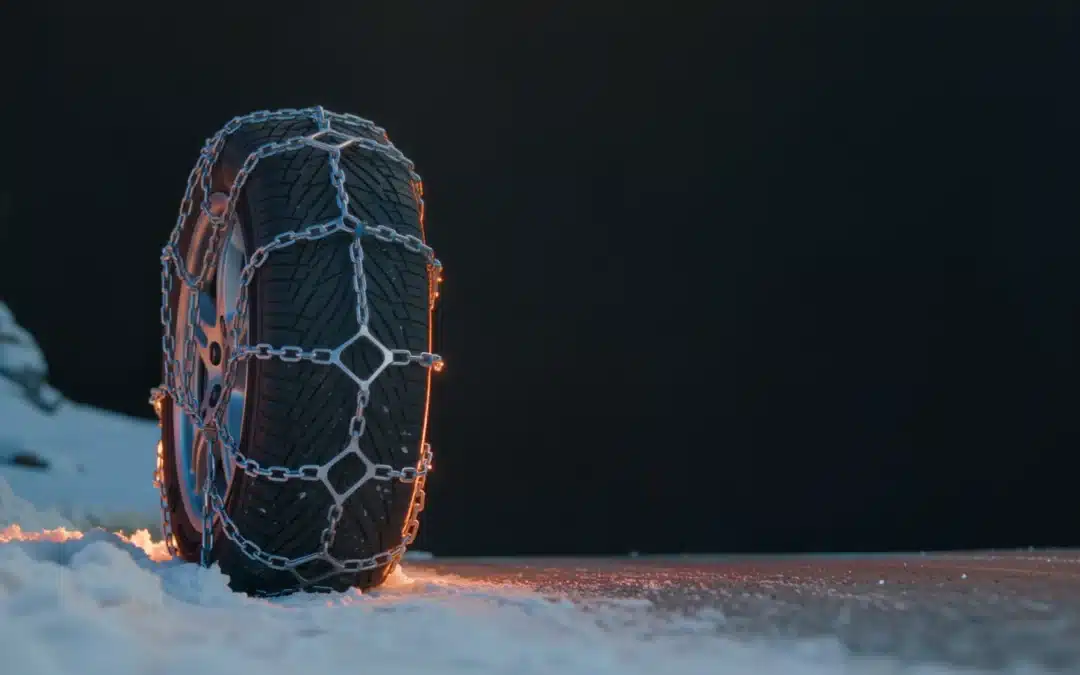
Sign 268 shows a tyre wrapped in chains on a blue background. Annex 2 of the road traffic code (StVO) puts it in one sentence: whoever drives a vehicle may use the road only with snow chains.
Note one thing. The sign applies even if the road looks clear at that moment. The administrative rule (VwV-StVO) says authorities may only put it up where traffic and weather really make chains necessary. That is their job, not yours. If you see the sign, you fit the chains.
Does four-wheel drive exempt you? No. ADAC states clearly that sign 268 also applies to all-wheel-drive cars.
The 50 km/h limit
Chains come with a speed cap. § 3 para. 4 StVO sets the maximum for motor vehicles with snow chains at 50 km/h, even under the best conditions. Chains are made for crawling up a pass, not for cruising. Go faster and they wear out, shake your car and can damage the wheel arch.
Which wheels get the chains
- Front-wheel drive: chains on the front axle.
- Rear-wheel drive: chains on the rear axle.
- All-wheel drive: on one driven axle, both wheels, as ADAC explains. Check your owner’s manual for the exact axle.
- Chains are no replacement for winter tyres. You need both.
If the road is very steep and slippery, chains on all axles help when braking downhill. That is a tip from ADAC, not a legal duty.
Choosing chains that are allowed
Anti-skid devices fall under § 22a para. 1 no. 2 StVZO. They must be of an officially approved design. Buy from a known brand, check that the chain fits your tyre size and look in the car manual for the maximum chain thickness. Many modern cars have little room in the wheel arch, so a cheap chain that is too fat can scratch the body or the brake lines.
Alloy wheels need care too. Pick a chain that is made for them or has plastic protectors on the inner side.
How to fit them, step by step
- Practice once at home on a dry driveway. In a snowstorm your fingers will not forgive you.
- Stop early on a flat spot, away from traffic. Put on the warning vest and use the hazard lights if needed.
- Clear snow around the tyre so the closures stay clean.
- Lay the chain over the tyre as the instructions show. Close it and move a few metres.
- Re-tighten after that first stretch. A loose chain can hit the car body.
Mistakes to avoid
- Driving on bare asphalt for long distances. Chains and road both suffer.
- Driving faster than 50 km/h because the road looks fine.
- Fitting the chain on the wrong axle.
- Believing four-wheel drive means you can skip the chains at the sign.
- Buying a chain online without checking the tyre size and wheel arch clearance.
Do the math: Without chains at sign 268 ADAC names a €20 warning fee. Too fast with chains costs up to €150 plus one point in Flensburg. So the speed mistake costs up to 7.5 times more than the missing chains. And the €20 does not solve your real problem: you still cannot drive on. Chains are a cheap insurance, and practicing the fitting costs you ten minutes.
FAQ
Do I need chains in Germany at all times in winter? No. There is no general chain duty. You need them where sign 268 is posted. Winter tyres are a separate rule that depends on the conditions on the road.
Can I take the chains off after the sign? Yes. The duty ends where the road no longer requires it. Remove them once you are on bare road to protect the chains and the asphalt.
Do the rules apply abroad? No. Austria, Italy and Switzerland have their own rules and fines. ADAC lists them by country, so check before you cross the border.
Before you leave
Pack gloves, a mat to kneel on and a small torch. Check the weather and road reports for your pass. Fit the chains before the steep part, not on it. Then you are calm when the sign appears.
Ivan’s Take
I carry chains from the first winter trip to the mountains. Not because Germany forces me, but because the sign leaves no discussion. Buy a good approved set, practice once, keep it in the boot and stay under 50. That is cheaper than a tow truck.
Sources: StVO Anlage 2, lfd. Nr. 42 (Zeichen 268); StVO § 3 Abs. 4; StVZO § 22a; ADAC: Schneeketten.
Published:
More from this section

The AvtoGear weekly
Once a week: new tests, the best deals and one useful tip for your car. Nothing extra.
