








In short
- Motor vehicles must use headlights or daytime running lights whenever they are driving, day and night (Road Traffic Act § 49).
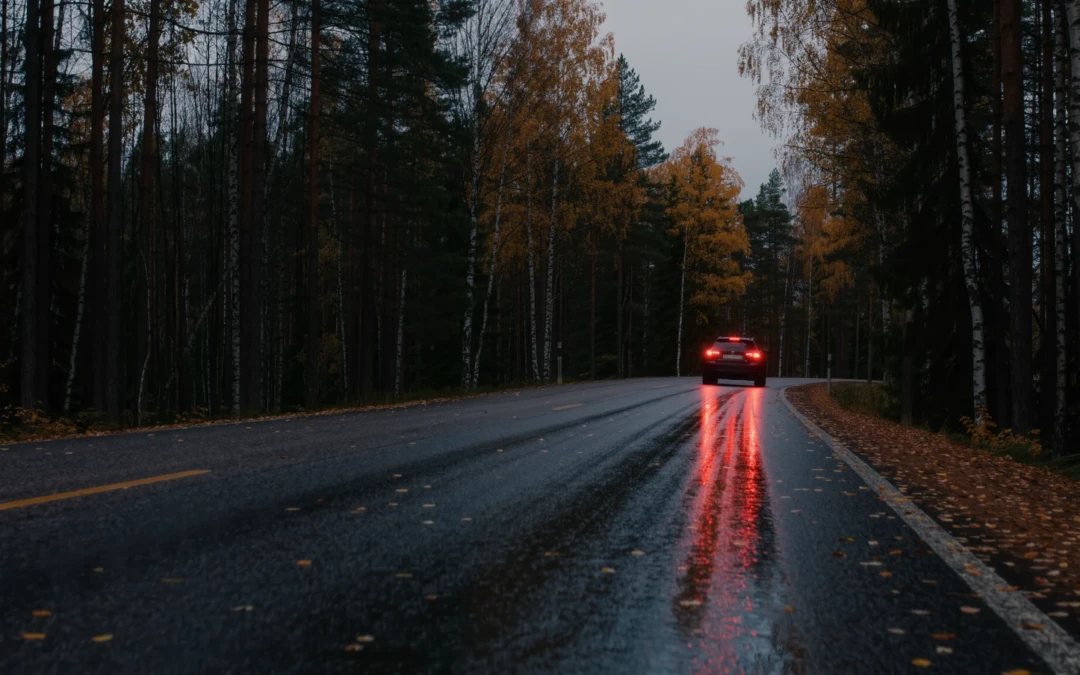
- In darkness, dusk or poor visibility you need headlights and tail lights, so daytime lights alone are not enough.
- Breaking the rules on lamps costs a €100 traffic infringement fee (€70 on a moped), under § 166.
If you come from a country where lights are optional in daylight, Finland will catch you out. The rule is simple, but the detail about dusk and rear lights is where drivers slip. Here is the text of the law, in plain words.
The basic rule (§ 49, first paragraph)
Section 49 of the Road Traffic Act says that a motor vehicle must use headlights or daytime running lights while driving. This is not tied to the season or to the weather. It applies to cars, vans, lorries and motorcycles alike, on any road, in broad daylight too.
If the car has daytime running lights that switch on automatically, you are covered in good light. If it does not, switch on the dipped beam yourself.
Dusk, darkness and poor visibility
The second sentence adds a second duty. When you drive in darkness or dusk, or when weather or another reason makes visibility worse, a motor vehicle must use headlights and tail lights. Many daytime running lights light only the front. In rain, snow, fog or at dusk, check that your rear lights are on too, because § 49 asks for both.
Other vehicles, for example bicycles, must show a white or light-yellow light to the front and a red light to the rear in darkness, dusk or poor visibility.
High beam and fog lights (§ 49)
- High beam must not be used on a lit road, so close to an oncoming vehicle or tram that the driver can be dazzled, or when driving close behind another vehicle.
- Fog lights may be used in fog or heavy rain. Front fog lights may then replace dipped beam if the front lights are switched on at the same time.
- The rear fog light may also be used when snow, dust or mud thrown up by traffic substantially limits how well your vehicle can be seen from behind.
- A vehicle must not use devices that show or reflect red light forward, or, unless otherwise provided, white or light-yellow light backward.
Stopped and parked vehicles (§§ 50–51)
A motor vehicle stopped or parked on the road in darkness, dusk or poor visibility must use its front or dipped lights and its tail lights, unless the road is so well lit, or visibility is otherwise so good, that the vehicle can be clearly seen from far enough. In a built-up area a vehicle parked along the carriageway may use the parking light instead. This does not apply to a vehicle in a parking place outside the carriageway.
Hazard lights may be used if an accident, damage or another compelling reason has stopped you in a place where you could cause special danger, and on a moving vehicle to warn others of immediate danger (§ 51).
The fee
A driver who intentionally or negligently breaks the traffic rules on using lights in §§ 49–51 can be given a €100 traffic infringement fee. For a moped rider it is €70 (§ 166). If several infringements are handled at once, the fee for the most severe one is raised by €40 (§ 160).
Foreign drivers and rental cars
The text of § 49 speaks of motor vehicles in general. I found no exception for foreign cars or hire cars. A car that does not switch on daytime lights by itself, which is common in older models, needs your hand on the switch.
Mistakes I see most often
- Relying on daytime running lights at dusk or in rain, when the tail lights may be off.
- Using high beam on a lit road because it feels brighter.
- Leaving the rear fog light on after the fog is gone. The Act allows it in fog, heavy rain and thrown-up spray, not for general use.
Do the math: The fee for a lamp breach is €100. Turning the switch to dipped beam costs €0. Walking round the car once before a trip takes a minute, and spares you a €100 fee at the first police stop.
FAQ
Do I need lights in the middle of a sunny summer day? Yes. Section 49 requires headlights or daytime running lights whenever a motor vehicle is driving.
Are daytime running lights enough at dusk? Not if they leave the rear dark. In dusk, darkness or poor visibility the law asks for headlights and tail lights.
Can I use fog lights in a snowfall? The Act names fog and heavy rain for fog lights. The rear fog light may also be used when thrown-up snow, dust or mud substantially limits how you are seen from behind.
Where to check
Read Road Traffic Act 729/2018 §§ 49–51, 160 and 166 on finlex.fi. I used the consolidated text including amendment 281/2026.
Ivan’s Take
In Finland I treat the light switch like the seat belt: it goes on before the engine starts and stays on. It costs nothing, the rule is clear, and the €100 fee is a silly price for a forgotten switch.
Sources: Finlex: Road Traffic Act 729/2018 (§§ 49–51, 160, 166).
Published:
More from this section

The AvtoGear weekly
Once a week: new tests, the best deals and one useful tip for your car. Nothing extra.
