








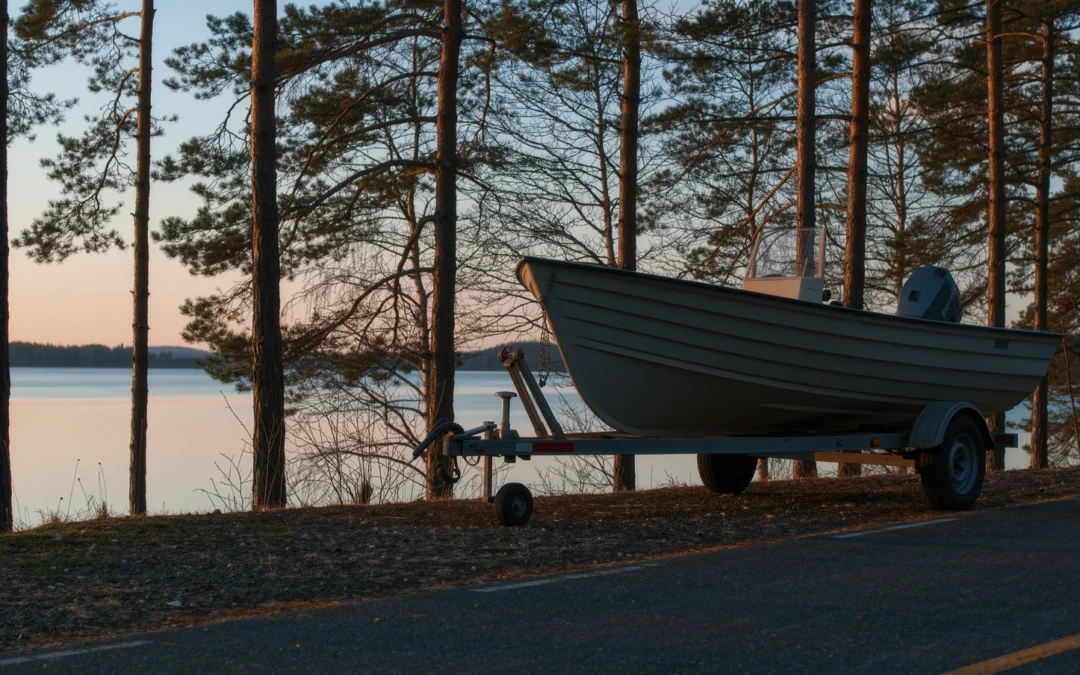
In short
- On a B licence you may tow a trailer up to 750 kg, or a heavier trailer if the combination’s total mass is at most 3,500 kg. B96 covers up to 4,250 kg and BE a trailer up to 3,500 kg.
- The speed limit with a trailer up to 750 kg is 100 km/h, even when it is empty. With other trailers it is 80 km/h.
- Breaking the coupling or loading rules costs a €140 traffic infringement fee. Wrong tyres cost €100.
Towing a caravan or a boat trailer in Finland is not just about what the car can pull. Your licence class, the registered masses, the safety cable and the speed limit all apply at once. Here is how they fit together.
The licence rule
The Driving Licence Act (386/2011, section 4) and Traficom define what each class covers. Under class B you may drive a combination with a B-class towing car and a trailer whose total mass is at most 750 kg, or a trailer over 750 kg if the whole combination’s total mass is at most 3,500 kg. Class BE covers a trailer up to 3,500 kg. Class B96 covers a combination with a trailer over 750 kg and a total mass above 3,500 kg but not above 4,250 kg, and your card must carry the entry for the combination driving test (section 7).
The masses in the licence rule are the maximum permitted masses, not what is on the scale that day. Traficom’s example: car A has a maximum trailer mass of 1,500 kg on its registration certificate, and trailer P has a registered mass of 1,800 kg. You may tow P with A if its real mass at the time is at most 1,500 kg. On a B licence the car may weigh at most 1,700 kg (1,700 plus 1,800 makes 3,500). If A is heavier, you need B96 or BE. With B96 in this example A could weigh up to 2,450 kg.
What the car may pull
The Road Traffic Act (729/2018, sections 151 and 152) lets cars and vans tow trailers up to 3,500 kg classification mass. The coupling mass may not exceed the smallest of the limits that apply:
- unbraked trailer: half of the towing car’s own mass, and at most 0.75 tonnes;
- trailer with overrun brakes: the towing car’s maximum permitted mass (1.5 times for a car classed as off-road), and at most 3.5 tonnes.
The maximum trailer mass for your car is on its registration certificate (Traficom).
Coupling, load and mirrors
- Only one trailer at a time (section 150). The trailer’s brakes and lights must work, and the mirrors must be adjusted or extra mirrors fitted so you can see the sides of the car and trailer and the traffic behind.
- For a trailer over 750 and up to 3,500 kg, use the safety cable where both coupling devices have attachment points. The cable must apply the trailer brakes if the coupling comes apart while driving (section 151).
- Load low and central. The downward force of a centre-axle trailer on the hitch may be at most 10 % of the trailer’s permitted axle mass or 1,000 kg, whichever is smaller (section 108).
Speed with a trailer
Section 99 says you may not exceed the maximum speed of any vehicle in the combination. Annex 5.2 sets the numbers: 80 km/h for a car with a trailer, 100 km/h for a car or van with a trailer of at most 750 kg classification mass, and 60 km/h with an unsprung trailer or an unbraked trailer over 750 kg. Traficom adds that the 100 km/h limit with a light trailer applies even when the trailer is empty.
Winter and inspection
A trailer over 0.75 and up to 3.5 tonnes needs winter tyres in November to March when conditions require (section 105). If the towing car runs studs, the trailer must still have winter tyres (section 106).
Penalties
- Minor breach of the coupling rules (sections 150 to 154): €140 traffic infringement fee (section 170).
- Loading rules or masses and dimensions: €140 (section 168).
- Tyre or anti-skid rules, or combination stability: €100 (section 171).
- A combination your licence class does not cover: section 7 of the Driving Licence Act lets you drive only the vehicles and combinations whose class is on your card. The texts I read do not say expressly that a class mismatch counts as driving without a right under Criminal Code chapter 23, section 10 (a fine or up to 6 months in prison), so I do not state it as certain.
Foreign drivers
A licence from another EU or EEA state entitles you to drive the vehicles and combinations of the classes shown on the card (Driving Licence Act, section 59). Check that your card shows B, BE or B96 as needed before you hitch up.
Mistakes I see most often
- Weighing the trailer on a scale and calling it legal. The licence rule counts the maximum permitted masses.
- Driving 100 km/h with a heavy trailer. Above 750 kg the limit is 80.
- Skipping the safety cable or the extra mirrors.
Do the math: Take Traficom’s example. Car 1,700 kg plus trailer 1,800 kg is 3,500 kg, so a B licence is enough. Swap in a car at 1,800 kg and the combination is 3,600 kg, so you need B96 or BE. A breach of the coupling rules costs €140, and a second infringement at the same stop adds €40 to the highest fee.
FAQ
Can I tow a 1,000 kg trailer on a B licence? Yes, if the whole combination’s total mass is at most 3,500 kg and the car may pull that mass.
How fast can I drive with a caravan? 80 km/h as a rule. With a trailer up to 750 kg, 100 km/h.
Where to check
Driving Licence Act 386/2011, sections 4, 7 and 59, and Road Traffic Act 729/2018, sections 99, 105, 106, 108, 150 to 152, 165 to 171 and Annex 5.2, on Finlex. Traficom page on towing a trailer (peräkärryn vetäminen autolla).
Ivan’s Take
Read the figures on the registration certificates before the trip, not at the hitch. Add the two maximum masses and compare the total with 3,500. If it is over, do not guess: B96 or BE, or a lighter trailer.
Sources: Ajokorttilaki 386/2011 (Finlex); Tieliikennelaki 729/2018 (Finlex); Traficom: Peräkärryn vetäminen autolla.
Published:
More from this section

The AvtoGear weekly
Once a week: new tests, the best deals and one useful tip for your car. Nothing extra.
