








In short
- Bulbs in Estonian-registered cars must be approved under UN Regulation 37, 99 or 128, and lamps may be replaced only with lamps intended for that vehicle type (regulation No 42, annex 1, code 201).
- A dipped-beam light source above 2,000 lumens needs automatic levelling and a headlamp cleaner – also on retrofitted lamps, whatever the car’s age (code 204).
- Cars may carry at most 6 high-beam lamps; extra work lights may be on only while working and must not dazzle (code 203, Traffic Act § 43).
Estonian winters are long and dark, so I understand every driver who wants more light. The question is not whether you may have bright lights, but which ones. The technical regulation answers that in surprising detail.
The rule in detail
The lighting rules for vehicles entered in the Estonian traffic register since 1997 are in regulation No 42, annex 1, group 2 (version in force since 1 January 2026). The key points for anyone thinking about LED, xenon or a light bar:
- Code 201 point 1: only the lighting devices listed in codes 202–224, 226–229 and 1002 may be fitted (plus a few required by special regulations), and all fitted lights must work.
- Code 201 point 2: manufacturer-fitted lamps may be replaced only with lamps intended for that vehicle type, made of their own optics, light source and lens. The Transport Administration may in justified cases allow rebuilding a manufacturer lamp – but not a type-approved one.
- Code 201 point 3: the bulb in a lamp must comply with UN Regulation 37, 99 or 128.
- Code 201 point 5: dipped beams made only for left-hand traffic are prohibited.
Above 2,000 lumens: levelling and washers
Code 204 limits light sources over 2,000 lm to high beams and asymmetric dipped beams. If an M or N category vehicle’s dipped beam source exceeds 2,000 lm, the beam height must adjust automatically and a headlamp cleaner is required for:
- gas-discharge (xenon) cars first registered from 1 October 2000;
- halogen and LED cars first registered from 10 July 2011;
- any car with retrofitted dipped-beam lamps above 2,000 lm, regardless of registration date.
Each dipped-beam lamp may have only one gas-discharge light source.
High beams, fog lamps and light bars
- Code 203: M and N vehicles must have two high-beam lamps; the maximum is 6 for M, N1 and N2 vehicles and 10 for N3 trucks. High-beam lamps must comply with UN Regulation 1, 5, 8, 20, 31, 98, 112 or 123 (or directive 76/761/EEC) and be installed according to UN Regulation 48.
- Code 207: up to two front fog lamps complying with UN Regulation 19.
- Code 219: work lamps must not dazzle, must give diffused white or selective-yellow light, must not carry the marking of a road lamp, and need their own switch and a tell-tale on the dashboard.
- Traffic Act § 43: extra lights meant for lighting a work area may be on only while doing that work and must not dazzle other drivers.
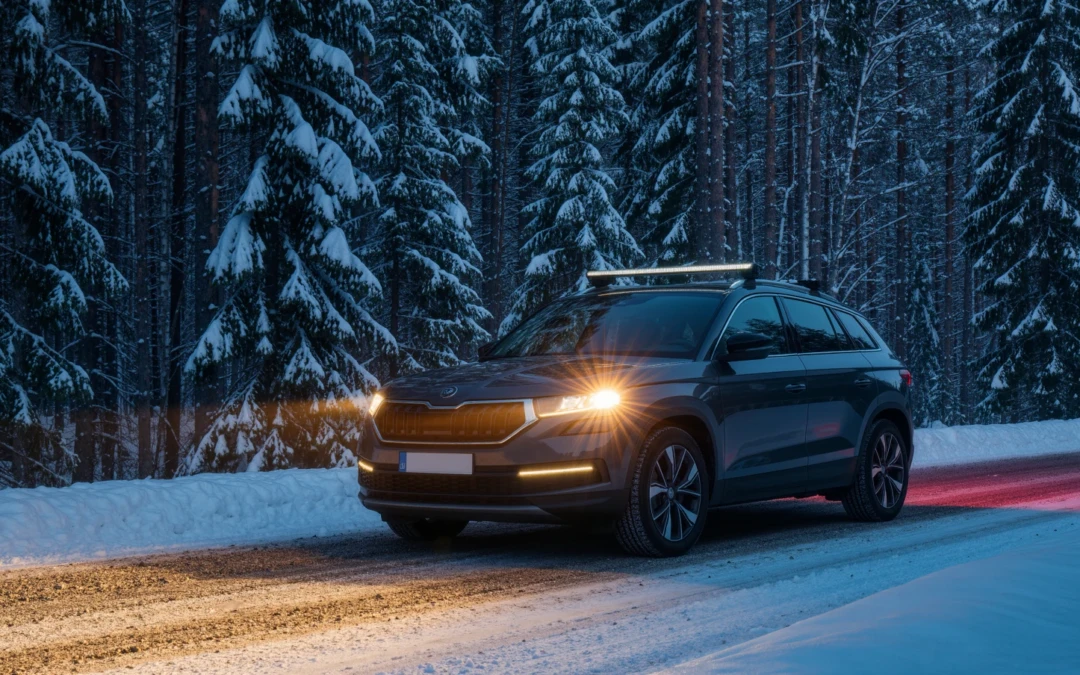
A roof light bar used to light the road ahead is a high beam in function, so it must meet code 203 and count toward the six-lamp limit. One sold as a work light falls under code 219 and § 43.
Use on the road
- § 41(1): high beams may be used when driving in the dark or in poor visibility.
- § 42: front fogs may be on with the headlights in fog or precipitation, and may replace dipped beams; rear fogs only outside built-up areas in fog or precipitation, or when snow, dust or mud thrown up by the wind seriously reduces visibility from behind.
Fines and consequences
The Traffic Act (consolidated version RT I, 11.07.2026, 45) writes no fine line for a non-approved bulb. What it does have: driving a vehicle that was rebuilt without permission is punished with up to 50 fine units = up to €400 (§ 218; rebuilding needs Transport Administration permission under § 79). The texts I read do not say whether a bulb swap counts as a rebuild, so I do not claim it. At a roadside check the police may also send a car with a significant or dangerous fault to an extraordinary inspection (§ 196²(1) point 9). One fine unit is €8 (Penal Code § 47(1)).
Foreign drivers and rental cars
Regulation No 42 is written for vehicles in the Estonian register. The rules on using lights (§ 41–§ 43) apply to every driver in Estonia, foreign plates included.
Mistakes I see most often
- A “plug-and-play” LED bulb in a halogen headlamp. Code 201 asks for a bulb approved under UN Regulation 37, 99 or 128.
- A xenon kit in a car without automatic levelling and washers – code 204 requires both above 2,000 lm, even for retrofits.
- A work-light bar left on while driving on a public road.
Do the math: The bill: correct approved bulbs = €0 risk. A rebuild without permission, if a change is judged to be one = up to 50 × €8 = €400. Self-levelling and washers are expensive – which is exactly why a cheap xenon kit is never really cheap.
FAQ
Can I put LED bulbs into my halogen headlamps? Only if the bulb is approved under UN Regulation 37, 99 or 128 for that use (code 201 point 3). Above 2,000 lm, code 204 also demands self-levelling and a headlamp cleaner.
Is a roof light bar legal? As a driving beam, only if it is approved under one of the regulations in code 203, installed per UN Regulation 48 and within six high beams in total. As a work light, it may be on only while working (§ 43).
Who can approve a lamp conversion? The Transport Administration, in justified cases, under code 201 point 2 – not for type-approved lamps.
Where to check
Riigi Teataja: regulation No 42, annex 1, codes 201, 203, 204, 207, 219 (version RT I, 24.10.2025, 4); Liiklusseadus § 41, § 42, § 43, § 79, § 196², § 218 (version RT I, 11.07.2026, 45); Karistusseadustik § 47(1).
Ivan’s Take
More light in an Estonian winter is a real safety gain – if it is the right light. I would rather pay once for approved headlamps with levelling than save on a kit that blinds every oncoming driver. Bright is good; dazzling is just rude and expensive.
Sources: Riigi Teataja – Mootorsõiduki ja selle haagise tehnonõuded ning nõuded varustusele (RT I, 24.10.2025, 4); Riigi Teataja – Liiklusseadus (RT I, 11.07.2026, 45); Riigi Teataja – Karistusseadustik (RT I, 09.07.2026, 28).
Published:
More from this section
The AvtoGear weekly
Once a week: new tests, the best deals and one useful tip for your car. Nothing extra.
