








In short
- Loads may be carried only so that they do not hinder driving, restrict the driver’s view or cover lights, number plates or signals (Traffic Act § 34(1)).
- A load sticking out more than 1 m to the front or rear must be marked at its furthest point; a load sticking out to the side needs a white or yellow light in front and a red one behind (regulation No 42, codes 115 and 226).
- Breaking load-carrying rules costs up to 100 fine units = up to €800 (§ 238).
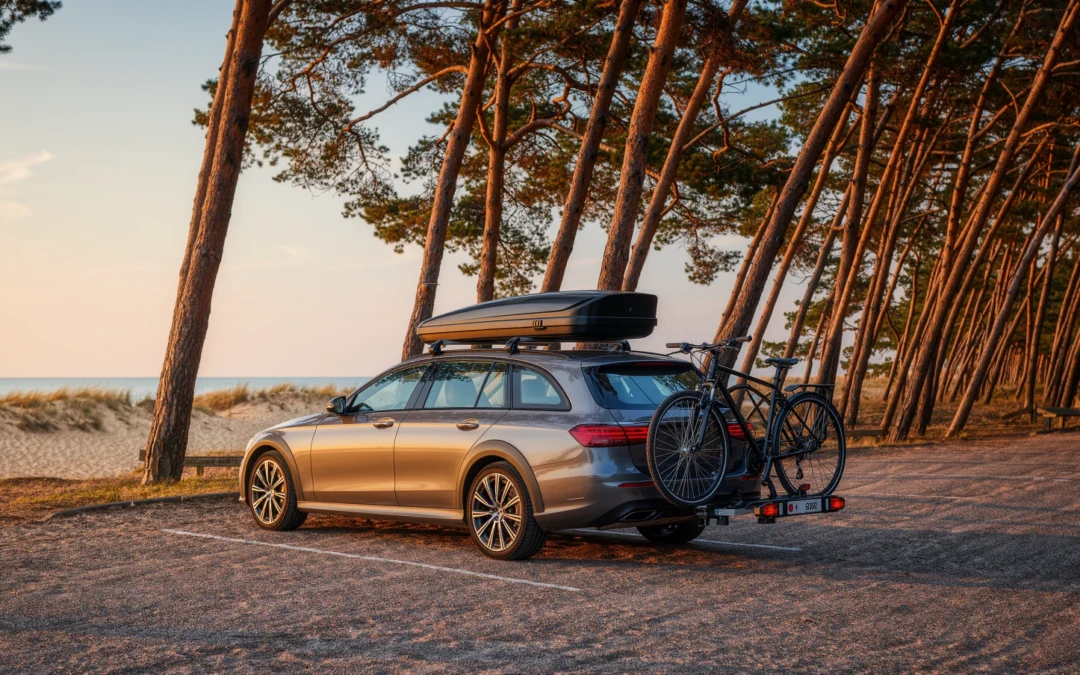
Summer at the Estonian seaside means bikes on the back and a roof box on top. Both are legal. What gets drivers fined is not the box or the rack, but what they hide or how loosely they are tied down.
The rule in detail
§ 34 of the Traffic Act (Liiklusseadus, consolidated text in force since 1 October 2026) covers carrying passengers and loads. For anyone with a roof box, a bike rack or a trailer full of boards, these parts matter:
- § 34(1): loads may be carried only in a way that does not hinder driving, does not restrict the driver’s field of view and does not cover the vehicle’s lights, registration and identification plates or the driver’s signals.
- § 34(6): the load must be placed, secured and covered according to its nature so that it does not endanger people or the environment, cause damage or obstruct traffic.
- § 34(13¹): the mass should be spread as evenly as possible, the load should form one unit, the centre of gravity should be as low as possible, shifting must be prevented and sharp ends must point backwards.
- § 34(13²): straps and other securing devices must meet the requirements, suit the purpose, be intact and strong enough to hold the load in place.
- § 34(7): when driving under a viaduct, power line or similar, the driver must always make sure it is safe – worth remembering with a roof box and bikes on the roof.
- § 34(8) and (12): the vehicle with its load may not exceed the dimensions set under § 80(3), and its actual mass may not exceed the registered mass.
§ 33(2) point 8¹ adds that the driver must make sure fitted extra equipment – a rack is exactly that – does not endanger people, cause damage or obstruct traffic.
Marking overhanging loads
- Code 115 (regulation No 42, annex 1): a load sticking out more than 1 m to the front or rear of the vehicle or combination must have an overhanging-load sign at its furthest point.
- Code 226: a load sticking out beyond the side of the vehicle is marked with a white or yellow light in front and a red light behind, fixed on a flexible rod or on the load.
- Code 201 point 9: vehicle parts or the load must not cover the light opening of a lamp or reduce its visibility.
The same regulation names the roof rack (pakiraam) among the parts exempt from its sharp-edge rule for the car body (code 604 point 2) – the rules clearly expect cars to carry roof racks.
Fines
One fine unit is €8 (Penal Code § 47(1), since 1 January 2025).
- Breaking passenger- or load-carrying requirements (§ 238): up to 100 units = up to €800.
- The out-of-court processor is the Police and Border Guard Board (§ 263(1)).
I found no separate fine line for a missing overhang sign or a covered plate; both are load-carrying requirements, and § 238 is the article the law writes for breaking them.
Foreign drivers and rental cars
§ 34 and § 238 apply to every driver on Estonian roads. If you arrive with a bike rack on a foreign car, the Estonian rule about visible lights and plates applies on the first kilometre. On a rental, check the rack fits and the plate is not hidden before you leave the lot.
Mistakes I see most often
- A tow-bar bike rack that hides the number plate or a rear lamp.
- Long boards or pipes sticking out more than 1 m behind with no marking.
- A roof box packed with the heavy stuff, a loose strap flapping on the motorway – against § 34(13¹) and (13²).
Do the math: The bill: a covered plate or an unmarked 1.5 m overhang can cost up to 100 × €8 = €800. A proper overhang sign or a rack with its own lights costs a fraction of that. The cheapest piece of holiday equipment is the one that keeps your plate visible.
FAQ
Is a roof box legal in Estonia? Yes. The law does not ban it; it requires the load to be secured, not to restrict the view and not to exceed the permitted dimensions and mass.
My bike rack covers the number plate – what now? § 34(1) forbids loads that cover lights or registration plates. You need a solution that keeps both visible, for example a rack with its own lights and plate holder.
From what overhang do I need a sign? From more than 1 m to the front or rear (code 115). Side overhangs need lights front and rear (code 226).
Where to check
Riigi Teataja: Liiklusseadus § 33(2) point 8¹, § 34, § 238, § 263 (version RT I, 11.07.2026, 45); regulation No 42, annex 1, codes 115, 201, 226, 604 (version RT I, 24.10.2025, 4); Karistusseadustik § 47(1).
Ivan’s Take
I love a loaded car heading for Pärnu, but I check two things before every trip: can I see the plate and both rear lights, and does every strap pass the shake test. Ten minutes in the driveway is cheaper than €800 and a bike on the road.
Sources: Riigi Teataja – Liiklusseadus (RT I, 11.07.2026, 45); Riigi Teataja – Mootorsõiduki ja selle haagise tehnonõuded ning nõuded varustusele (RT I, 24.10.2025, 4); Riigi Teataja – Karistusseadustik (RT I, 09.07.2026, 28).
Published:
More from this section
The AvtoGear weekly
Once a week: new tests, the best deals and one useful tip for your car. Nothing extra.
