








In short
- A wireless car charger (Qi) charges your phone when you place it on a pad or magnetic mount. No cable.
- It is slower and warmer than a cable, and it stops if the phone slips out of position.
- A cable costs a few euros. Wireless is an extra on top of the phone holder you need anyway.
The short answer: Wireless car charging is convenient for short trips but slower and warmer than a cable, so keep the cable for long drives.
What it is
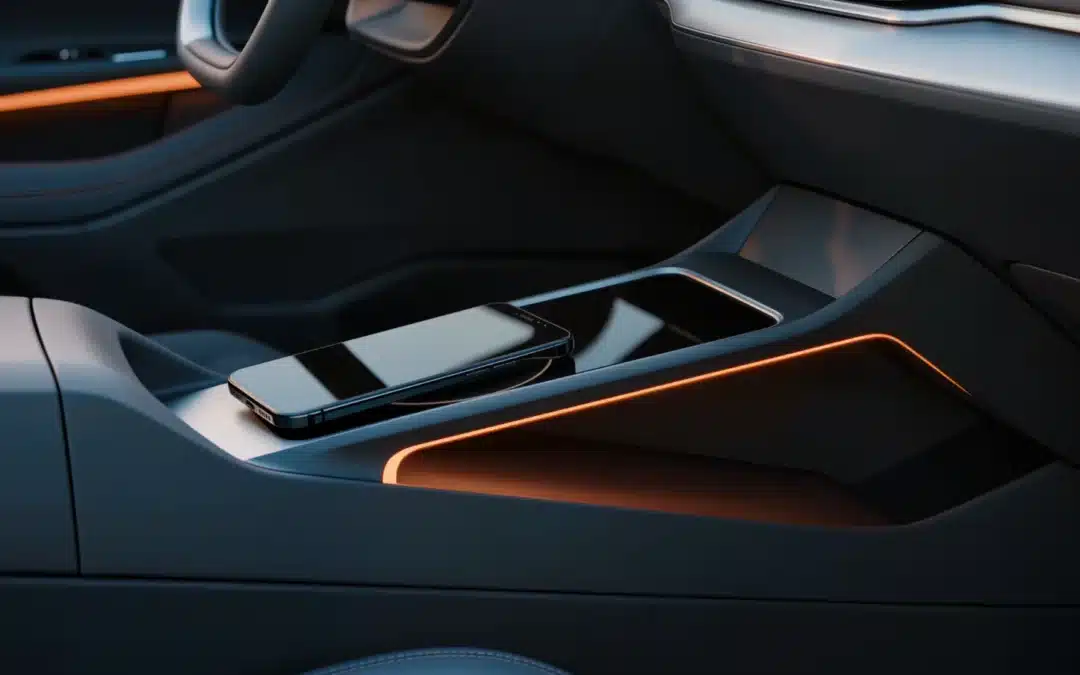
Wireless charging in the car uses the Qi standard. You put the phone on a pad in the console, or on a mount on the vent or windscreen, and it charges. No plug.
Qi2 adds magnets that snap the phone into the right spot. Many recent phones with a magnet ring, such as iPhones with MagSafe, work with magnetic mounts. Check your own model before you buy.
What it gives you
Convenience. You drop the phone on the mount and it charges. Nothing to plug in with one hand, no worn USB port, one cable less in sight.
It suits short trips where you just want the battery topped up for navigation.
What it costs you
Speed. A USB-C car charger with a cable can deliver more power than most car pads. We covered 30 W, 65 W and 100 W in our car charger wattage article.
Heat. Wireless charging turns part of the power into heat. A phone on a sunny dashboard can slow its own charging to protect the battery.
Position. A thick case, a metal plate or a card behind the phone can stop charging. A bump in the road can move the phone off the coil.
Navigation. With maps running and the screen on, a slow pad may only slow the drain, not fill the battery.
Do the math: A charging cable costs a few euros. A wireless mount is a phone holder plus charging, so you pay extra for the charging part. I have no verified price list for charging mounts, so check the shelf price. For scale, Auto Bild’s holder test in our earlier article found a €16 magnet mount tied with a €38 motorised suction mount, and those are holders alone. Is the extra worth it? Only if you really hate plugging in a cable.
What to look for
Qi2 or a magnetic mount if your phone has magnets. Without magnets, pick a mount with a clamp that holds the phone firmly.
The power in watts, stated by the maker. Be sceptical of vague claims.
A fit for your phone with its case on.
A solid mount that does not wobble on a rough road.
A proper power source. The pad needs a good car charger plugged into the 12 V socket, or it will charge slowly.
Pros and cons
- Pro: drop in and go, no cable fiddling.
- Pro: less wear on the phone’s charging port.
- Con: slower and warmer than a cable.
- Con: stops when the phone shifts, and a thick case can block it.
- Con: costs more than a simple holder plus a cable.
Who it is for
Drivers who make many short trips, get in and out of the car all day and hate cables. Skip it if you take long trips with navigation running, or your phone has a thick case you do not want to remove. A good cable does the job better there.
Ivan’s Take
My verdict: nice to have, not worth chasing. For long drives with navigation I would take the cable every time, because it charges faster and stays cooler. I would buy a magnetic wireless mount only if my phone has magnets and I make lots of short hops.
Published:
More from this section

The AvtoGear weekly
Once a week: new tests, the best deals and one useful tip for your car. Nothing extra.
