








In short
- Great Britain has no legal rule that you must carry a warning triangle, reflective vest or first aid kit. The Highway Code only advises a triangle ‘if you have them’, and never on motorways.
- What the law does require is on the car itself: tyres with at least 1.6 mm tread, a horn, wipers and washers, mirrors, a clear view ahead, and clean, correctly aimed lights.
- Defective tyres: £100 (≈ €120) fixed penalty and 3 points, or up to £2,500 (≈ €2,992) in court. Other construction and use breaches: £50 (≈ €60) fixed penalty.
Drivers from the continent arrive with a boot full of kit that British law does not ask for. Then they get stopped for a bald tyre. Here is the real list for England, Scotland and Wales.
How to read British rules
The Highway Code tells you which rules are law. Rules written with MUST or MUST NOT are legal requirements, and breaking them is a criminal offence. The other rules are advice, though a court can use them as evidence. Euro amounts use the Bank of England rate of 11 November 2026: £1 = €1.1969.
Warning triangle, vest, first aid kit: advice only
Rule 276 says that if you break down you should use your hazard warning lights, wear light-coloured or fluorescent clothing in daylight and reflective clothing at night, and put a warning triangle at least 45 metres behind the car, or other permitted warning devices, if you have them. Never use them on motorways.
No MUST in that rule. So in Great Britain there is no fine for not carrying a triangle or a vest. If you drive on to France or Spain, their rules apply there.
- United Kingdom: Cycle Carriers That Cover the Number Plate, Roof Boxes and Overhang Limits
- United Kingdom: MOT Test – Due at 3 Years, Maximum £54.85, and up to £1,000 Fine Without One
- United Kingdom: Road Safety Strategy 2026 – Lower Drink-Drive Limit, Seat Belt Points and Eye Tests at 70 on the Table
What the law requires on the car
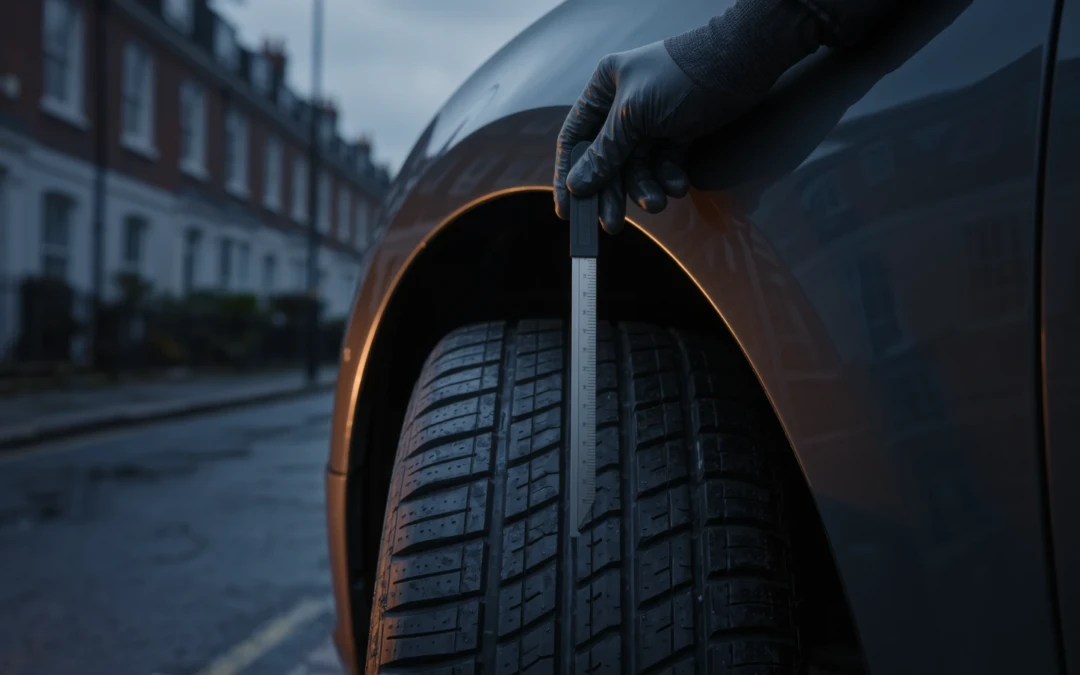
- Tyres: cars, light vans and light trailers need at least 1.6 mm of tread across the central three-quarters of the tread and around the whole circumference. Tyres must be inflated to the maker’s specification for the load (C&U Regulations 1986, reg. 27).
- Horn: every motor vehicle with a top speed above 20 mph must have one. Its sound must be continuous, uniform and not strident; bells, gongs, sirens and two-tone horns are banned on normal cars (reg. 37).
- Wipers and washers: efficient automatic wipers that give an adequate view ahead, plus a washer that clears the swept area (reg. 34).
- View ahead: the driver must have a full view of the road and traffic ahead, and all glass must be kept so it does not obscure the driver’s vision (reg. 30).
- Mirrors: the mirrors or other devices for indirect vision required for your vehicle class (reg. 33).
- Lights: lights, indicators, reflectors and number plates must be kept clean and clear, and lights must be adjusted so they do not dazzle (Road Vehicles Lighting Regulations 1989, regs. 23 and 27).
An MOT certificate does not cover you here. Gov.uk says a car can be unsafe even with a current MOT, and you are responsible for keeping it roadworthy.
Fines and penalties
- Defective tyres, brakes or steering (Road Traffic Act 1988, s.41A): fixed penalty £100 (≈ €120) and 3 points (tyres: code CU30); in court up to £2,500 (≈ €2,992), level 4.
- Using a vehicle in a dangerous condition (s.40A): up to £2,500 (≈ €2,992), 3 points and possible disqualification.
- Other construction and use breaches (s.42), for example horn, wipers or mirrors: fixed penalty £50 (≈ €60); in court up to £1,000 (≈ €1,197) for a car.
- Minor defect such as a broken brake light: police may issue a vehicle defect rectification notice. You then have 14 days to show proof of the repair.
Fixed penalty amounts come from the Fixed Penalty Order 2000 (items 4 and 41); court maximums from Schedule 2 of the Road Traffic Offenders Act 1988.
Foreign drivers and rental cars
Rental car: check the tread and lights before you leave the desk. The points go on the licence of the person driving.
Your own left-hand-drive car: the rule that lights must not dazzle applies to you too. A continental dipped beam is aimed for driving on the right, so check how your car’s headlights are adjusted for driving on the left before the trip.
Mistakes I see most often
- Spending on a triangle and vest for the UK while the front tyres are at 2 mm and wearing unevenly.
- Driving with a cracked or iced windscreen. The view-ahead rule is law, not advice.
- Fitting a two-tone or musical horn. It is banned on a normal car.
Do the math: The math: a tread depth gauge costs a few pounds and a check takes a minute. A defective tyre at a stop: £100 (≈ €120) and 3 points as a fixed penalty, or up to £2,500 (≈ €2,992) if it goes to court. Gov.uk reminds you that 12 points within 3 years can mean a driving ban, so 3 points for one worn tyre is a quarter of the way there.
FAQ
Do I have to carry a warning triangle in the UK? No. The Highway Code advises using one if you have it, at least 45 metres behind the car, but never on motorways. It is not a MUST rule.
What is the minimum tread depth in the UK? 1.6 mm for cars, light vans and light trailers, across the central three-quarters of the tread and around the whole tyre.
Can police fine me for a broken bulb? They may instead give you a vehicle defect rectification notice. You then have 14 days to prove it has been fixed.
Ivan’s Take
Britain checks the car, not the boot. I would rather spend the money on two good tyres and a working set of bulbs than on a kit bag nobody will ask to see. Keep the triangle anyway, just never put it out on a motorway.
Sources: The Highway Code – Introduction (MUST/MUST NOT = law); The Highway Code – Breakdowns and incidents, rule 276; The Highway Code – Annex 6: Vehicle maintenance, safety and security; GOV.UK – Check your vehicle is safe to drive; GOV.UK – Stopped by the police: faults with your vehicle; Road Vehicles (Construction and Use) Regulations 1986, regs. 27, 30, 33, 34, 37; Road Traffic Offenders Act 1988, Schedule 2 (s.40A, s.41A, s.42); Road Traffic Offenders Act 1988, Schedule 3 (fixed penalty offences); Fixed Penalty Order 2000, Schedule 1 (items 4 and 41); GOV.UK – Endorsement codes (CU30); Bank of England – daily spot exchange rates (GBP/EUR, 11.11.2026).
Published:
More from this section

The AvtoGear weekly
Once a week: new tests, the best deals and one useful tip for your car. Nothing extra.
