








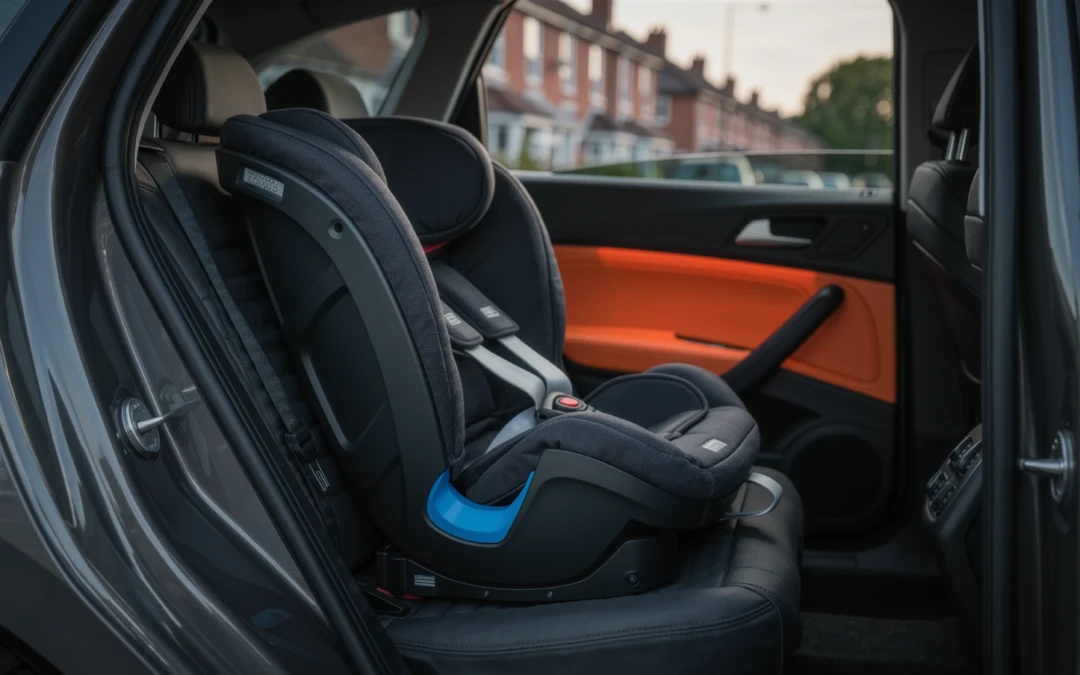
In short
- Children must use a child car seat until they are 12 years old or 135 cm tall, whichever comes first. After that, a seat belt.
- Only approved seats are allowed: height-based i-Size seats marked R129, rear-facing until the child is over 15 months, or weight-based seats marked ECE R44.
- The driver is responsible for every child under 14: a £100 (€120) fixed penalty, up to £500 (€598) in court.
Many parents pack the child seat for a UK trip and forget the second half of the rule: the age limit. In the UK a 10-year-old who is 130 cm still needs a booster. And if a rear-facing baby seat goes in the front, the airbag must be off, or the driver commits an offence under the Road Traffic Act. Here is what GOV.UK and the law require.
The basic rule
Section 15 of the Road Traffic Act 1988 makes it an offence to drive with a child under 14 who is not restrained as the regulations require, in the front or in the rear. GOV.UK sets out the practical rule:
- A child must normally use a child car seat until 12 years old or 135 cm tall, whichever comes first.
- Children over 12 or taller than 135 cm must wear a seat belt.
- Children aged 12 and 13 are still the driver’s responsibility: they must wear the belt, and the driver is the one fined.
Which seats are legal
Only approved seats can be used in the UK. There are two systems:
- Height-based (i-Size) seats: a label with a capital E in a circle and R129. They must be rear-facing until the child is over 15 months old.
- Weight-based seats: a label with E in a circle and ECE R44. Group 0 up to 10 kg and group 0+ up to 13 kg are rear-facing; group 1 covers 9 to 18 kg; groups 2 and 3 cover 15 to 36 kg with high-backed boosters or booster cushions.
- Manufacturers can now make new booster cushions only for group 3 (22 to 36 kg). Existing group 2 cushions can still be used.
- United Kingdom: Cycle Carriers That Cover the Number Plate, Roof Boxes and Overhang Limits
- United Kingdom: MOT Test – Due at 3 Years, Maximum £54.85, and up to £1,000 Fine Without One
- United Kingdom: Road Safety Strategy 2026 – Lower Drink-Drive Limit, Seat Belt Points and Eye Tests at 70 on the Table
Fitting rules
- Use a child seat only with a seat belt that has a diagonal strap, unless the seat is designed for a lap belt or fitted with ISOFIX.
- Deactivate the front airbag before fitting a rear-facing baby seat in the front. Section 15(1A) makes driving with an active airbag in that case an offence.
- Never fit a child seat in a side-facing seat.
- Children with a disability can use a disabled person’s belt or a restraint designed for them. A doctor can issue an exemption certificate.
When a child may travel without a child seat
- Taxis and minicabs: if the driver has no suitable seat, a child of 3 or older may use an adult belt on a rear seat, and a child under 3 may travel on a rear seat without a belt.
- Unexpected journey: a child of 3 or older may use an adult belt if the trip is unexpected, necessary and over a short distance.
- No room for a third child seat in the back: a child of 3 or older may sit in the back with an adult belt. A child under 3 must go in the front in the correct child seat.
- Cars made without seat belts, such as some classic cars: no children under 3 at all, and children over 3 only in the back.
Vans follow the same rules as cars. Minibuses and coaches have their own lighter rules, because operators do not have to provide child seats.
Fines
- Fixed penalty under the Fixed Penalty Order 2000 for an offence under section 15(2) or 15(4) of the Road Traffic Act: £100 (€120).
- In court: up to level 2, which GOV.UK puts at up to £500 (€598) if a child under 14 is not in the correct seat or belt.
- No penalty points: the Road Traffic Offenders Act 1988, Schedule 2, does not list section 15 as an endorsable offence.
Foreign drivers and rental cars
- The rules apply to every car on UK roads, including foreign-registered ones.
- A seat from home is fine if it carries the R129 or ECE R44 approval label.
- When renting, ask for an R129 seat and check the airbag switch before you put a baby in the front.
Mistakes I see most often
- Taking a 9-year-old out of the booster because she looks big enough. Under 135 cm and under 12, she still needs it.
- A rear-facing seat in the front with the airbag on. That is a separate offence, and very dangerous.
- Thinking a short daily run counts as an unexpected journey. It must be unexpected and necessary.
Do the math: Do the math: A fixed penalty of £100 (€120), up to £500 (€598) in court, every time you are stopped. A decent high-backed booster costs less than that and lasts years. The airbag switch costs nothing.
FAQ
At what age can a child stop using a car seat in the UK? At 12 years old or 135 cm tall, whichever comes first.
Can a child sit in the front seat in the UK? Yes, in the correct child seat or belt. For a rear-facing seat in the front, the airbag must be deactivated.
Who pays the fine if a child is not belted in? The driver, for every child under 14.
Where to check
GOV.UK pages Child car seats: the rules and Seat belts: the law; Road Traffic Act 1988 section 15; Fixed Penalty Order 2000, Schedule 1 item 8; Road Traffic Offenders Act 1988, Schedule 2, all on legislation.gov.uk. Pounds at the Bank of England rate of 11 November 2026: £1 = €1.1969.
Ivan’s Take
I check the child seat label before I check the tyre pressure. R129 or R44, the right height, airbag off if the seat faces back. Two minutes in the car park, and the £100 is the least of what it saves.
Sources: GOV.UK: Child car seats: the rules; GOV.UK: Seat belts: the law; Road Traffic Act 1988, section 15 (children in motor vehicles); Fixed Penalty Order 2000, Schedule 1 (item 8); Road Traffic Offenders Act 1988, Schedule 2; Bank of England: GBP/EUR spot rate 11.11.2026.
Published:
More from this section

The AvtoGear weekly
Once a week: new tests, the best deals and one useful tip for your car. Nothing extra.
