








In short
- Great Britain has no winter tyre requirement. The legal tyre rule all year is at least 1.6 mm of tread on cars.
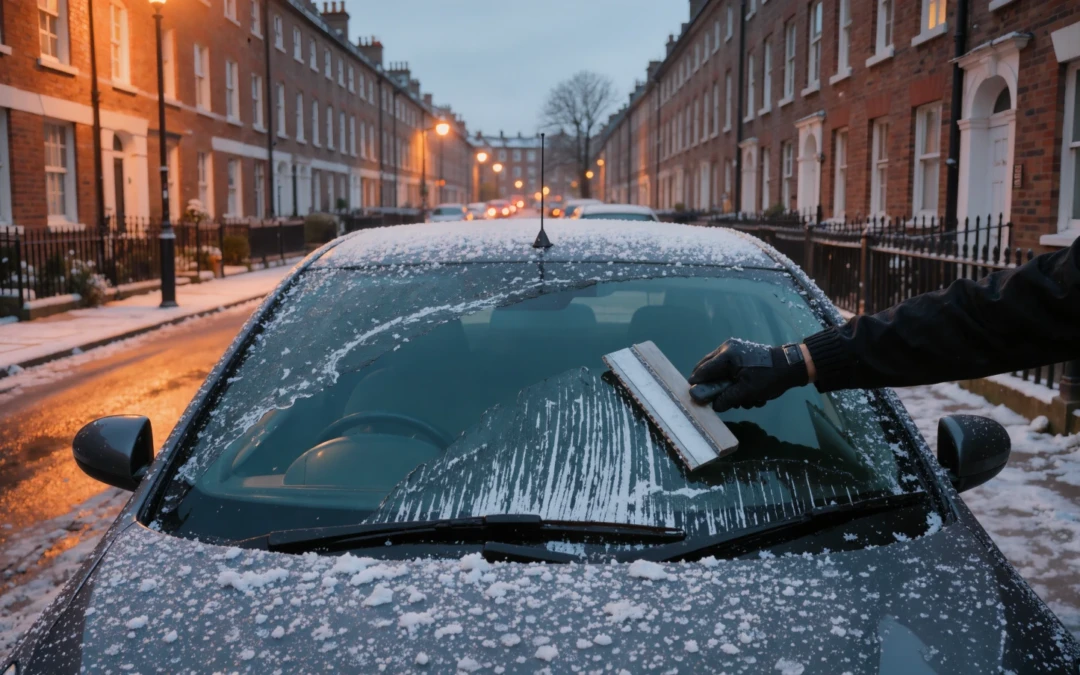
- Before you drive you MUST clear snow and ice from all windows and keep lights clean and number plates readable (Highway Code rule 229).
- Obscured number plate: £100 (≈ €120) fixed penalty or up to £1,000 (≈ €1,197) in court. Iced-up windows or engine left running unattended: £50 (≈ €60) fixed penalty.
British winters are short and wet, and many drivers from the continent assume nothing applies. Wrong. The UK does not care about your tyre type, it cares about what you can see. Here are the rules for England, Scotland and Wales.
Winter tyres and chains
The Highway Code’s winter rules (228 to 231) say nothing about winter tyres. There is no date from which they are required. The legal tyre rule is the same all year: cars, light vans and light trailers need at least 1.6 mm of tread across the central three-quarters and around the whole tyre, and the right pressure for the load (Construction and Use Regulations 1986, reg. 27).
So winter tyres are your choice, not a legal duty. We found no official rule on snow chains in the sources below, so we do not quote one. Euro amounts use the Bank of England rate of 11 November 2026: £1 = €1.1969.
What you MUST do before setting off
Rule 229 of the Highway Code has two MUST points, which means they are law:
- You must be able to see, so clear all snow and ice from all your windows (C&U reg. 30: full view of the road ahead, glass must not obscure vision).
- Lights must be clean and number plates clearly visible and legible (Road Vehicles Lighting Regulations, reg. 23; Vehicle Excise and Registration Act 1994, s.43).
The same rule also advises clearing the mirrors, demisting the windows and removing snow that could fall off into the path of other road users, for example from the roof.
- United Kingdom: Cycle Carriers That Cover the Number Plate, Roof Boxes and Overhang Limits
- United Kingdom: Road Safety Strategy 2026 – Lower Drink-Drive Limit, Seat Belt Points and Eye Tests at 70 on the Table
- United Kingdom drink-drive limits: 35 µg in England, 22 µg in Scotland, and a 1-year minimum ban
While you drive
- Headlights are a MUST when visibility is seriously reduced, generally when you cannot see more than 100 metres (rule 226).
- Fog lights may be used then, but you MUST switch them off when visibility improves (rule 226, RVLR regs. 25 and 27).
- On icy roads stopping distances can be ten times greater than on dry roads (rule 230). Keep well back.
The warm-up trap
Leaving the car running on the drive to defrost? On a road, the law says you must not leave a motor vehicle unattended unless the engine is stopped and the parking brake set (C&U reg. 107). A separate rule says the driver must stop the engine when stationary, other than in traffic, where needed to prevent noise or exhaust emissions (reg. 98).
Fines and penalties
- Number plate obscured or not easily distinguishable (VERA 1994, s.43): fixed penalty £100 (≈ €120); in court up to £1,000 (≈ €1,197). The law gives a defence if you took all reasonably practicable steps to keep it clear.
- Windows iced or misted so the glass obscures your vision (C&U reg. 30), engine left running unattended (reg. 107): offences under s.42 Road Traffic Act 1988, fixed penalty £50 (≈ €60); in court up to £1,000 (≈ €1,197) for a car.
- Tyres below 1.6 mm (s.41A): fixed penalty £100 (≈ €120) and 3 points; in court up to £2,500 (≈ €2,992).
Fixed penalty amounts come from the Fixed Penalty Order 2000, Schedule 1 (items 4, 12 and 41).
Foreign drivers and rental cars
Rental car in December? Ask for a scraper and de-icer at the desk, or buy them at the first petrol station. You are the driver, so a frozen windscreen is your offence, not the rental company’s.
Driving on to the Alps after the ferry? The UK does not ask for winter tyres, but your next country may. Check its rules before the trip.
Mistakes I see most often
- Scraping a small ‘porthole’ in the windscreen and driving off. The law asks for all windows.
- Forgetting the rear plate under a layer of slush.
- Leaving the engine running on the street to warm the car while you go back inside.
Rule 228: the advised winter kit
The Highway Code recommends, without a MUST, taking de-icer and an ice scraper, a torch, warm clothing and boots, a first aid kit, jump leads, a shovel, a warm drink and emergency food. It also says do not drive in icy or snowy weather unless your journey is essential.
Do the math: The math: a scraper and a can of de-icer cost a few pounds and five minutes. A plate covered in slush can cost £100 (≈ €120) on the spot, and a windscreen you can’t see through another £50 (≈ €60). In court each can go up to £1,000 (≈ €1,197). Five minutes of scraping is the cheapest winter kit you will ever buy.
FAQ
Are winter tyres mandatory in the UK? No. Neither the Highway Code winter rules nor the tyre regulation require them. The legal minimum is 1.6 mm of tread on a car.
Can I be fined for not clearing snow off the car? Yes for windows and plates: those are legal requirements. Snow on the roof is covered by advice in rule 229, not by a MUST.
Can I leave the engine running to defrost the car? Not unattended on a road. The engine must be stopped and the parking brake set when nobody licensed to drive is with the car.
Ivan’s Take
British winter rules are about one thing: seeing and being seen. Winter tyres are a smart buy if you live up north, but no officer will ask about them. The plate and the windscreen they will look at, so clear both completely before you drive off.
Sources: The Highway Code – Driving in adverse weather conditions, rules 226–237; The Highway Code – Introduction (MUST/MUST NOT = law); The Highway Code – Annex 6 (tyres); Road Vehicles (Construction and Use) Regulations 1986, reg. 27, 30, 98, 107; Vehicle Excise and Registration Act 1994, s.43; Road Traffic Offenders Act 1988, Schedule 2; Fixed Penalty Order 2000, Schedule 1 (items 4, 12, 41); Bank of England – daily spot exchange rates (GBP/EUR, 11.11.2026).
Published:
More from this section
The AvtoGear weekly
Once a week: new tests, the best deals and one useful tip for your car. Nothing extra.
