








In short
- In England, Scotland and Wales you may not hold and use a phone or any device that can send or receive data while driving, even at traffic lights or in flight mode (regulation 110, Construction and Use Regulations).
- The fixed penalty is £200 (about €239) and 6 penalty points. In court: up to £1,000 (about €1,197) and a possible ban.
- Passed your test less than 2 years ago? 6 points cancel your licence, and you start again with a new provisional licence and both tests.
The UK does not do warnings for this one. A phone in your hand at the wheel costs £200 and 6 points on the spot. For a new driver it costs the licence itself. Here is what the law really says, what hands-free allows and the few exceptions.
The rule: no device in your hand
Regulation 110 of the Road Vehicles (Construction and Use) Regulations 1986 applies in England, Wales and Scotland. You must not drive a motor vehicle on a road while using a hand-held mobile phone or any other hand-held device that can transmit and receive data. Since 25 March 2022 it does not matter whether that function is switched on. A phone in flight mode still counts.
Hand-held means the device is, or must be, held at some point while you use it. And “using” is defined very widely. The law lists:
- lighting up the screen, checking the time or notifications, unlocking the phone
- making, taking or rejecting a call
- sending or receiving text, photos or video, recording video or sound
- drafting a text, opening documents, music, playlists or photos
- opening an app or the internet
GOV.UK adds the situations people get caught in: stopped at traffic lights, queuing in traffic, a car whose engine switches off when you stop. All of them still count as driving. The same ban applies to the person supervising a learner driver.
What hands-free allows
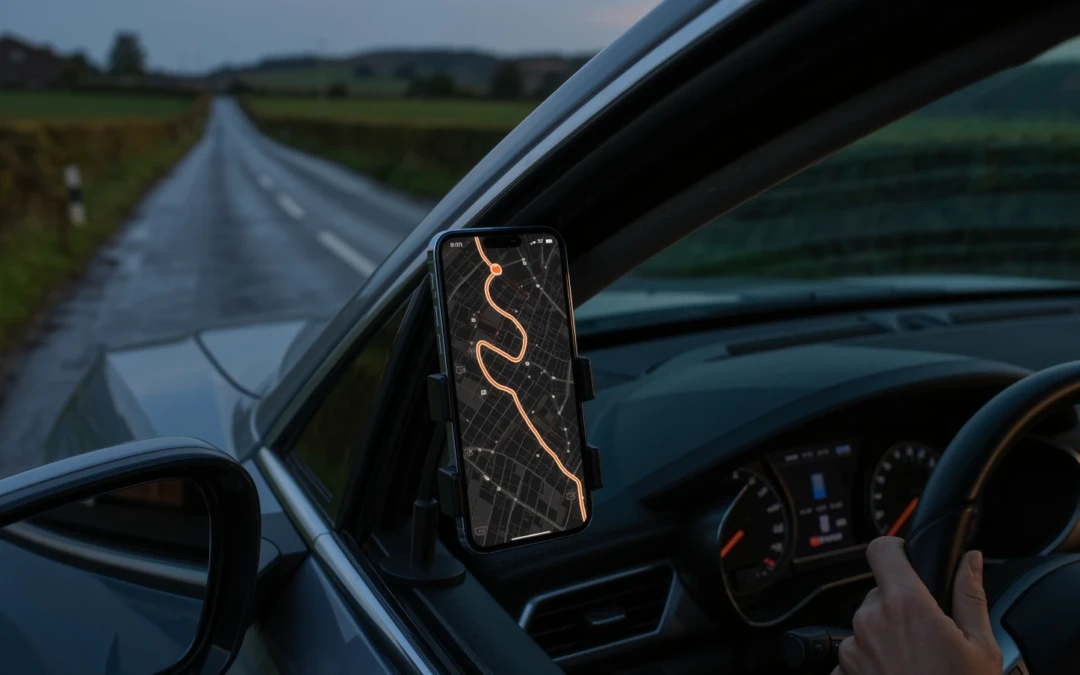
You may use a device as long as you never hold it. GOV.UK names a Bluetooth headset, voice command, a dashboard holder or mat, a windscreen mount and a built-in sat nav. Two conditions: the device must not block your view of the road and traffic ahead, and you must stay in full control. Rule 149 of the Highway Code adds a trap: you must not pick the phone up to dial and then put it in the cradle for the call. Picking it up is the offence.
The only exceptions
- Calling 999 or 112 in a genuine emergency when it is unsafe or impractical to stop.
- Being safely parked.
- A contactless payment while the car is not moving, for something you receive at the same time or after, for example at a drive-through.
- Remote-control parking with an app: the app needs continuous activation and the phone may be no more than 6 metres from the car.
Fines and points
- Holding and using a phone or data device while driving: £200 (about €239) and 6 penalty points.
- No full view of the road or no proper control, for example a badly placed mount or a distraction with hands-free: 3 penalty points.
- If it goes to court: a driving ban is possible and a maximum fine of £1,000 (about €1,197), or £2,500 (about €2,992) for lorry and bus drivers.
- New drivers: 6 points within 2 years of passing the test and the licence is cancelled.
Northern Ireland has its own legislation, but nidirect gives the same result: automatic fixed penalty of £200 and 6 points, up to £1,000 in court (£2,500 for buses and goods vehicles), and the same 6-point rule for new drivers.
Foreign drivers and rental cars
The ban applies to every driver on a UK road, whatever the plate on the car or the country on the licence. GOV.UK says the new-driver rule covers drivers who passed their first test in Great Britain, Northern Ireland, the Isle of Man, the Channel Islands, Gibraltar and EU or EEA countries. A rental car usually has a built-in screen with phone mirroring. Pair your phone before you leave the car park, not on the motorway.
Mistakes I see most often
- Picking the phone up at red lights. Stationary in traffic is still driving.
- Flight mode as an excuse. Since 2022 it changes nothing.
- A mount in the middle of the windscreen that hides part of the road. That is the 3-point offence.
Do the math: A new driver caught once: £200 fine. Licence cancelled, so a new provisional licence £34, theory test £23 and practical test £62 on a weekday. Total £319, about €382, plus months without driving. A dashboard holder costs a fraction of the fine alone.
FAQ
Can I use my phone as a sat nav? Yes, if it sits in a holder or mount, you set the route before you drive and you do not hold it at any point while using it.
Can I touch the phone in its holder? The ban is about a hand-held device. Rule 149 and GOV.UK still require full control and a clear view at all times. If the police think you were distracted, they can prosecute you.
Does the ban apply at a drive-through? Paying contactless with your phone is allowed when the car is not moving and you get the goods at the same time or after.
Where to check
- Road Vehicles (Construction and Use) Regulations 1986, regulation 110, on legislation.gov.uk
- Highway Code rules 149 and 150
- GOV.UK: Using mobile phones when driving: the law; Penalty points: new drivers
- nidirect: Using your mobile phone while driving (Northern Ireland)
- Exchange rate: Bank of England, 11 November 2026, £1 = €1.1969
Ivan’s Take
I keep my phone in a holder and set the route before I start the engine. That is all it takes. £200 and 6 points for one look at a message is the worst deal on British roads, and for a new driver it is the most expensive text of their life.
Sources: Road Vehicles (Construction and Use) Regulations 1986, reg. 110 (legislation.gov.uk); GOV.UK: Using mobile phones when driving: the law; The Highway Code, rules 144-158 (GOV.UK); GOV.UK: Penalty points, new drivers; GOV.UK: Driving test costs; nidirect: Using your mobile phone while driving; Bank of England: spot exchange rate XUDLERS, 11.11.2026.
Published:
More from this section
The AvtoGear weekly
Once a week: new tests, the best deals and one useful tip for your car. Nothing extra.
