








In short
- The ICO treats a private driver’s dash cam recording of the road as personal activity, outside UK GDPR.
- Post the clip online and that changes: UK GDPR applies and you need a lawful basis. Use a dash cam for work and the rules apply from day one, including a data protection fee that most small businesses pay at £52 a year (about €62).
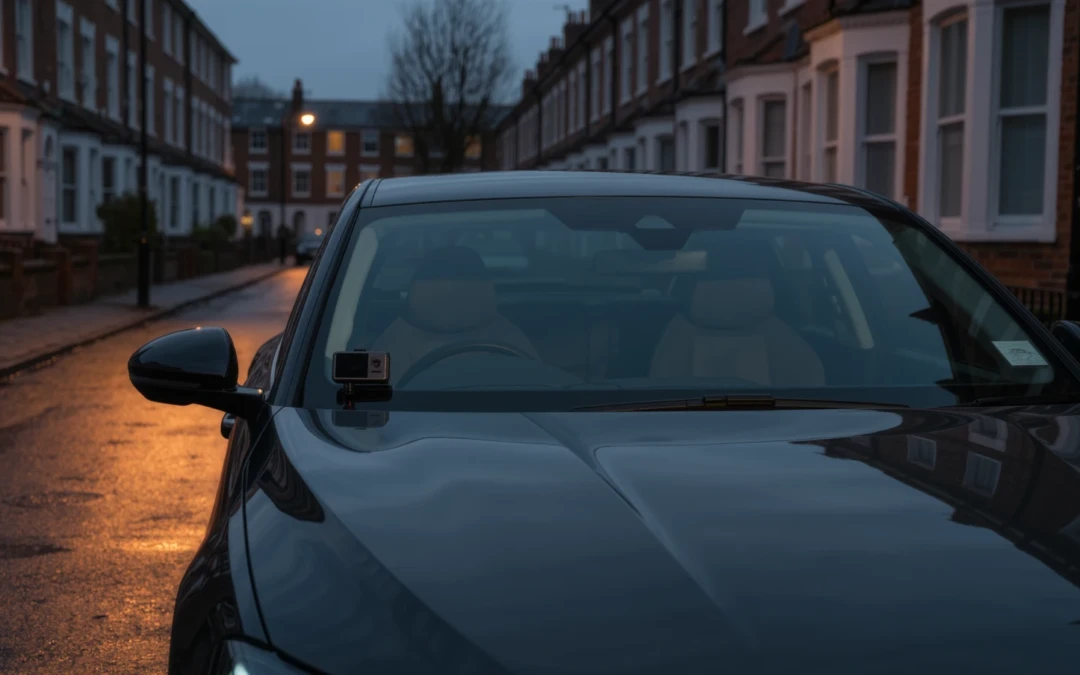
- Mount it out of your view of the road. Regulation 104 requires a full view of the road ahead; GOV.UK lists 3 penalty points for not having one, and an obstruction in the wiper area is a Major MOT defect.
A dash cam is one of the cheapest pieces of evidence you can buy for your car. In the UK nobody asks you to register it for private use. But the Information Commissioner’s Office (ICO) draws a clear line between filming for yourself, posting online and using the camera for business. Here is where that line runs.
Private use: personal activity
UK GDPR does not cover processing by a person for a purely personal or household activity. In its guidance on consumer smart products, the ICO uses exactly a dash cam as the example. The camera records the road and surroundings while the car moves. It does not continually monitor one specific public space. It captures images linked to the movements of the car, so the recording is part of the driver’s personal activity.
UK GDPR is UK-wide, so this applies in England, Wales, Scotland and Northern Ireland.
Posting online changes the picture
The same ICO example goes one step further. If the driver posts dash cam recordings online, processing the personal information in them is no longer personal activity. It falls within UK GDPR, and the driver needs an appropriate lawful basis. Faces and number plates of other people are personal information. A funny clip on social media is no longer just your business.
The ICO also notes that the manufacturer’s processing of dash cam data, for example through the app or cloud, is a commercial activity and always in scope of UK GDPR.
Work vehicles: different rules
The ICO has separate guidance for small businesses (marked as under review after the Data (Use and Access) Act). The main points:
- You can use a camera in a business vehicle if you can justify it, and you need a lawful basis. Consider whether a less intrusive way would do.
- Tell people you are recording, for example with a sticker or a sign in the vehicle, and say where to find your privacy notice.
- Switch audio recording off by default and use it only in exceptional circumstances.
- If a business vehicle is used for personal journeys, the camera should be off outside working hours.
- Keep footage safe and delete it when you no longer need it. Without an accident, the ICO suggests deleting after a week or so.
- If any work vehicle has a dash cam, the business must register and pay a data protection fee. Most small businesses pay £52 a year (about €62).
People can complain to the ICO, and a business that ignores the rules can face a fine.
Mounting: keep the view clear
No regulation names dash cams. The rules on view apply to everything on your windscreen. Regulation 104 of the Construction and Use Regulations: you must not drive if you cannot have proper control or a full view of the road and traffic ahead. Regulation 30 requires that glass is kept so it does not obscure the driver’s vision. GOV.UK lists 3 penalty points for not having a full view of the road and traffic ahead.
At the MOT, an obstruction that significantly affects your view of the road through the area swept by the wipers is a Major defect, so the car fails. Outside the swept area it is a Minor defect. The DVSA manual lets the tester remove items such as a sat nav that block the view. The safest spot is behind the rear-view mirror.
Foreign drivers and rental cars
The same rules apply to foreign drivers. Bringing your own camera is fine; on a right-hand-drive rental, check it does not block your view.
Mistakes I see most often
- Mounting the camera in the middle of the driver’s side of the screen. That is the swept area.
- Posting clips with readable faces and plates without thinking about UK GDPR.
- A sole trader with a dash cam in the work van who never checked the data protection fee.
Do the math: A business dash cam costs £52 a year in data protection fee, about €62, roughly £1 a week. A badly placed private one can mean 3 penalty points and an MOT fail as a Major defect, then a retest on a test that costs up to £54.85 (about €66). Mounting it right costs nothing.
FAQ
Is a dash cam legal in the UK? Yes for private use. The ICO treats a private driver’s road recording as personal activity. Your duties start when you post footage online or use the camera for work.
Do I need a sticker on my private car? The ICO’s signage advice is for business vehicles, including sole traders whose customers are in or near the vehicle.
Should I record sound? For work vehicles the ICO says audio should be off by default and used only in exceptional circumstances, because it is intrusive.
Where to check
- ICO: Guidance for consumer Internet of Things products and services (dash cam example)
- ICO: Dashcams and UK GDPR, what small businesses need to know
- Road Vehicles (Construction and Use) Regulations 1986, regulations 30 and 104
- DVSA MOT inspection manual for cars, section 3 Visibility
- Exchange rate: Bank of England, 11 November 2026, £1 = €1.1969
Ivan’s Take
I would fit one in every car. Behind the mirror, loop recording, clips saved only when something happens. The camera is cheap evidence; the trouble starts when people turn it into content. Keep footage for the insurer or the police, not for likes.
Sources: ICO: Guidance for consumer IoT products and services (dashcam example); ICO: Dashcams and UK GDPR, what small businesses need to know; Road Vehicles (Construction and Use) Regulations 1986, reg. 104; Road Vehicles (Construction and Use) Regulations 1986, reg. 30; DVSA MOT inspection manual: 3. Visibility; GOV.UK: MOT test fees; GOV.UK: Using mobile phones when driving (3 points, full view); Bank of England: spot exchange rate XUDLERS, 11.11.2026.
Published:
More from this section
The AvtoGear weekly
Once a week: new tests, the best deals and one useful tip for your car. Nothing extra.
