








In short
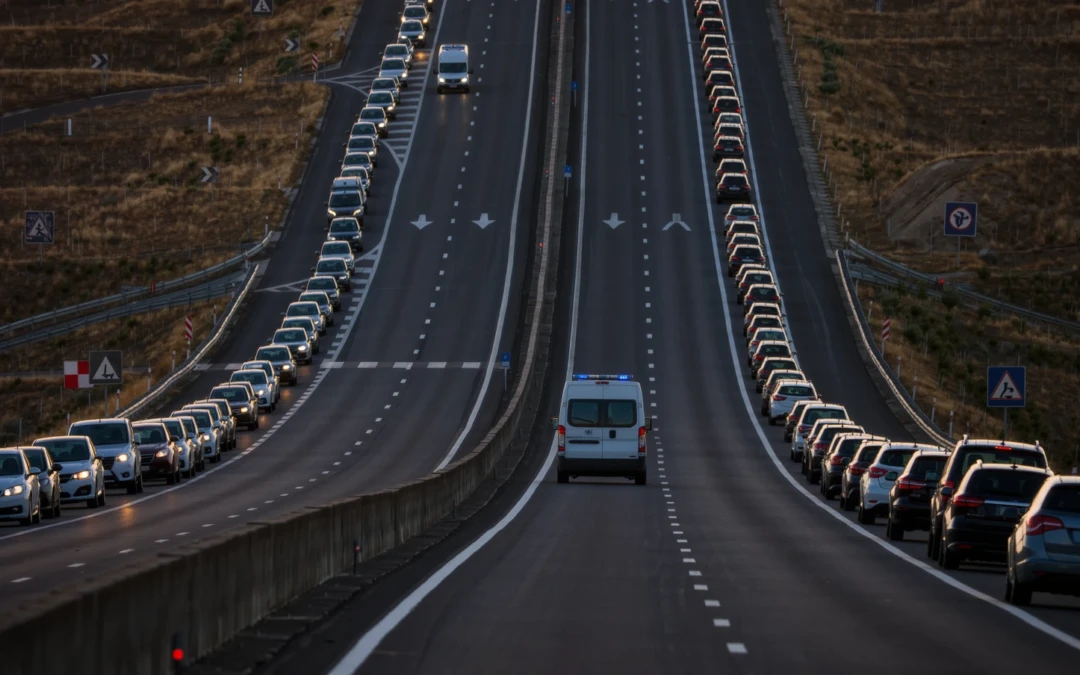
- Since 1 October 2026, in a jam on a Spanish motorway or autovía where traffic moves at walking pace or stops, you must move aside and open an emergency corridor (carril de emergencia) for priority vehicles.
- Two lanes: the corridor goes in the middle. Three or more: between the far left lane and the next one. On snow, overtaking is banned and you keep right.
- Passing a vehicle stopped after a breakdown, accident or roadwork: at least 1.5 metres and at least 20 km/h below the limit. Breaking that rule is a serious offence: 200 euros.
Spain now writes the emergency corridor into its General Traffic Regulation. The decree itself says it follows what other European countries already regulate. If you know the move from home, it is now the law in Spain too. If not, learn it before your first jam.
How the emergency corridor works
Royal Decree 518/2026 (BOE 26 June 2026, in force 1 October 2026) rewrites article 32 of the General Traffic Regulation (RD 1428/2003). On autopistas and autovías, when a jam slows traffic to walking pace or stops it, vehicles must move aside and leave a free lane for approaching priority vehicles. The regulation calls it the carril de emergencia.
- Two lanes in your direction: the corridor forms in the centre, between the two lanes. Left lane moves left, right lane moves right.
- Three or more lanes: the corridor forms between the far left lane and the lane next to it. Cars in the far left lane move as far left as possible; cars in all the other lanes move as far right as possible.
- You form it as soon as traffic is at walking pace or stopped, not only when you hear a siren.
Article 69 was updated to match. When you notice a priority vehicle with its special signals, you make way, normally by moving right or stopping if needed, or by acting under article 32 in a motorway jam.
Snow on motorways
The new article 32.2 adds a winter rule. On autopistas and autovías, when snow on the road makes driving difficult:
- overtaking is prohibited;
- you must drive in the far right lane;
- on stretches with three or more lanes you may also use the lane next to it;
- the remaining lanes to the left stay free for emergency vehicles and snowploughs.
- Spain: first national motorhome parking rules since 1 October 2026, no awnings, no levelling jacks, no dumping
- Spain winter tyres and snow chains: the new 3PMSF rule from May 2026, when chains are compulsory and what M+S no longer covers
- Spain: Retrofit LED Headlamp Bulbs Need UN R37 Approval – Rules for Xenon and Extra Lamps
Passing stopped vehicles
Article 88 was rewritten too. When a vehicle is stopped on the road because of a breakdown or accident, during an emergency or roadside assistance job, road maintenance work, or traffic management, and it takes up all or part of your lane, you must:
- keep a lateral gap of at least 1.5 metres, even if that means using the opposite side of the road;
- reduce your speed by at least 20 km/h below the road’s limit.
So passing a tow truck on a 120 km/h autovía means 100 km/h or less, with a 1.5 metre gap. On a no-overtaking stretch you may still pass such a stopped vehicle, using the opposite side, after checking it is safe, unless the stop is simply part of the traffic flow.
Fines
- Breaking the rules for passing stopped vehicles (article 88): serious offence, 200 euros. The article itself says so, citing article 76 c) of the Traffic Act.
- Paid within 20 calendar days: 100 euros (Traffic Act, article 94).
- Emergency corridor and snow rules (article 32): the decree text does not state a category next to them. The Traffic Act (article 76 c) classes breaches of lane-use and overtaking rules as serious offences, which carry 200 euros. No points for these appear in Annex II.
Foreign drivers and rental cars
These are road rules, so they apply to every driver in Spain, whatever the plate or licence. A rental car gets the same 200 euro fine as a local car. If the corridor is new to you, picture the move before you set off: jam forms, left lane goes left, everyone else goes right.
Mistakes I see most often
- Waiting for the siren. By then the cars are bumper to bumper and there is no room left to move.
- Forming the corridor in the wrong place on a three-lane road. It goes between the far left lane and the middle lane, not between middle and right.
- Using the hard shoulder or the corridor yourself to get ahead. The space is for priority vehicles only.
Do the math: Opening the corridor costs you nothing. Moving your car half a metre is free. Getting it wrong can mean 200 euros and, worse, an ambulance that arrives minutes later to someone you may know.
FAQ
Does the emergency corridor apply on normal roads? The text of article 32 refers to autopistas and autovías. On other roads, article 69 still obliges you to make way for priority vehicles.
Where exactly is the corridor on a four-lane motorway? Between the far left lane and the one next to it. Only the far left lane moves left; all the others move right.
Do I have to slow down when passing a broken-down car on the shoulder? Article 88 applies when the stopped vehicle takes up all or part of your lane. Then it is 1.5 metres and at least 20 km/h below the limit.
Ivan’s Take
This is one of the few rules that costs drivers nothing and can save a life. Make it automatic: traffic stops, you steer to your side of the gap. Teach it to whoever drives with you. The day you need the ambulance, you will want the others to know it too.
Sources: BOE: Real Decreto 518/2026 (modifica arts. 32, 69, 88 RGC); BOE: Ley sobre Tráfico RDL 6/2015, arts. 76 c, 80, 94, anexo II; La Moncloa / Interior: reforma del Reglamento de Circulación (30.9.2026).
Published:
More from this section
The AvtoGear weekly
Once a week: new tests, the best deals and one useful tip for your car. Nothing extra.
