








In short
- Since 1 October 2026 (Royal Decree 518/2026, new article 92.4 of the General Traffic Regulation), a parked motorhome or campervan in Spain must stay inside its own outline, rest only on its tyres and not release any fluids from the living area.
- Chocks and wedges are allowed. Awnings, chairs, tables and anything else that extends beyond the vehicle are not, when you are parked on the road.
- The decree sets no specific fine. Under the Traffic Act, a breach not listed as serious is a minor offence: up to 100 euros. Towns still set their own parking rules.
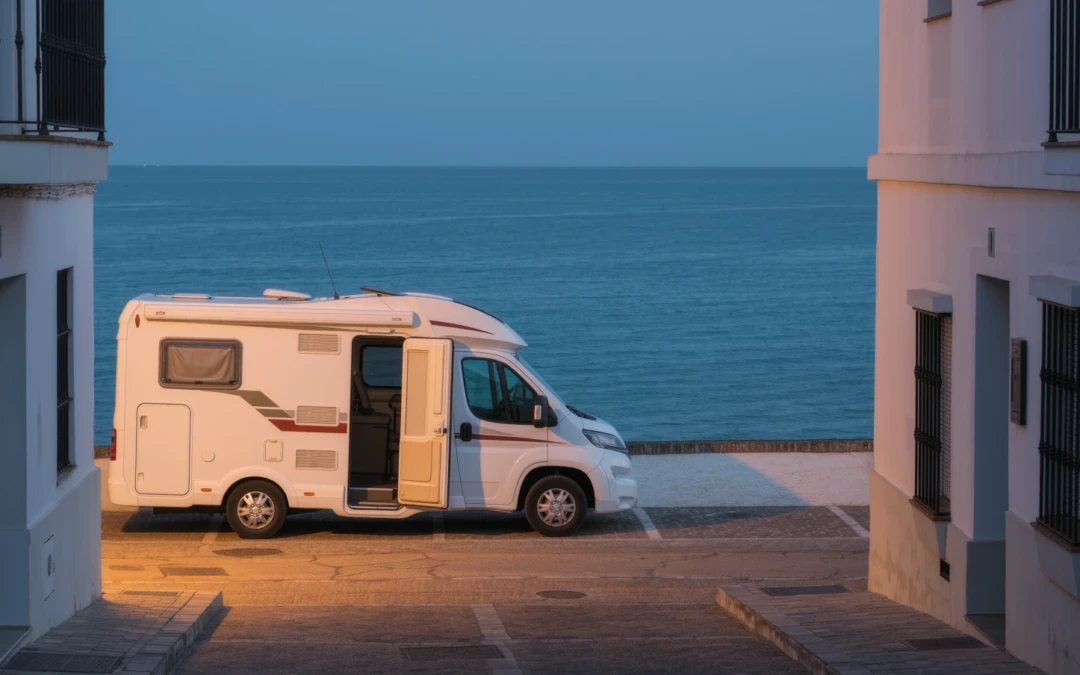
For years motorhome owners in Spain argued with town halls about what is parking and what is camping. The national regulation now gives a short answer. If your van passes three simple tests, you are parked. If not, you are not.
The new rule
Royal Decree 518/2026 (BOE 26 June 2026, in force 1 October 2026) adds paragraph 4 to article 92 of the General Traffic Regulation (RD 1428/2003). Its preamble says it is the first time the regulation deals with parking of motorhomes and other vehicles fitted out as living space.
Parking of autocaravanas and other vehicles adapted as housing must meet three conditions:
- No own elements extending beyond the vehicle’s perimeter, measured as its outline seen from above. Awning out, step out, chairs and table outside: not parked under this rule.
- Resting only on the tyres. Safety chocks or wedges are allowed. Levelling jacks or stabiliser legs lowered to the ground are not.
- No fluids poured out from the living area. Grey or black water stays in the tanks until you reach a proper service point.
The rule covers campervans too, not just factory motorhomes: the text says other vehicles fitted out as living space.
The preamble explains why. In ten years Spain went from about 3,000 motorhome registrations a year to 9,000, and from 150 specialised areas to just over 1,000.
What towns can still decide
The reform also deleted the old article 93 and added a new article 156 for urban areas. Town halls regulate stopping and parking through their bylaws. They may set time limits, and may tow or immobilise a vehicle that has no valid ticket in a time-limited zone or stays beyond three times the paid time, until the driver is identified.
So the national rule tells you what counts as properly parked. The town decides where and for how long you may park. Read the local signs and bylaw, especially in coastal towns.
- Spain: the emergency corridor is now law on motorways, plus new snow and breakdown rules from 1 October 2026
- Spain V16 connected beacon: the only legal warning device since 2026, the €80 fine and what foreign cars need
- Spain: Retrofit LED Headlamp Bulbs Need UN R37 Approval – Rules for Xenon and Extra Lamps
Fines
- Breaking article 92.4: the decree gives no category or amount. Under article 75 c) of the Traffic Act (RDL 6/2015), breaches not expressly listed as serious or very serious are minor offences, and article 80 sets minor offences at up to 100 euros.
- Paid within 20 calendar days, the fine is halved (article 94).
- Parking in a dangerous place, in a bus or bike lane, in a disabled bay, or where you seriously block traffic is a separate serious offence for any vehicle: 200 euros (article 76 d).
- No penalty points for these parking rules in Annex II.
Other motorhome rules the DGT lists
- With a category B licence you may drive a vehicle up to 3,500 kg maximum authorised mass.
- In a motorhome, passengers may travel in the living area, within the number of seats on the registration certificate. Seat belts or approved child restraints are compulsory in the cab and in the living area.
- A vehicle homologated as a motorhome has the same speed limits as a car. A car towing a caravan is limited to 90 km/h on motorways and 80 km/h on conventional roads.
- Travelling inside a towed caravan is prohibited.
Foreign drivers and rental motorhomes
These are traffic rules, so they apply to foreign-registered and rented motorhomes in exactly the same way. Rental vans are often bigger than what people drive at home, so check the maximum mass on the registration document against your licence before you collect it.
Mistakes I see most often
- Rolling out the awning for a coffee in a street parking space. Under article 92.4 that is no longer parking.
- Putting down levelling jacks on asphalt. Chocks are fine; legs on the ground are not.
- Draining grey water in a car park because it is only water from the sink. The rule says no fluids from the living area, full stop.
Do the math: A minor offence can cost up to 100 euros, or half if paid within 20 days. Rolling the awning back in and lifting the jacks takes a few minutes. The grey water can wait for the next service point.
FAQ
Can I sleep in my motorhome when it is legally parked? The national rule only looks at the three conditions: inside the outline, on the tyres, no fluids. What you do inside is not part of article 92.4. Local bylaws on where and how long you may park still apply.
Are wheel chocks allowed? Yes. The text explicitly allows safety chocks or wedges.
Does this apply to a converted van, not a factory motorhome? Yes. It covers motorhomes and other vehicles fitted out as living space.
Ivan’s Take
I like rules that fit in three lines. Inside your outline, on your tyres, nothing on the ground. Do that and you have a clear argument with any local officer. Want the awning and the chairs out? Go to a campsite or a motorhome area, where that is what the place is for.
Sources: BOE: Real Decreto 518/2026 (art. 92.4, supresión art. 93, nuevo art. 156 RGC); BOE: Ley sobre Tráfico RDL 6/2015, arts. 75, 76 d, 80, 94; DGT: Viaja seguro con caravana, remolque o autocaravana.
Published:
More from this section
The AvtoGear weekly
Once a week: new tests, the best deals and one useful tip for your car. Nothing extra.
