








In short
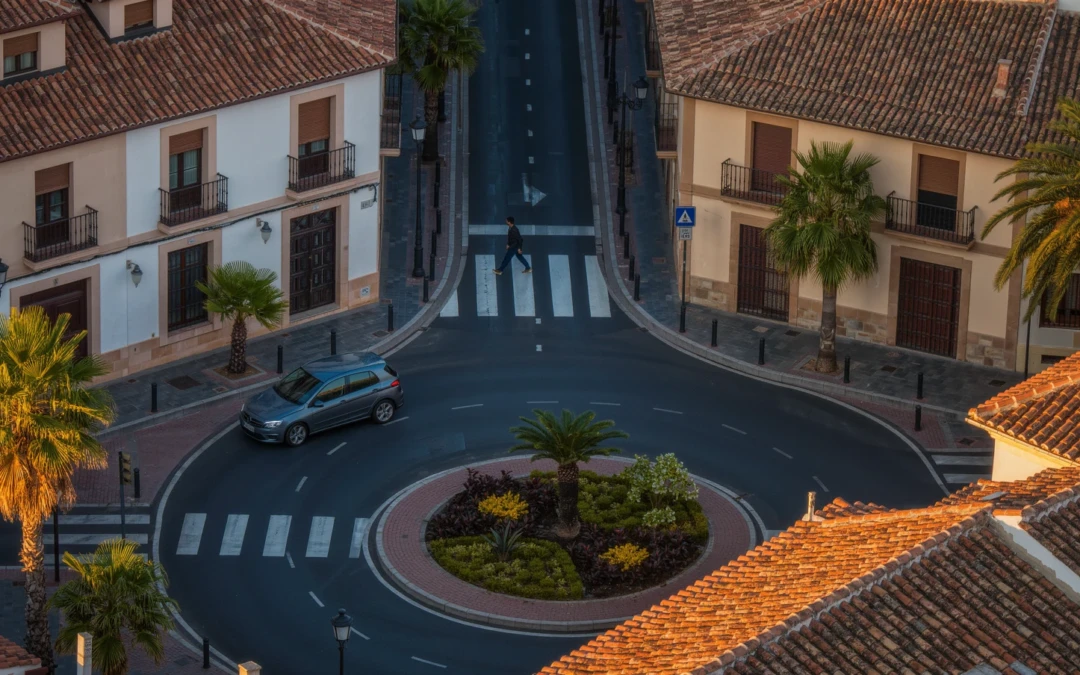
- Signs come first. Without signs, give way to traffic from the right. In a roundabout, cars already on the ring have priority over cars entering.
- Pedestrians have priority on marked crossings, pavements, pedestrian zones and when you turn into a street they are crossing.
- Not giving way, ignoring stop, give-way or a red light = €200 and 4 points. Driving the wrong way round a roundabout = €500 and 6 points.
In town, speed is not the only thing that costs points. Priority does too. The rules are short and clear in the General Traffic Regulation, and the fine for getting them wrong is the same €200 with 4 points whether it is a car from the right or a pedestrian on a zebra.
Junctions with signs and without
Article 56 of the General Traffic Regulation (RD 1428/2003, consolidated text last amended by RD 518/2026; Article 56 itself was rewritten by RD 465/2025 with effect from 1 July 2025) says that priority at a junction follows the signs. At a give-way or stop sign you yield to vehicles on the priority road, whichever side they come from, and you stop completely whenever necessary and always when the sign says so.
Article 57 covers junctions without signs: you give way to vehicles coming from your right. The exceptions are:
- Vehicles on a paved road have priority over those coming from an unpaved road.
- Rail vehicles have priority over all other users.
- Roundabouts: vehicles already on the circular road have priority over those that want to enter (Article 57.1(c)).
- Vehicles on a motorway have priority over those that want to join it.
Article 58 adds how you give way: you must not start or continue a manoeuvre if it forces the driver with priority to brake or swerve suddenly, and you must show early, mainly by slowing down, that you are going to yield. Article 59: even with priority, do not enter a junction, a pedestrian crossing or a cycle crossing if you are likely to get stuck there and block cross traffic.
Roundabouts
Article 43.2: in squares, roundabouts and road meeting points you drive keeping the centre on your left, so anticlockwise. Article 46(h) requires moderate speed when approaching roundabouts where you do not have priority. Overtaking near junctions is generally banned, but Article 87.1(c) makes an exception for roundabouts. The road markings section of the Regulation also describes arrows at roundabout entries that show which exits you can take from each lane, where the roundabout uses lane selection.
Pedestrians and cyclists
Article 65 gives pedestrians priority over vehicles on properly marked pedestrian crossings, pavements and other pedestrian areas; when you turn into another road and people are crossing it, even with no crossing marked; when you cross a hard shoulder pedestrians are walking on; at signposted bus stops between the bus and the pavement; and for marching troops, school lines and organised processions. Article 46(b) also requires moderate speed near crossings not controlled by lights or officers.
Article 64, in its version in force since 1 October 2026, gives cyclists priority when they ride in a cycle lane, on a cycle crossing or on a properly marked hard shoulder; when you turn right or left into another road and a cyclist is close; and when they ride in a group and the first rider has already started crossing or entered a roundabout.
Fines and points
- Not respecting priority, including pedestrians and cyclists (Article 76(c) of the Traffic Law RDL 6/2015): serious offence, €200 (Article 80) and 4 points (Annex II, item 10).
- Ignoring a stop or give-way sign (Article 76(l)): €200 and 4 points.
- Running a red light (Article 76(k)): €200 and 4 points.
- Driving the wrong way, including clockwise round a roundabout (Article 43.3 of the Regulation, Article 77(f) of the law): very serious, €500 and 6 points (Annex II, item 4).
Paying within 20 days halves the fine (Article 94). The points still go.
Foreign drivers and hire cars
These rules apply to everyone. Two things catch visitors: in a Spanish roundabout without signs saying otherwise, the car already circulating has priority, and a pedestrian who has started to cross the street you are turning into has priority even without a zebra. If you cannot prove residence in Spain, the fine can be collected as a deposit on the spot (Article 87.5).
Mistakes I see most often
- Entering a roundabout because the gap looks big enough and forcing the car on the ring to brake. Article 58 calls that not giving way.
- Turning right on a green light into a street where pedestrians are crossing on their own green.
- Rolling through a stop sign at walking pace. The sign means a full stop.
Do the math: One forced entry into a roundabout = €200 and 4 points, €100 if paid within 20 days. Waiting for the next gap usually costs a few seconds. Three such mistakes in two years and a normal driver has lost 12 points.
FAQ
Who has priority at a Spanish roundabout? Vehicles already on the circular road, unless signs say otherwise (Article 57.1(c)).
Must I stop for a pedestrian waiting at a zebra? Pedestrians have priority on marked crossings (Article 65). Approach crossings without lights at moderate speed (Article 46) and let them cross.
Do I lose points for not giving way? Yes, 4 points and €200 under Annex II, item 10.
Ivan’s Take
In Spain I treat every roundabout entry as a give-way line and every zebra as a stop line if anyone is near it. It costs me seconds. The €200 is not the point. A pedestrian on a zebra has no airbag.
Sources: BOE – Reglamento General de Circulación (RD 1428/2003), arts. 43, 46, 56-59, 64, 65, 87; BOE – Ley sobre Tráfico (RDL 6/2015), arts. 76, 77, 80, 87, 94 y anexo II.
Published:
More from this section

The AvtoGear weekly
Once a week: new tests, the best deals and one useful tip for your car. Nothing extra.
