








In short
- Article 44 of the Road Traffic Act: stop, secure the scene, move the car out of the way if nobody is hurt, and give your details and your insurer to the other party on request.
- If someone is killed or injured: help, call the ambulance and the police, stay at the scene, change nothing, and drink no alcohol until the police test you.
- Not moving the car after a minor crash costs 150 zł (about €34). Not helping a victim means a compulsory driving ban and 15 points, and can be a crime with up to 3 years in prison.
A crash is the worst moment to look up the rules. Polish law puts the driver’s duties in one short article, and the penalties for ignoring them range from a 150 zł ticket to prison. Here is the list, straight from the Road Traffic Act, the Code of Petty Offences and the Criminal Code.
Every accident: the four duties
Article 44(1) of the Road Traffic Act (Prawo o ruchu drogowym, consolidated text up to Dz.U. 2026 item 1073) says a driver involved in a road accident must:
- Stop the vehicle without endangering traffic.
- Secure the scene with appropriate measures.
- Move the vehicle from the scene without delay so it does not endanger or block traffic, if nobody has been killed or injured.
- Give details on request of another person involved: your personal data, the data of the vehicle’s owner or keeper, and the insurer of the compulsory third-party liability (OC) policy.
Article 44(3) applies the same duties to other people involved in the accident, not only drivers.
Someone is killed or injured
Article 44(2) adds four more duties:
- give the victims the help they need and call the medical rescue team and the police;
- do nothing that could make it harder to establish how the accident happened;
- drink no alcohol and take no similar substances until the police arrive and test you;
- stay at the scene, and if calling help forces you to leave, come back immediately.
The warning triangle
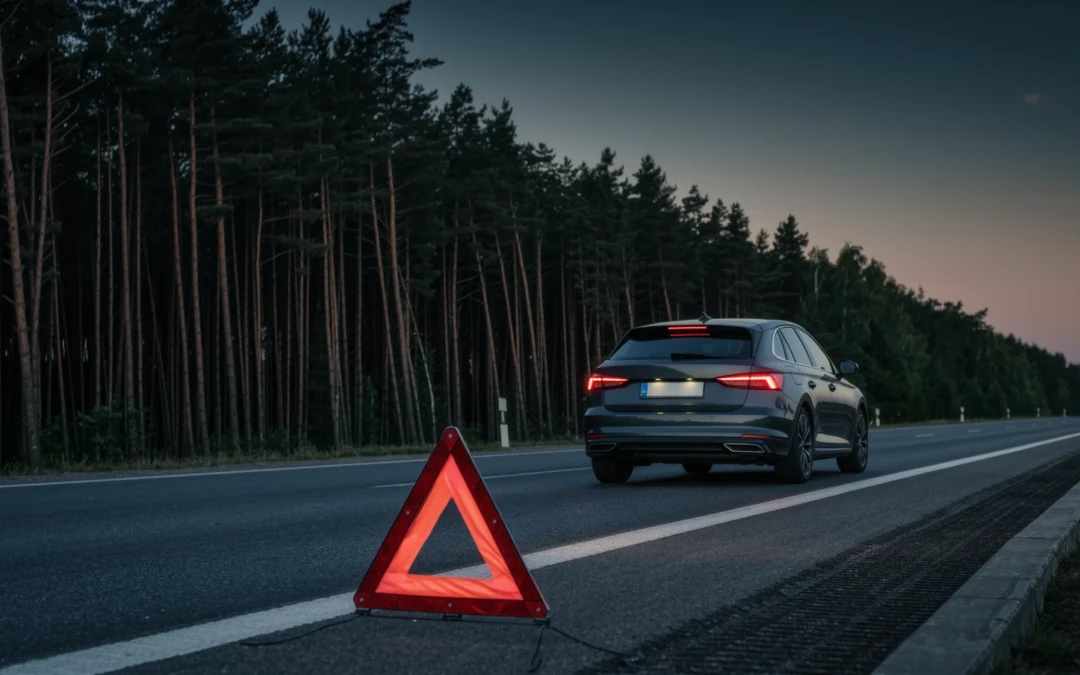
Article 50 says how to mark a car stopped after a breakdown or accident, for the whole time it stands there:
- Motorway or expressway, always: hazard lights on, and the warning triangle 100 m behind the car, on the carriageway or hard shoulder depending on where the car stopped.
- Other roads outside built-up areas, when the car stands on the carriageway where stopping is banned, or on the shoulder and cannot be seen from far enough: triangle 30-50 m behind the car and hazard lights.
- Built-up areas, when the car stands where stopping is banned: hazard lights. A car without hazard lights uses position lights and a triangle behind it or on it, no higher than 1 m.
Penalties
- Not moving the car after an accident without dead or injured: 150 zł (€34) (fine tariff Dz.U. 2021 item 2484, Table B, row 70).
- Not marking, or wrongly marking, a car stopped after a breakdown or accident: 150 zł (€34) (row 181).
- Not giving immediate help to a victim: arrest or a fine, and a compulsory driving ban (Article 93 of the Code of Petty Offences, consolidated text Dz.U. 2026 item 1372). The ban lasts 6 months to 3 years (Article 29). Points: 15 (code A04 of the regulation of 29 May 2026, Dz.U. 2026 item 724).
- Not helping a person in immediate danger of death or serious injury when you could do so without risk: up to 3 years in prison (Article 162 § 1 of the Criminal Code, consolidated text Dz.U. 2026 item 1342).
If the driver caused the accident, the Criminal Code adds its own scale. Causing an accident in which someone suffers the injuries described in Article 157 § 1 carries up to 3 years in prison; with death or serious harm, 6 months to 8 years (Article 177). If the driver was drunk, fled the scene or drank alcohol after the accident and before the police test, Article 178 § 1 raises the range by half, and Article 42 § 2 requires a driving ban of at least 3 years. Euro amounts use the National Bank of Poland rate of 12 November 2026: €1 = 4.4018 zł.
Foreign drivers and hire cars
Article 44 applies to everyone involved in an accident in Poland. With a hire car, the details you must hand over include the data of the vehicle’s owner or keeper and the third-party insurer, so keep the rental contract and the insurance papers where you can reach them. Moving the car after a minor crash is a legal duty here, not a choice: leaving it in the lane to wait for the police is itself the 150 zł offence.
Mistakes I see most often
- Leaving both cars in the lane after a scratch with nobody hurt. The law says move them without delay.
- Placing the triangle a few steps behind the car on a motorway. The rule is 100 m.
- Having a drink “for the nerves” after a crash with injured people before the police arrive. Article 44(2) forbids it, and Article 178 treats it like drunk driving when sentencing.
Do the math: Do the math: A fender-bender with nobody hurt: move the cars, swap names and insurers, done. Leave the cars blocking the road and it costs 150 zł (€34). Drive away from an injured person and you face a compulsory ban, 15 points and possibly a criminal case with up to 3 years in prison.
FAQ
Must I call the police after every accident in Poland? Article 44(2) requires it when someone is killed or injured. If nobody is hurt, the law requires you to stop, secure the scene, move the cars and exchange data.
Where do I put the warning triangle on a Polish motorway? 100 m behind the car, on the carriageway or hard shoulder, with the hazard lights on (Article 50).
What details must I give the other driver? Your personal data, the owner’s or keeper’s data, and your third-party insurer, if they ask (Article 44(1)(4)).
Ivan’s Take
After any crash I do three things in this order: hazard lights, triangle, then talk. If someone is hurt, nothing else matters until help is on the way. The fines here are small, but leaving the scene turns a bad day into a criminal case.
Sources: ISAP (Sejm) – Prawo o ruchu drogowym, consolidated text, arts. 44, 50; ISAP – Kodeks wykroczeń, Dz.U. 2026 poz. 1372, arts. 29, 93; ISAP – Kodeks karny, Dz.U. 2026 poz. 1342, arts. 42, 162, 177, 178; ISAP – Fine tariff, Table B, Dz.U. 2021 poz. 2484, rows 70, 181; ISAP – Penalty points regulation, Dz.U. 2026 poz. 724, annex 1 (A04); NBP – EUR mid rate, table 220/A/NBP/2026 of 12.11.2026.
Published:
More from this section

The AvtoGear weekly
Once a week: new tests, the best deals and one useful tip for your car. Nothing extra.
