








In short
- After a crash with injured people, the officer orders alcohol and drug tests for the direct participants; if the test is positive or impossible, blood or blood and urine are taken (Art. 172, new paras 3 and 4).
- A repeat offender under Art. 317a or 318, convicted of one of them in the last two years, has the car used for the offence seized until the court proceedings end, and pays the storage costs (new Art. 307a).
- Municipalities get a legal basis for 30 km/h zones, school zones and other calming measures in settlements (Art. 157).
Three changes in the 2026 amendments are about enforcement rather than rules: what happens at a crash scene, what happens to the car of a repeat offender and what a town may do to slow traffic. The amending law of Službeni list CG 111/2026 applies since 7 August 2026. I read the amending text and some pages of the original 2012 text, not a consolidated version.
Tests after a crash with injuries
Article 172 got two new paragraphs. When an authorised officer investigates a traffic accident in which people were injured, he determines that the direct participants of the accident are tested with suitable means (an alcometer, a drug test and similar) for the amount of alcohol in the blood or the presence of psychoactive substances.
If the test finds alcohol or psychoactive substances in a participant, or if it cannot be carried out, the officer orders that blood, or blood and urine, be taken from that participant to establish the alcohol or the substances. The amendment also removed the words “or injured” from paragraph 2 of Article 172; I did not read what paragraph 2 covers, so I do not say more about it.
Seizure of the car of a repeat offender
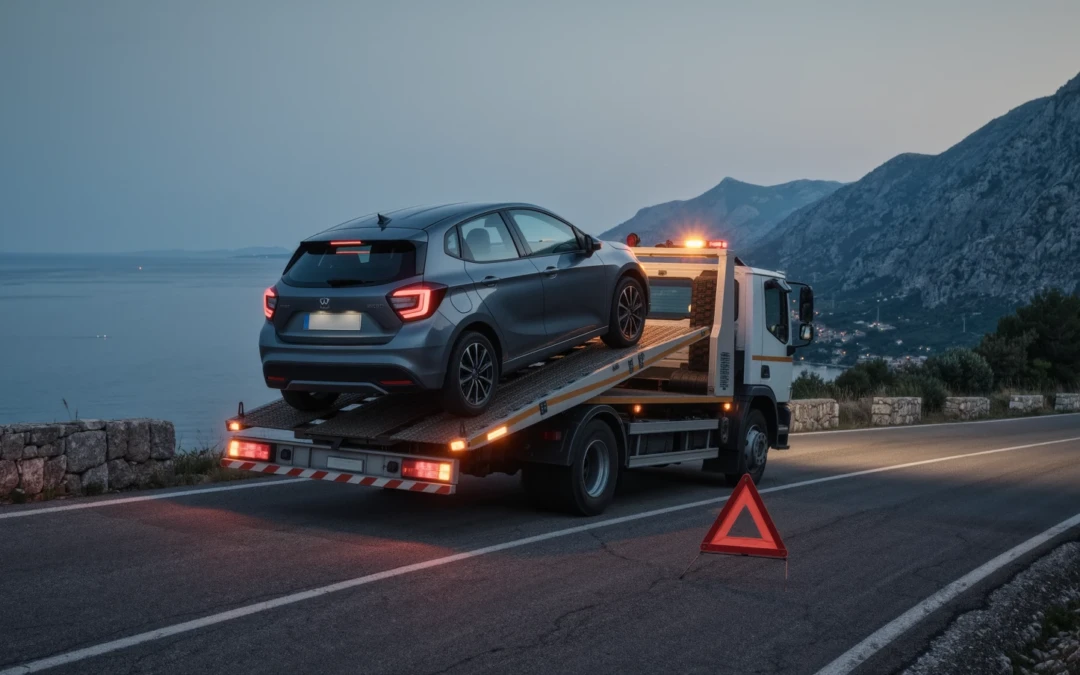
New Article 307a says that at a traffic check an authorised police officer will temporarily seize the vehicle used for the offence from a person who committed an offence under Article 317a and/or 318 and who was finally convicted of any of those offences in the last two years.
- Who: a repeat offender, meaning a final conviction for Art. 317a or 318 within the last two years.
- What: the vehicle used for the offence, not another vehicle.
- How long: until the proceedings before the competent court end.
- Who pays: the person from whom the vehicle was seized pays the cost of keeping it.
Article 318, as amended, carries a fine of 500 to 1,000 euro or up to 60 days in prison; Article 317a carries 15 to 60 days in prison. Both lists come from the 2019 amendment (Službeni list CG 66/19); the 2026 law changed only the bracket of Article 318. Article 317a covers, among others: speeding by 70 km/h or more in a built-up area or 90 km/h or more outside; not stopping at a police officer’s signal; driving under drugs or with 2 g/kg of alcohol or more; driving while your licence is withdrawn or during a driving ban; and refusing an alcohol or drug test. Article 318 covers, among others: a radar detector or jammer in the car; driving against traffic on a road with separated carriageways; speeding by 60-70 km/h in a built-up area or 80-90 km/h outside; overtaking that endangers oncoming traffic, or at a crest, a blind bend or in a tunnel; passing a red light; driving with 1 to 2 g/kg of alcohol; no winter tyres in winter conditions between 15 November and 1 April; and drinking after a crash before the police inspection.
- Montenegro: new cars get their first technical inspection after two years, and inspection lines go on camera
- Montenegro accident procedure: stop, warning triangle, European report, the 50 euro police call-out and fines up to 400 euro
- Montenegro: technical inspection – yearly test, six months for rental cars and the police order to re-test
Zone 30, school zones and other local measures
Article 157 got three new paragraphs. In a settlement, traffic-technical measures can set the traffic regime in normal conditions and during roadworks. The list in the text includes routing of transit, freight, cycle and pedestrian traffic, routes and lanes for public transport, speed limits for all or some categories of vehicles, one-way streets, pedestrian streets, calmed-traffic zones, a “30” zone, school zones, environmental protection zones, safe regulation of junctions, and space for parking and stopping.
To carry out such a measure, a traffic project must be made, and the signs, equipment and devices must be placed according to it. The law also defines a settlement (point 33 of Article 7) as a functionally integrated area for living and work whose borders are marked by the traffic signs for marking a settlement. I found no list of towns with zone 30; that depends on local decisions.
Foreign drivers and rental cars
The tests apply to the direct participants in a crash, whatever their nationality. The seizure targets the vehicle used for the offence. The text I read does not mention the rights of an owner who is not the driver, so a rental company’s car driven by a repeat offender could be affected, and the rental contract matters. Zone 30 and school zones are marked by signs, so read the signs.
Mistakes I see most often
- Believing the test is only for the driver who is at fault. The text speaks of direct participants of a crash with injured people.
- Thinking a seized car comes back after paying a fine. The seizure can last until the end of the court case.
- Assuming a 30 km/h zone is only near schools. The list names zone 30 and school zones as separate measures.
Do the math: A roadside test takes minutes. A seized car stays until the court case ends, and you pay for the storage the whole time.
FAQ
Does the test apply to passengers? The text says direct participants of the accident. I did not find a definition in the amending text, so I do not claim whether passengers are covered.
Is the seizure automatic for any driver? No. It is for a person who committed an offence under Art. 317a and/or 318 and who was finally convicted of one of them in the last two years.
Ivan’s Take
My view: testing everyone at an injury crash is logical, because the answer to who was drunk should not depend on who was blamed first. The seizure rule is hard but narrow, since it needs a previous conviction. If you are not a repeat offender, none of this touches you. If you rent out cars, read your contract.
Sources: Zakon o izmjenama i dopunama Zakona o bezbjednosti saobraćaja na putevima, Službeni list CG 111/2026 (30.07.2026, in force 07.08.2026): Art. 1 (points 33 of Art. 7), Art. 22 (Art. 157), Art. 23 (Art. 172), Art. 52 (Art. 307a), Art. 60 (Art. 318); Zakon o bezbjednosti saobraćaja na putevima, Službeni list CG 33/2012 (original text): Art. 317, 318 ; Zakon o izmjenama i dopunama Zakona o bezbjednosti saobraćaja na putevima, Službeni list CG 66/2019: Art. 98 (Art. 317a), Art. 99 (Art. 318).
Published:
More from this section
The AvtoGear weekly
Once a week: new tests, the best deals and one useful tip for your car. Nothing extra.
