








In short
- Since 7 August 2026 the speed rules apply to the speed measured at a point and to the average speed over a road section (new Art. 38a and point 92a of Art. 7).
- If a device or a police officer records an offence and the driver is not identified, the owner or user of the vehicle must give credible driver data within 8 days of the notice (Art. 308).
- Failure to do so: 300 to 600 euro for a person (Art. 319(1)(30)); 1,500 to 4,000 euro for a company (Art. 316(1)(42)).
A camera photo arrives, the driver was a friend, and nobody remembers who. Until now that was a problem for the police. Since the amending law of Službeni list CG 111/2026, it is a problem for the owner or user of the car, and the clock is 8 days. I read the amending text and the original 2012 text of Article 308; I did not read a consolidated version.
Average speed now counts
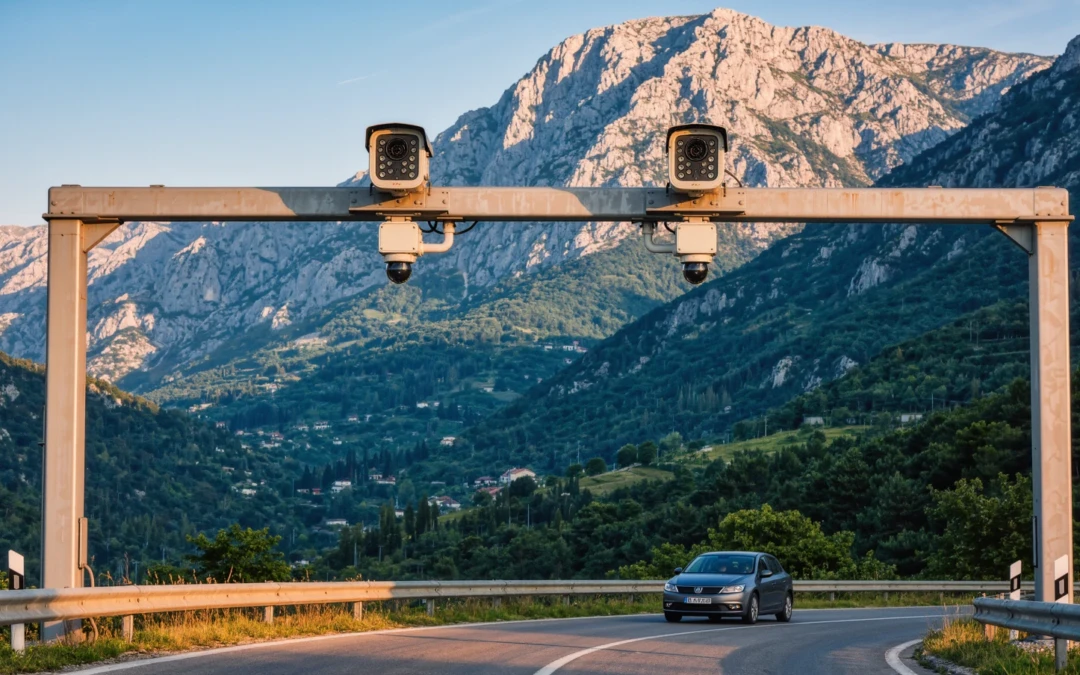
The new point 92a of Article 7 defines average speed as the quotient between the length of a road section and the time the vehicle needs to cover it. The new Article 38a says that every provision of the law on speed applies both to the instantly measured speed and to the average speed.
In practice this means a limit applies to the whole section, not only to the spot where a camera stands. Example: on a 5 km section with an 80 km/h limit, covering it in less than 3 minutes 45 seconds means your average is above the limit. The law does not list the sections, and I do not know where they will be used.
Signs and markings: what overrules what
Article 14 got three new paragraphs. A road user must follow the meaning of the marking on the carriageway, cycle path, pedestrian path or pavement even if this departs from the traffic rules. A road sign must be followed even if it departs from a marking or the rules. A sign with variable content, such as an electronic message sign, must be followed even if it departs from another sign, a marking or the rules. In short: variable message sign, then sign, then marking, then the general rule.
The owner must name the driver
Article 308 says that when devices for establishing offences, or direct observation by a police officer, show that an offence was committed and the driver is not identified, the owner or user of the vehicle is responsible for having made the offence possible with his vehicle. The amendment adds five paragraphs:
- The owner or user must give the competent authority credible data on the person who was driving at the time of the offence.
- Credible data means a certified statement by that person confirming that he or she drove at that time, or other data that clearly identifies the driver.
- The deadline is 8 days from receipt of the notice about the offence.
- The owner or user is not liable if he proves unauthorised use of the vehicle.
- If the owner is a company, the responsible person in the company must deliver the data.
Article 310 of the original text already extends the owner’s responsibility to the user of a vehicle under a financial lease. For rental cars, the law speaks of owner and user. A rental company will normally pass the notice to the renter, but the text I read does not describe that process.
Fines for not naming the driver
- Owner or user, a person: 300 to 600 euro (Art. 319(1)(30)).
- Company: 1,500 to 4,000 euro (Art. 316(1)(42)); the responsible person in the company 300 to 600 euro; an entrepreneur 800 to 2,000 euro (Art. 316, paras. 2 and 3).
Evidence under Article 313 includes a video or photo record on which the vehicle, its registration number and the essential features of the offence can be clearly seen. The amending law did not change the speed fines themselves, and I do not quote them here.
Foreign drivers
The text does not say how a notice is sent to a foreign owner of a foreign-registered car. I found no rule on it and I do not claim one. If you get a letter after a trip, treat the 8 days as real and answer in time.
Mistakes I see most often
- Slowing down only at the camera. Average speed is length divided by time, so you cannot make up for speeding before the camera.
- Ignoring a notice because the driver was someone else. The duty to name the driver sits with the owner or user.
- Naming a person without a certified statement or other clear identification. The law asks for credible data.
Do the math: For a person the failure to name the driver costs 300 to 600 euro. A short message with a certified statement of the real driver costs a few euro in fees and one afternoon.
FAQ
When do the 8 days start? On the day you receive the notice about the offence, not on the day of the offence.
What if someone used my car without permission? The amendment says the owner or user is not liable if he proves unauthorised use of the vehicle.
Does the law say where average speed is measured? No. The text I read only defines average speed and says the speed rules apply to it.
Ivan’s Take
My view: the average-speed rule is fair, because it ends the trick of braking for the camera. The 8-day duty is the real change for car owners. Keep a note of who drives your car, and tell friends that a borrowed car comes back with a paper trail.
Sources: Zakon o izmjenama i dopunama Zakona o bezbjednosti saobraćaja na putevima, Službeni list CG 111/2026 (30.07.2026, in force 07.08.2026): Art. 1 (point 92a of Art. 7), Art. 4 (Art. 14), Art. 6 (38a), Art. 53 (308), Art. 58 (316), Art. 61 (319); Zakon o bezbjednosti saobraćaja na putevima, Službeni list CG 33/2012: Art. 308, 310, 313.
Published:
More from this section



The AvtoGear weekly
Once a week: new tests, the best deals and one useful tip for your car. Nothing extra.
