








In short
- Default limits: 50 km/h in built-up areas, 60 km/h on rural local roads (since 7 February 2025), 80 km/h on regional roads, 100 km/h on national roads, 120 km/h on motorways.
- Speeding by any margin: €160 fixed charge and 3 penalty points.
- 12 points in 3 years (7 for learner and novice drivers) means a 6-month driving ban.
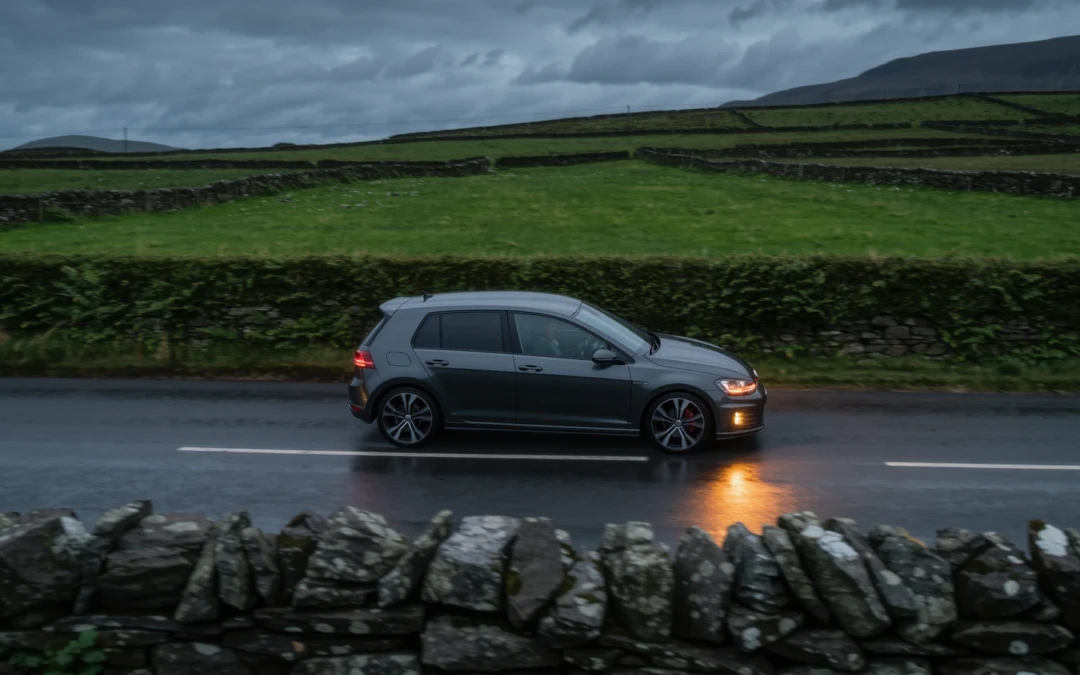
Ireland cut its speed limits in 2025 and doubled down on cameras. The country lanes that used to be 80 km/h are now 60 km/h. If you drive there on old habits, the post brings you a €160 letter and 3 points.
The default speed limits
The default limits are set in the Road Traffic Act 2004, sections 5 to 8, as amended by the Road Traffic Act 2024. A sign on the road always wins over the default.
- Built-up areas: 50 km/h on all public roads except motorways (section 5).
- Rural local roads: 60 km/h (section 6(2)). This dropped from 80 km/h on 7 February 2025.
- Regional roads (R-roads) outside built-up areas: 80 km/h (section 6(1)).
- National roads (N-roads, including dual carriageways) outside built-up areas: 100 km/h (section 7).
- Motorways: 120 km/h (section 8).
The rural local road sign is a white circle with five black diagonal lines and a plate saying “Go Mall / Slow”. It does not show a number. It now means 60 km/h, not 80.
Councils can set special limits by bye-law: 20, 30, 40, 50, 60 or 80 km/h depending on the road (section 9). Variable limits run on some roads, including the M50, and change with conditions.
What is coming next
The Road Traffic Act 2024 also lowers the built-up default to 30 km/h and the national secondary road default to 80 km/h. Both changes were not yet in force in the revised Act text I checked (updated to 3 November 2026). Citizens Information says councils are reviewing urban limits with a target of 31 March 2027. Until a sign or the law changes, the numbers above apply.
Lower limits for some vehicles
Some vehicles must go slower than the sign. Per the official Citizens Information table:
- A car or van towing a trailer: 80 km/h on every road, motorways included.
- Trucks over 3,500 kg drawing a trailer: 90 km/h on motorways, 80 km/h elsewhere.
- Coaches with seated passengers only: 100 km/h on motorways and dual carriageways, 80 km/h elsewhere.
- Buses with standing passengers: 65 km/h.
The caravan crowd gets caught by this every summer. 120 on the sign does not mean 120 for you.
Fines and penalty points
Speeding is a fixed charge offence under S.I. No. 227 of 2024, Schedule 2. Penalty points come from the Road Traffic Act 2002, First Schedule, Part 1, reference 7. There is one rate. 5 km/h or 40 km/h over, the fixed charge is the same.
- Paid within 28 days: €160 and 3 penalty points.
- Paid between day 29 and day 56: €240 (50% more) and 3 points.
- Not paid, court summons: you can still pay €320 up to 7 days before the court date and take 3 points.
- Convicted in court: fine up to €1,000 and 5 penalty points.
Points stay on your record for 3 years. 12 points in that window means an automatic 6-month disqualification (Road Traffic Act 2002, section 3). For learner permit holders and drivers in the first 2 years of their first full licence, the line is 7 points. You must hand your licence to the NDLS within 14 days of the ban starting.
Cameras are everywhere. GoSafe vans run on behalf of An Garda Síochána. Average speed cameras run on the M7, the Dublin Port Tunnel, the N3 in Cavan, the N5 in Mayo and the N2 in Meath.
Foreign drivers and rental cars
Penalty points also apply to foreign licence holders. Ireland creates a record for you, and 12 points in 3 years bans you from driving in Ireland. Points are not passed to your home country.
Camera notices go to the registered owner. With a rental car, that is the rental company. If the owner was not driving, they must name the driver on the notice within 28 days. The rental company names you, and the notice is then issued to you. Check your rental contract for any admin fee it charges for this.
Mistakes I see most often
- Treating the “Go Mall / Slow” sign as 80 km/h. Since February 2025 it is 60 km/h.
- Towing at 100 or 120 km/h. With a trailer or caravan, the cap is 80 km/h everywhere.
- Ignoring the notice. Every 28 days of waiting adds money, and a conviction adds 2 extra points.
Do the math: Paying on time: €160. Late: €240. Last chance before court: €320. Conviction: up to €1,000 plus 5 points instead of 3. Driving 60 instead of 80 on a 10 km country stretch costs you about 2.5 minutes. Four camera hits in 3 years cost €640 and a 6-month ban.
FAQ
Is there a tolerance before the fine? The law has no published tolerance. Any speed over the limit is the offence. Do not plan your driving around a margin.
Do I get more points for going much faster? Not through the fixed charge: it is 3 points at any margin. On conviction in court it is 5 points and a fine of up to €1,000.
Can a speeding notice be cancelled? You can ask the Gardaí to cancel it, but only on procedural or exceptional grounds. Examples given officially: a wrong speed limit was recorded, the car was stolen or already sold, or you were rushing someone to hospital in a life-threatening emergency. The cancellation form is on garda.ie.
Ivan’s Take
I like that Ireland keeps it simple: one fixed fine, no haggling over margins. The 60 km/h on country lanes is not a trap, it is honest. Those roads are narrow, with tractors and blind bends. Pay on time if you got caught, the price only goes up.
Sources: Road Traffic Act 2004 (revised), ss. 5-9; Road Traffic Act 2002 (revised), s. 3 and First Schedule; S.I. No. 227/2024 Fixed Charge Offences Regulations, Schedule 2; Citizens Information: Speed limits in Ireland; Citizens Information: Penalty points.
Published:
More from this section
The AvtoGear weekly
Once a week: new tests, the best deals and one useful tip for your car. Nothing extra.
