








In short
- Since 7 February 2025 the default limit on rural local roads in Ireland is 60 km/h, down from 80 km/h.
- Regional roads stay at 80 km/h; national roads 100 km/h and motorways 120 km/h are unchanged for now.
- Speeding costs a €160 fixed charge and 3 penalty points, or 5 points if it goes to court.
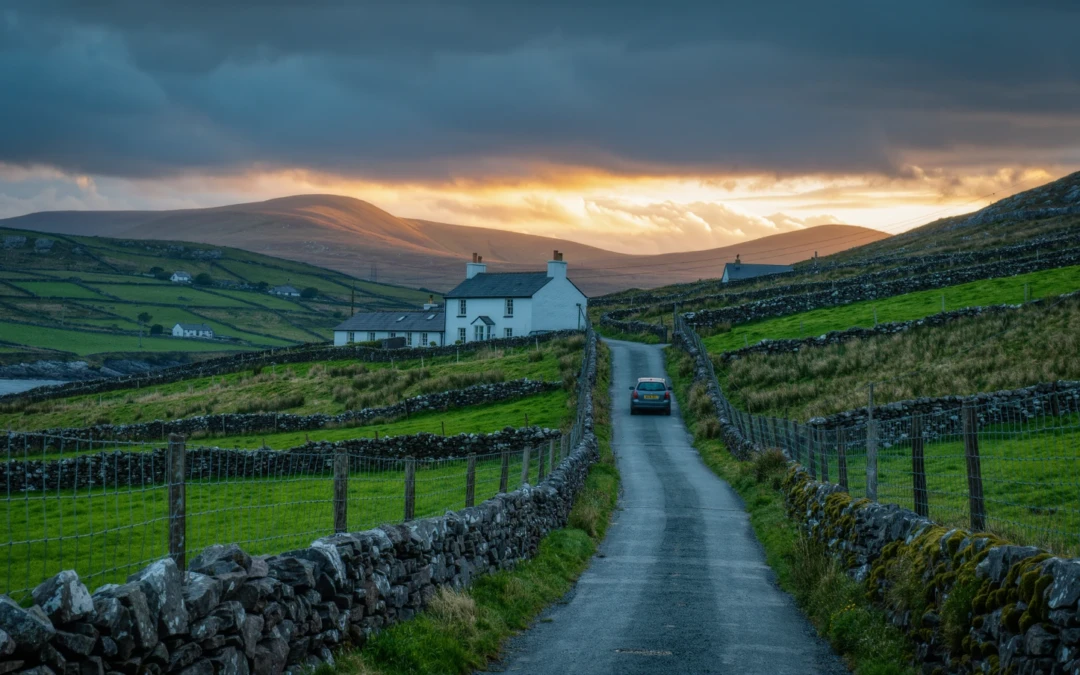
Ireland has thousands of kilometres of narrow local roads: stone walls, blind bends, tractors and no hard shoulder. Since February 2025 the law treats them differently from regional roads, and the default limit has dropped by a quarter. If you drive in rural Ireland, this is the change you will meet most often.
The rule in detail
Section 7 of the Road Traffic Act 2024 replaced section 6 of the Road Traffic Act 2004. Before, regional and local roads outside built-up areas shared one 80 km/h limit. Now they are split. The regional roads speed limit is 80 km/h. The new local roads speed limit is 60 km/h. Both apply to all mechanically propelled vehicles, and only outside built-up areas.
The Minister for Transport brought section 7 into force on 7 February 2025 with the Road Traffic Act 2024 (Commencement) (No. 5) Order 2024 (S.I. No. 616 of 2024). The same order started paragraphs (a) and (b) of section 5, which list the regional and local road limits in section 47 of the Road Traffic Act 1961, and paragraph (c) of section 10, which lets councils set a special 80 km/h limit on a local road.
The default limit does not apply where a special speed limit or a road works speed limit is in place. Councils set special limits by bye-laws under section 9 of the 2004 Act. The options are 20, 30 or 40 km/h under ministerial guidelines, 50 km/h outside built-up areas, 60 km/h, 80 km/h on a motorway, national road, local road or road in a built-up area, 100 km/h and, on certain national dual carriageways, 120 km/h. Before making bye-laws the council must notify the Garda Commissioner, publish a notice and give the public 30 days to object. So a posted sign always beats the default.
What has not changed yet
The 2024 Act also contains a 30 km/h default for built-up areas (section 6) and an 80 km/h default for national secondary roads (sections 8 and 9). According to the Irish Statute Book commencement table, updated to 3 November 2026, these sections are not yet commenced. Today the default limits are: 50 km/h in built-up areas, 60 km/h on local roads, 80 km/h on regional roads, 100 km/h on national roads and 120 km/h on motorways, unless a sign says otherwise.
Fines and penalty points
- Exceeding a speed limit: €160 fixed charge (Road Traffic Act 2010 (Part 3) (Fixed Charge Offences) Regulations 2024, S.I. No. 227 of 2024, Reg. 8(b) and Schedule 2).
- Penalty points: 3 if you pay the fixed charge, 5 on conviction in court (Road Traffic Act 2002, First Schedule, Part 1, ref. 7).
- 12 points in total, or 7 for a learner or novice driver: automatic 6-month disqualification (section 3 of the 2002 Act).
- Points stay on your record for 3 years (section 4 of the 2002 Act).
- If you do not pay the fixed charge in line with the notice, you can be prosecuted (section 35(2) of the 2010 Act).
Foreign drivers and rental cars
The limits apply to every vehicle on Irish roads, whatever its plates. A fixed charge notice can be posted to an address outside the State (section 35(3) of the 2010 Act). If a camera catches a rental car, the notice goes to the registered owner, the rental company. It must name the driver within 28 days (section 35(6)), and the notice then follows you home.
Mistakes I see most often
- Driving a narrow local road at 80 out of habit. Since February 2025 that is 20 km/h over the limit.
- Assuming every country road is the same. A regional road can still be 80 km/h while the side road you turn into is 60.
- Ignoring the sign. A special limit set by bye-law overrides the default, up or down.
Do the math: Four speeding notices at €160 each cost €640 and 12 penalty points, which is an automatic 6-month ban. On a 5 km stretch of local road, 60 km/h instead of 80 km/h costs you 1 minute and 15 seconds. A learner or novice driver hits the 7-point ban after just three paid notices.
FAQ
Does 60 km/h apply on all rural roads? No. Only on local roads outside built-up areas. Regional roads stay at 80 km/h and national roads at 100 km/h unless a sign says otherwise.
Is the 30 km/h town limit already law? The 30 km/h default is in section 6 of the 2024 Act, but it is not yet commenced. Councils can already set 30 km/h on specific streets by bye-law, so watch the signs.
Can a local road have a higher limit than 60? Yes. A council can set a special 80 km/h limit on a local road by bye-law. Then the sign applies, not the default.
Ivan’s Take
I think 60 on a road where two cars can barely pass is simple common sense. The real problem is habit: people drove those lanes at 80 for years. Reset your head, not just your speedometer, and €160 stays in your pocket.
Sources: Road Traffic Act 2024, s. 5, 7, 10 (irishstatutebook.ie); S.I. No. 616/2024 – Road Traffic Act 2024 (Commencement) (No. 5) Order 2024; Road Traffic Act 2024 – commencement table (Irish Statute Book); Road Traffic Act 2004, s. 5–9 (revised, Law Reform Commission); S.I. No. 227/2024 – Fixed Charge Offences Regulations 2024; Road Traffic Act 2002, s. 3, 4, First Schedule (revised); Road Traffic Act 2010, s. 35 (revised).
Published:
More from this section
The AvtoGear weekly
Once a week: new tests, the best deals and one useful tip for your car. Nothing extra.
