








In short
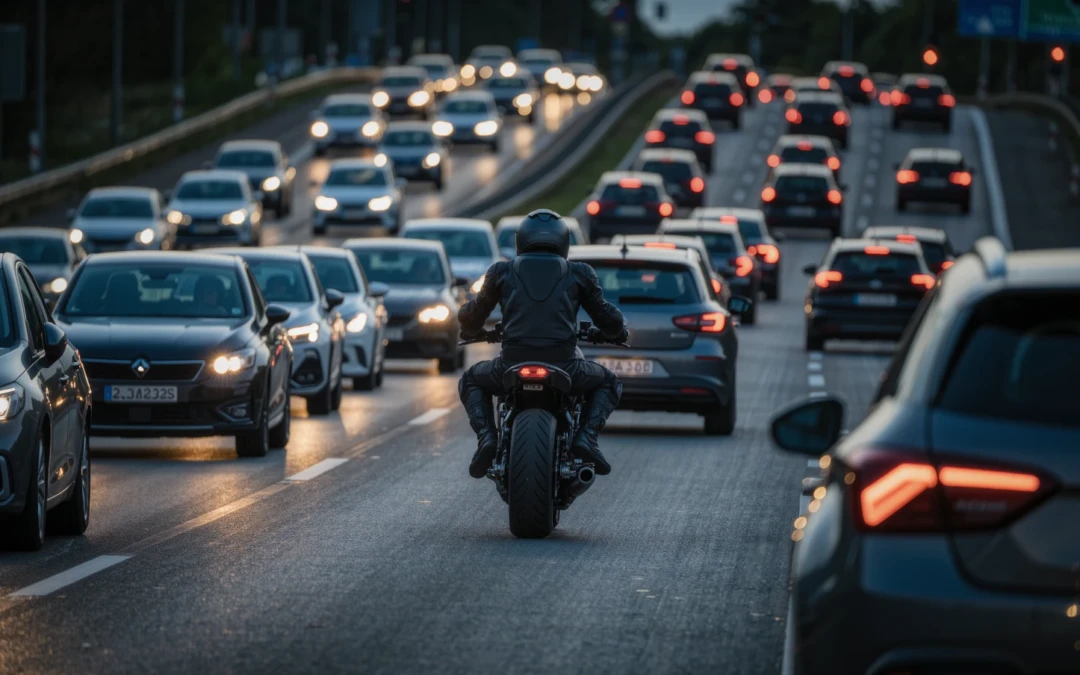
- Decree no. 2025-33 of 9 January 2025 made lane filtering (circulation en inter-files) a permanent national rule for motorised two- and three-wheelers under 1 metre wide.
- It is allowed only on motorways and roads with at least two lanes each way separated by a central reservation, where the limit is 70 to 130 km/h, between the two left-hand lanes, at 50 km/h maximum (30 km/h if one lane is stopped).
- Breaking any condition is a 4th-class offence with 3 points lost, and it can be recorded by video.
For years French lane filtering was only an experiment in some departments. Since January 2025 it is the same rule across the whole country, with a precise definition and its own penalty. If you ride a motorbike or scooter in France, here is exactly what is allowed.
The rule in detail
Lane filtering means riding a motorised two- or three-wheeler between the left-most lanes when the other vehicles are stopped or moving very slowly. After two experimental campaigns (2016–2021 and 2021–2024), assessed by CEREMA, the government generalised it by decree no. 2025-33 of 9 January 2025. The Sécurité routière gives the date as 11 January 2025. The conditions are now in article R412-11-3 of the Code de la route.
- Who: two- and three-wheeled motorised vehicles less than one metre wide.
- When: dense traffic forming uninterrupted queues in all lanes, and enough space between the vehicles to pass. It is forbidden when a lane is in roadworks or covered with snow or ice.
- Where: motorways and roads with at least 2 x 2 lanes separated by a central reservation, where the speed limit is between 70 and 130 km/h (or lower, where the local traffic authority has lowered it, for example the Paris ring road). Only between the two left-most queues of vehicles. It stays forbidden on all other types of road.
- How: do not force your way through. You may not overtake another motorised two-wheeler that is also filtering.
- Speed: 50 km/h maximum while filtering, and 30 km/h maximum if one of the queues is stopped.
- End: when traffic flows and vehicles move above 50 km/h on at least one of the two lanes, you must return to your lane.
Penalties
Breaking at least one of the conditions is a 4th-class contravention and costs 3 points. On its page on speed, service-public.fr lists the fixed fine for a 4th-class offence as €135. A specific penalty was created for this offence, and it can be recorded by video, which means you can be fined without being stopped. The rule was built that way on purpose: the CEREMA report recommended fining without interception to change behaviour.
Foreign riders
The official pages I read do not treat foreign riders differently. The rule applies to any rider on French roads. If you come from a country where filtering is tolerated on any road, remember that in France it is allowed only on the roads listed above.
Mistakes I see most often
- Filtering on an ordinary road or a city road. Outside motorways and 2 x 2 roads with a central reservation it stays forbidden.
- Filtering between the wrong lanes. Only the two left-most queues count.
- Going 50 km/h when one queue is stopped. The cap is then 30 km/h.
- Staying between the lanes once traffic moves above 50 km/h on one lane.
Do the math: one filtering mistake means €135 and 3 points, which is a quarter of a 12-point licence. The time you save in a jam is a few minutes. Riding by the rule costs nothing.
FAQ
Can I filter on a normal road in a town? No. It is forbidden on any road other than motorways and roads with at least two lanes each way separated by a central reservation.
Can I filter at 70 km/h if the traffic is slow? No. The maximum is 50 km/h, or 30 km/h if one queue is stopped.
Can a camera fine me? Yes. The offence can be recorded by video, so you can be fined without being stopped.
Ivan’s Take
Filtering is a real gain on a motorway jam, and I am glad France finally wrote a clear rule. But clear also means strict. Only between the two left lanes, 50 at most, never past another filtering bike. If you ride it like the old unwritten habit, you will pay for it with points, and a camera is now allowed to count them.
Sources: Sécurité routière – Généralisation de la circulation en inter-files à compter du 11 janvier 2025 (décret n° 2025-33 du 9 janvier 2025, article R412-11-3 du code de la route); Service-public.fr – Vitesse au volant (fiche F19460, amende forfaitaire de 4e classe).
Published:
More from this section

The AvtoGear weekly
Once a week: new tests, the best deals and one useful tip for your car. Nothing extra.
