








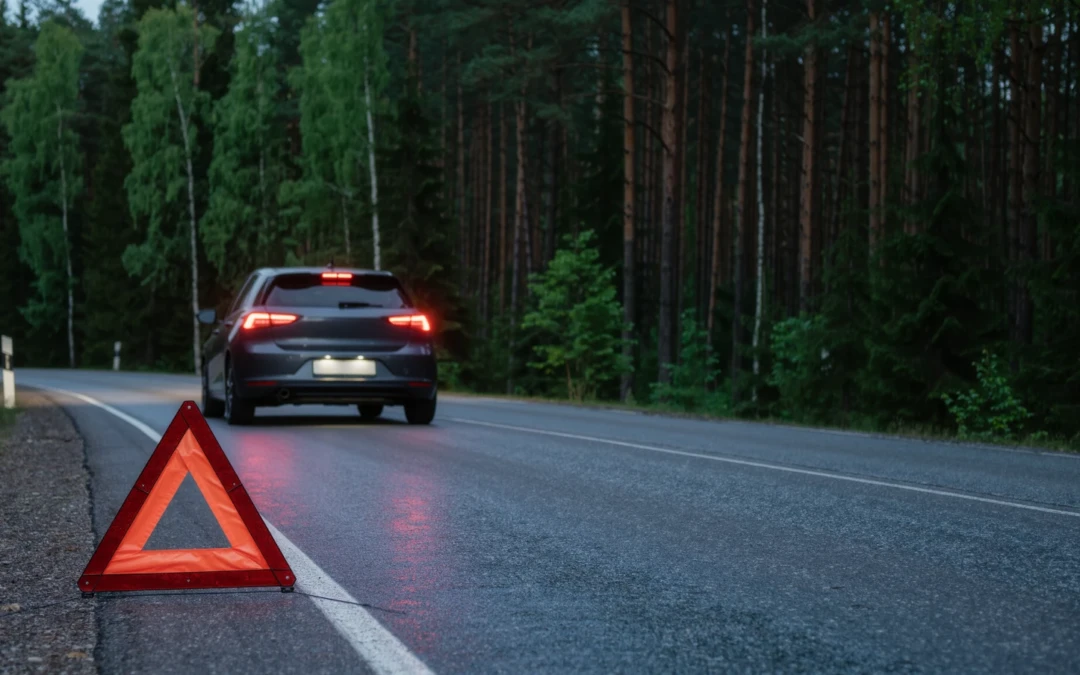
In short
- Cars registered in Estonia need a fire extinguisher with at least 1 kg of agent, two wheel chocks, a first aid kit and a warning triangle approved to UN rule 27 (regulation No 42, Annex 1).
- Foreign-registered passenger cars follow the equipment rules of their home country, but Estonian winter tyre rules still apply to them (regulation No 42, § 2(1) point 7).
- Outside towns, in the dark or in poor visibility, a driver who steps onto the road after an emergency stop must wear a safety vest (Traffic Act § 33(7)).
Most countries ask for a triangle and a vest. Estonia asks for more: an extinguisher and two wheel chocks too. If your car is registered here, this is part of the technical rules, not a recommendation. If you come with a foreign car, the picture changes, and many drivers get it wrong in both directions.
Where the list comes from
The Traffic Act says a motor vehicle in traffic and its equipment must meet the technical requirements and the vehicle must be properly equipped (§ 73(1)). The detail is in regulation No 42 of the Minister of Economic Affairs and Communications, ‘Technical requirements for motor vehicles and their trailers and requirements for equipment’. I read the consolidated text in force since 1 January 2026, with Annex 1 in the wording of regulation No 63 of 21 October 2025.
What an Estonian-registered car must carry
- Fire extinguisher: one with at least 1 kg of extinguishing agent for M1 and N1 vehicles up to 3.5 t. It must work, be within reach and be fixed so you can release it without tools (Annex 1, code 108).
- Wheel chocks: two usable chocks matching the wheel diameter for every M, N and O category vehicle, which includes ordinary cars (code 106).
- First aid kit: for M and N category vehicles, with contents and marking under § 13² of the Occupational Health and Safety Act. It must be within the driver’s reach (code 107).
- Warning triangle: it must comply with UN rule 27, so look for the approval mark (code 105).
Heavier vehicles need more: from 2 kg of agent for N2 and N3 trucks and for buses with up to 17 seats including the driver, and 6 kg (or two 2 kg units) for larger buses (code 108).
The vest rule
The Traffic Act does not list the vest as car equipment. It sets a behaviour rule instead. A driver of a category B, C, D or T vehicle must wear a safety vest when getting out onto the carriageway after an emergency stop on a road outside a built-up area, in the dark or in poor visibility (§ 33(7)). In practice, if you do not have a vest in the car, you cannot obey the rule.
Where the triangle goes
- In towns: at least 25 m behind the car, and far enough to be seen from at least 50 m in daylight (§ 39(9)).
- Outside towns: at least 50 m behind the car, visible from at least 100 m (§ 39(9)).
- On a motorway or a road with a limit above 90 km/h: hazard lights on and the car off the carriageway. If you cannot move it, the triangle goes at least 100 m behind (§ 61(3)).
- The triangle is required, even with hazard lights on, when the stopped car is on the carriageway in a place with poor or limited visibility (§ 39(8)).
Foreign cars and rental cars
This is the part most guides skip. Under § 2(1) point 7 of regulation No 42, passenger cars, motorcycles, mopeds and their trailers registered in another country must meet the requirements of the country of registration. On top of that they must follow the Estonian tyre rules: winter tyres and tread, stud rules and tyre condition. Foreign trucks and buses must meet Annex 1, except the first aid kit and extinguisher codes. So a German car does not need an Estonian extinguisher, but it does need what Germany requires. A rental car registered in Estonia must have the full Estonian kit.
Fines
The Traffic Act does not name a separate offence with its own amount for a missing extinguisher, chock or first aid kit. I do not print a number the law does not give. What the law does say: the driver must check the car is in order before driving (§ 33(2)) and must let a traffic officer check the vehicle’s technical condition and equipment (§ 38(5)).
Mistakes I see most often
- An extinguisher rolling loose in the boot. The rule wants it fixed and reachable without tools.
- No wheel chocks at all. Few drivers outside the Baltics know cars need two.
- A cheap triangle without the rule 27 mark.
Do the math: The whole Estonian kit, extinguisher, two chocks, first aid kit and an approved triangle, is a one-time buy that lasts for years. The extinguisher only has to stay in working order. There is no named fine to compare it with. The real comparison is a car fire you cannot stop, or a car rolling off a jack on a slope.
FAQ
Does my foreign car need a fire extinguisher in Estonia? Not under the Estonian list. Foreign passenger cars follow the rules of their country of registration (regulation No 42, § 2(1) point 7).
How big must the extinguisher be? At least 1 kg of extinguishing agent for a car or van up to 3.5 t (code 108).
When must I wear the vest? When you step onto the carriageway after an emergency stop outside a built-up area, in the dark or poor visibility (§ 33(7)).
Ivan’s Take
I like this list. An extinguisher and two chocks cost little and solve real problems on a dark, icy roadside. If your car is Estonian, check the kit once a year with the tyre change. If it is foreign, carry your home country’s kit plus a vest, and do not touch the Estonian tyre rules: they apply to you too.
Sources: Riigi Teataja – MKM määrus nr 42 „Mootorsõiduki ja selle haagise tehnonõuded ning nõuded varustusele“ (in force 01.01.2026), § 2, Lisa 1 codes 105–108; Riigi Teataja – Liiklusseadus (RT I, 11.07.2026, 45), §§ 33, 38, 39, 61, 73.
Published:
More from this section
The AvtoGear weekly
Once a week: new tests, the best deals and one useful tip for your car. Nothing extra.
